

Turbidity Removal by Polyelectrolytes as Flocculant Aids
307
:r::~~;a
j 3
II !+---~----~~~~~~~~~--~
-1
~ _2~~--....-
0.4 -I-..... ,.........,r-""I....,.....,.-T-............ -r-..... ,....-I
- 0 - 110 AI(N03)3
- - 2><10-5 MIL AI(N03)3
----0- SdO-S MIL AI(N03)3
- - - - Id0-4 MIL AI(N03)3
...... Sd0-4 MIL AI(N03)3
0.3
0.2
0.1
1
3
4
5
6
7
8
POLYMER DOSE mgIL
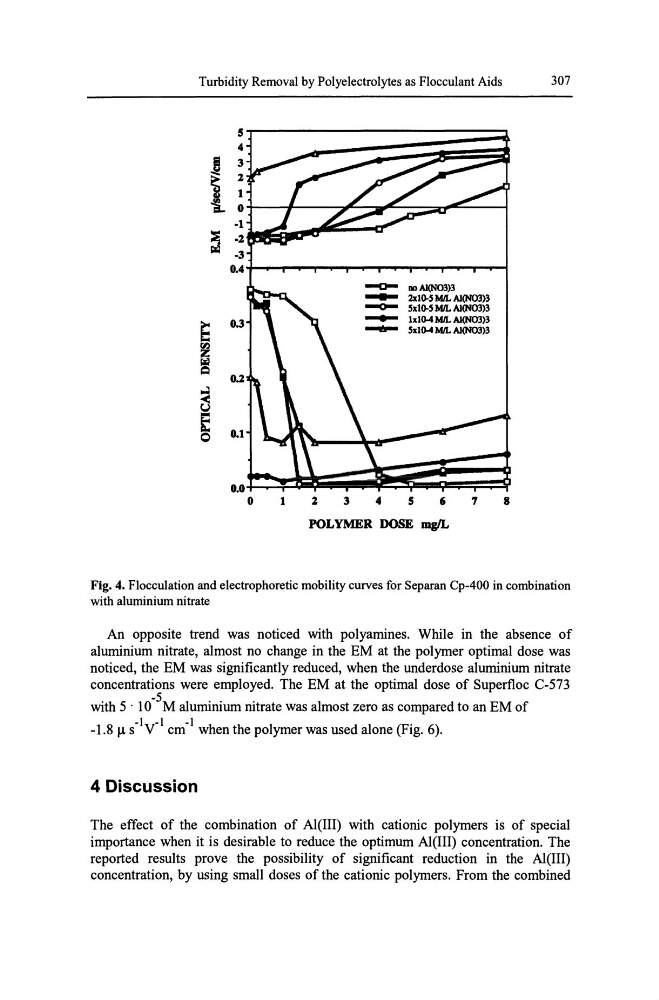
Fig. 4. Flocculation and electrophoretic mobility curves for Separan Cp-400 in combination
with aluminium nitrate
An opposite trend was noticed with polyamines. While in the absence of
aluminium nitrate, almost no change in the EM at the polymer optimal dose was
noticed, the EM was significantly reduced, when the underdose aluminium nitrate
concentrations were employed. The EM at the optimal dose of Superfloc C-S73
with S . 1O-5M aluminium nitrate was almost zero as compared to an EM of
-1 -1
-1
-1.8 J.l. s V cm when the polymer was used alone (Fig. 6).
4 Discussion
The effect of the combination of Al (III) with cationic polymers is of special
importance when it is desirable to reduce the optimum Al(III) concentration. The
reported results prove the possibility of significant reduction in the Al(III)
concentration, by using small doses of the cationic polymers. From the combined
307
:r::~~;a
j 3
II !+---~----~~~~~~~~~--~
-1
~ _2~~--....-
0.4 -I-..... ,.........,r-""I....,.....,.-T-............ -r-..... ,....-I
- 0 - 110 AI(N03)3
- - 2><10-5 MIL AI(N03)3
----0- SdO-S MIL AI(N03)3
- - - - Id0-4 MIL AI(N03)3
...... Sd0-4 MIL AI(N03)3
0.3
0.2
0.1
1
3
4
5
6
7
8
POLYMER DOSE mgIL
Fig. 4. Flocculation and electrophoretic mobility curves for Separan Cp-400 in combination
with aluminium nitrate
An opposite trend was noticed with polyamines. While in the absence of
aluminium nitrate, almost no change in the EM at the polymer optimal dose was
noticed, the EM was significantly reduced, when the underdose aluminium nitrate
concentrations were employed. The EM at the optimal dose of Superfloc C-S73
with S . 1O-5M aluminium nitrate was almost zero as compared to an EM of
-1 -1
-1
-1.8 J.l. s V cm when the polymer was used alone (Fig. 6).
4 Discussion
The effect of the combination of Al (III) with cationic polymers is of special
importance when it is desirable to reduce the optimum Al(III) concentration. The
reported results prove the possibility of significant reduction in the Al(III)
concentration, by using small doses of the cationic polymers. From the combined