

Drinking Water Quality for the 21 st Century
283
4.3 Ozonation
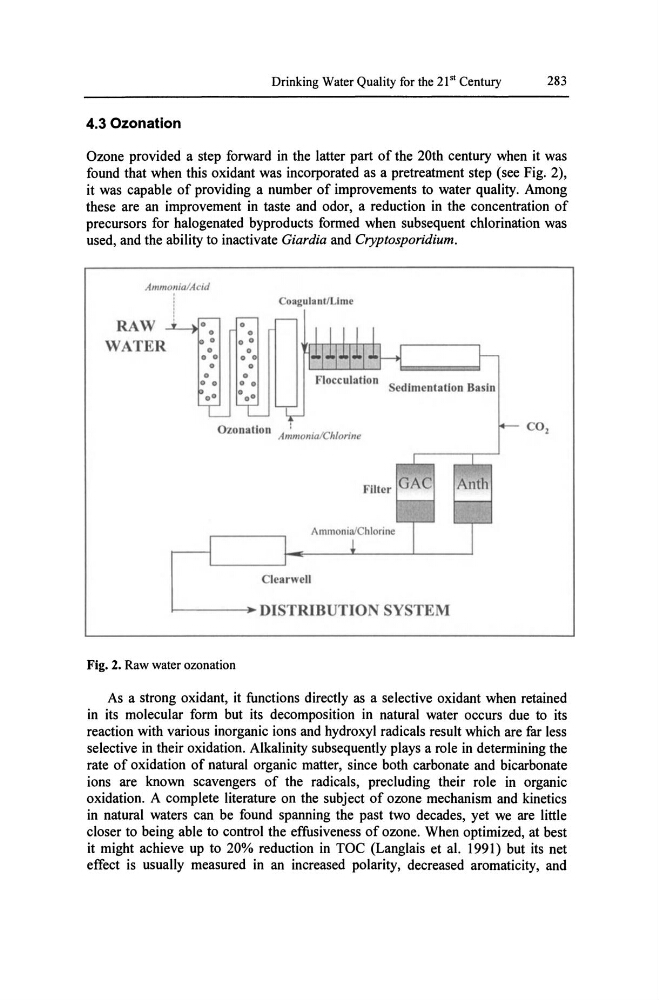
Ozone provided a step forward in the latter part of the 20th century when it was
found that when this oxidant was incorporated as a pretreatment step (see Fig. 2),
it was capable of providing a number of improvements to water quality. Among
these are an improvement in taste and odor, a reduction in the concentration of
precursors for halogenated bypro ducts formed when subsequent chlorination was
used, and the ability to inactivate Giardia and Cryptosporidium.
Ammonia/Acid
RAW
WATER
o
CoagulantfL.ime
Clearwell
1--- --.. DISTRIBUTION SYSTEM
Fig. 2. Raw water ozonation
As a strong oxidant, it functions directly as a selective oxidant when retained
in its molecular form but its decomposition in natural water occurs due to its
reaction with various inorganic ions and hydroxyl radicals result which are far less
selective in their oxidation. Alkalinity subsequently plays a role in determining the
rate of oxidation of natural organic matter, since both carbonate and bicarbonate
ions are known scavengers of the radicals, precluding their role in organic
oxidation. A complete literature on the subject of ozone mechanism and kinetics
in natural waters can be found spanning the past two decades, yet we are little
closer to being able to control the effusiveness of ozone. When optimized, at best
it might achieve up to 20% reduction in TOe (Langlais et al. 1991) but its net
effect is usually measured in an increased polarity, decreased aromaticity, and
283
4.3 Ozonation
Ozone provided a step forward in the latter part of the 20th century when it was
found that when this oxidant was incorporated as a pretreatment step (see Fig. 2),
it was capable of providing a number of improvements to water quality. Among
these are an improvement in taste and odor, a reduction in the concentration of
precursors for halogenated bypro ducts formed when subsequent chlorination was
used, and the ability to inactivate Giardia and Cryptosporidium.
Ammonia/Acid
RAW
WATER
o
CoagulantfL.ime
Clearwell
1--- --.. DISTRIBUTION SYSTEM
Fig. 2. Raw water ozonation
As a strong oxidant, it functions directly as a selective oxidant when retained
in its molecular form but its decomposition in natural water occurs due to its
reaction with various inorganic ions and hydroxyl radicals result which are far less
selective in their oxidation. Alkalinity subsequently plays a role in determining the
rate of oxidation of natural organic matter, since both carbonate and bicarbonate
ions are known scavengers of the radicals, precluding their role in organic
oxidation. A complete literature on the subject of ozone mechanism and kinetics
in natural waters can be found spanning the past two decades, yet we are little
closer to being able to control the effusiveness of ozone. When optimized, at best
it might achieve up to 20% reduction in TOe (Langlais et al. 1991) but its net
effect is usually measured in an increased polarity, decreased aromaticity, and