

282
H. S. Weinberg
4.2 Air Stripping
Air stripping exploits the transfer of volatile organic compounds (VOCs) from the
aqueous phase to the gaseous (air) phase, in order to remediate the aqueous phase.
The mass transfer of a constituent between the two phases is governed by the
constituent concentration in each phase relative to the equilibrium concentration
(Metcalf and Eddy 1991). Thus, the transfer ofa constituent between the phases is
greatest when the concentration in one of the phases is far from equilibrium
(Boegel 1989). The equilibrium concentrations in the two phases are controlled by
the Henry's Law constant for the substance. The magnitude of the Henry's
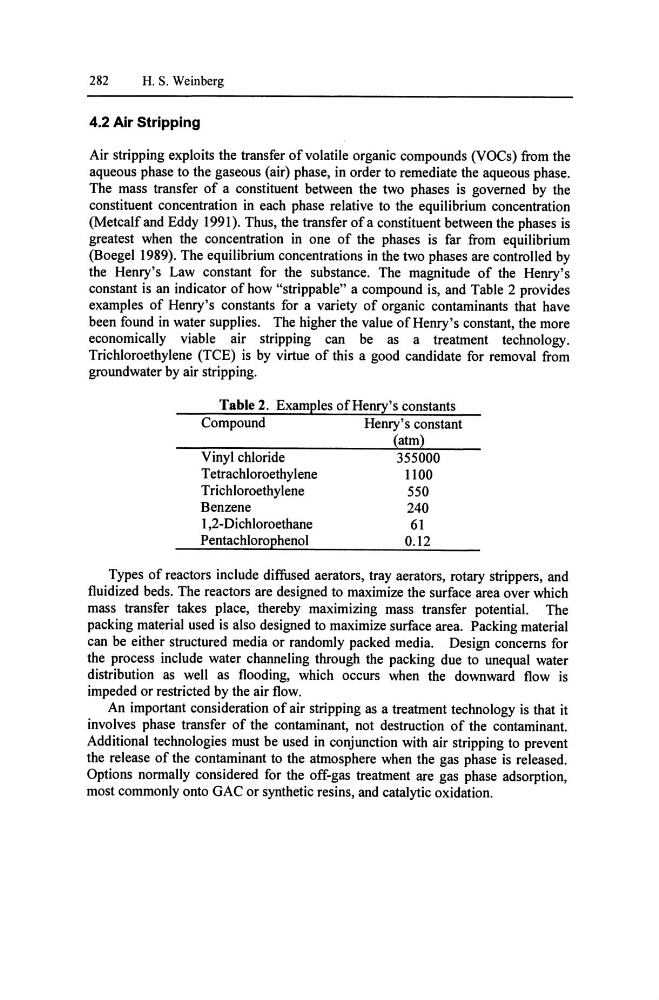
constant is an indicator of how "strippable" a compound is, and Table 2 provides
examples of Henry's constants for a variety of organic contaminants that have
been found in water supplies. The higher the value of Henry's constant, the more
economically viable air stripping can be as a treatment technology.
Trichloroethylene (TCE) is by virtue of this a good candidate for removal from
groundwater by air stripping.
Table 2. Examples of Henry's constants
Compound
Henry's constant
Vinyl chloride
Tetrachloroethylene
Trichloroethylene
Benzene
1,2-Dichloroethane
Pentachlorophenol
(atm)
355000
1100
550
240
61
0.12
Types of reactors include diffused aerators, tray aerators, rotary strippers, and
fluidized beds. The reactors are designed to maximize the surface area over which
mass transfer takes place, thereby maximizing mass transfer potential. The
packing material used is also designed to maximize surface area. Packing material
can be either structured media or randomly packed media. Design concerns for
the process include water channeling through the packing due to unequal water
distribution as well as flooding, which occurs when the downward flow is
impeded or restricted by the air flow.
An important consideration of air stripping as a treatment technology is that it
involves phase transfer of the contaminant, not destruction of the contaminant.
Additional technologies must be used in conjunction with air stripping to prevent
the release of the contaminant to the atmosphere when the gas phase is released.
Options normally considered for the off-gas treatment are gas phase adsorption,
most commonly onto GAC or synthetic resins, and catalytic oxidation.
H. S. Weinberg
4.2 Air Stripping
Air stripping exploits the transfer of volatile organic compounds (VOCs) from the
aqueous phase to the gaseous (air) phase, in order to remediate the aqueous phase.
The mass transfer of a constituent between the two phases is governed by the
constituent concentration in each phase relative to the equilibrium concentration
(Metcalf and Eddy 1991). Thus, the transfer ofa constituent between the phases is
greatest when the concentration in one of the phases is far from equilibrium
(Boegel 1989). The equilibrium concentrations in the two phases are controlled by
the Henry's Law constant for the substance. The magnitude of the Henry's
constant is an indicator of how "strippable" a compound is, and Table 2 provides
examples of Henry's constants for a variety of organic contaminants that have
been found in water supplies. The higher the value of Henry's constant, the more
economically viable air stripping can be as a treatment technology.
Trichloroethylene (TCE) is by virtue of this a good candidate for removal from
groundwater by air stripping.
Table 2. Examples of Henry's constants
Compound
Henry's constant
Vinyl chloride
Tetrachloroethylene
Trichloroethylene
Benzene
1,2-Dichloroethane
Pentachlorophenol
(atm)
355000
1100
550
240
61
0.12
Types of reactors include diffused aerators, tray aerators, rotary strippers, and
fluidized beds. The reactors are designed to maximize the surface area over which
mass transfer takes place, thereby maximizing mass transfer potential. The
packing material used is also designed to maximize surface area. Packing material
can be either structured media or randomly packed media. Design concerns for
the process include water channeling through the packing due to unequal water
distribution as well as flooding, which occurs when the downward flow is
impeded or restricted by the air flow.
An important consideration of air stripping as a treatment technology is that it
involves phase transfer of the contaminant, not destruction of the contaminant.
Additional technologies must be used in conjunction with air stripping to prevent
the release of the contaminant to the atmosphere when the gas phase is released.
Options normally considered for the off-gas treatment are gas phase adsorption,
most commonly onto GAC or synthetic resins, and catalytic oxidation.