

284
H. S. Weinberg
partial degradation of the TOC, which results in an overalJ increase in
biodegradability.
In order to provide protection against Giardia persistence in treated water, a
conventional design includes an average hydraulic retention time of between 8 and
12 min. with ozone doses ranging from 0.5 to 2 mg rl. However, in this mode no
detectable ozone residual remains and protection against Cryptosporidium is not
guaranteed. Higher ozone doses and/or contact times, known colJectively as the
CT credit, are now being promoted for this added protection and the point of
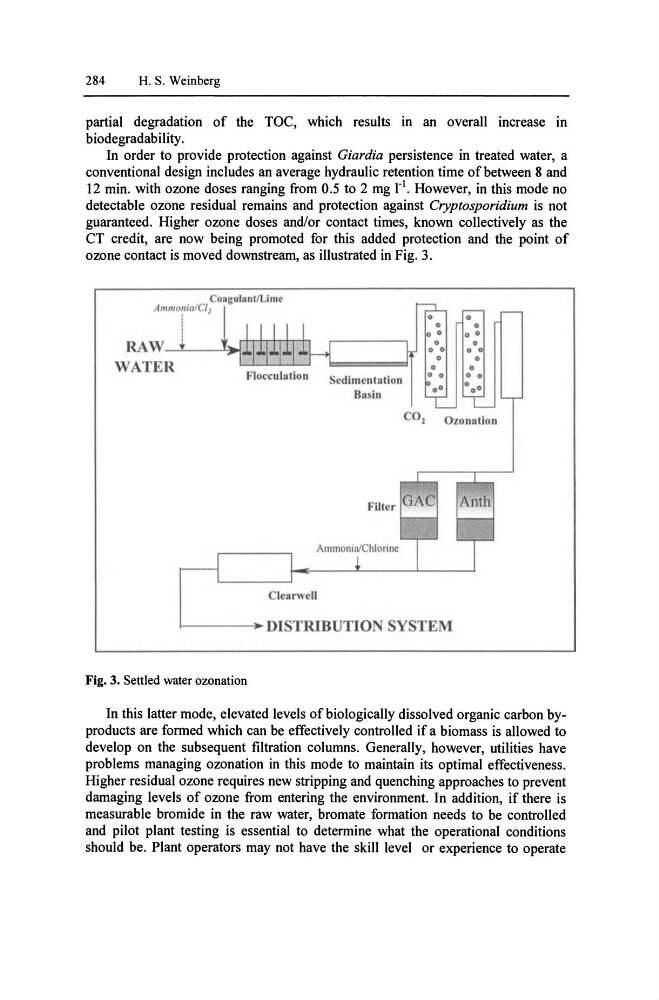
ozone contact is moved downstream, as illustrated in Fig. 3.
AmmOllia/ell
oagulant/Llme
I
RA W--I._---I:~
WATER
Basin
COl
Ozonation
Filter GAC
Anth
CICBnvcU
1 - - - -..... DISTRIBUTIO SYSTEM
Fig. 3. Settled water ozonation
In this latter mode, elevated levels of biologicalJy dissolved organic carbon byproducts are formed which can be effectively controlJed if a biomass is allowed to
develop on the subsequent filtration columns. Generally, however, utilities have
problems managing ozonation in this mode to maintain its optimal effectiveness.
Higher residual ozone requires new stripping and quenching approaches to prevent
damaging levels of ozone from entering the environment. In addition, if there is
measurable bromide in the raw water, bromate formation needs to be controlJed
and pilot plant testing is essential to determine what the operational conditions
should be. Plant operators may not have the skill level or experience to operate
H. S. Weinberg
partial degradation of the TOC, which results in an overalJ increase in
biodegradability.
In order to provide protection against Giardia persistence in treated water, a
conventional design includes an average hydraulic retention time of between 8 and
12 min. with ozone doses ranging from 0.5 to 2 mg rl. However, in this mode no
detectable ozone residual remains and protection against Cryptosporidium is not
guaranteed. Higher ozone doses and/or contact times, known colJectively as the
CT credit, are now being promoted for this added protection and the point of
ozone contact is moved downstream, as illustrated in Fig. 3.
AmmOllia/ell
oagulant/Llme
I
RA W--I._---I:~
WATER
Basin
COl
Ozonation
Filter GAC
Anth
CICBnvcU
1 - - - -..... DISTRIBUTIO SYSTEM
Fig. 3. Settled water ozonation
In this latter mode, elevated levels of biologicalJy dissolved organic carbon byproducts are formed which can be effectively controlJed if a biomass is allowed to
develop on the subsequent filtration columns. Generally, however, utilities have
problems managing ozonation in this mode to maintain its optimal effectiveness.
Higher residual ozone requires new stripping and quenching approaches to prevent
damaging levels of ozone from entering the environment. In addition, if there is
measurable bromide in the raw water, bromate formation needs to be controlJed
and pilot plant testing is essential to determine what the operational conditions
should be. Plant operators may not have the skill level or experience to operate