

184
D. Markel and U. Shamir
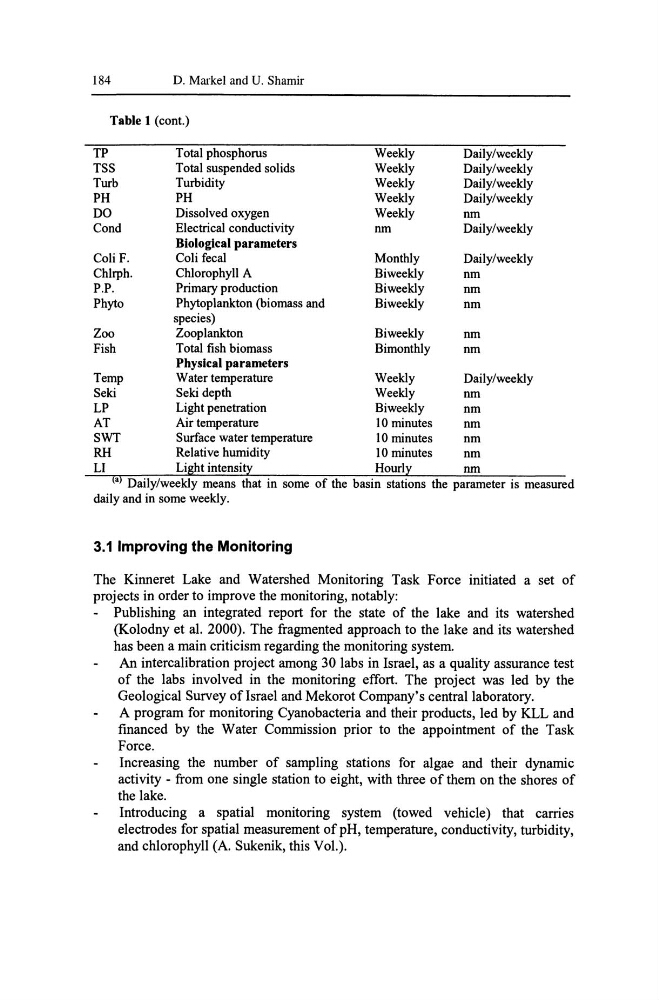
Table 1 (cont.)
TP
Total phosphorus
Weekly
Daily/weekly
TSS
Total suspended solids
Weekly
Daily/weekly
Turb
Turbidity
Weekly
Daily/weekly
PH
PH
Weekly
Daily/weekly
DO
Dissolved oxygen
Weekly
run
Cond
Electrical conductivity
nm
Daily/weekly
Biological parameters
Coli F.
Coli fecal
Monthly
Daily/weekly
Chlrph.
Chlorophyll A
Biweekly
nm
P.P.
Primary production
Biweekly
run
Phyto
Phytoplankton (biomass and
Biweekly
nm
species)
Zoo
Zooplankton
Biweekly
nm
Fish
Total fish biomass
Bimonthly
run
Physical parameters
Temp
Water temperature
Weekly
Daily/weekly
Seki
Seki depth
Weekly
run
LP
Light penetration
Biweekly
nm
AT
Air temperature
10 minutes
run
SWT
Surface water temperature
10 minutes
nm
RH
Relative humidity
10 minutes
nm
LI
Light intensity
Hourly
run
(a) Daily/weekly means that in some of the basin stations the parameter is measured
daily and in some weekly.
3.1 Improving the Monitoring
The Kinneret Lake and Watershed Monitoring Task Force initiated a set of
projects in order to improve the monitoring, notably:
Publishing an integrated report for the state of the lake and its watershed
(Kolodny et al. 2000). The fragmented approach to the lake and its watershed
has been a main criticism regarding the monitoring system.
An intercalibration project among 30 labs in Israel, as a quality assurance test
of the labs involved in the monitoring effort. The project was led by the
Geological Survey ofIsrael and Mekorot Company's central laboratory.
A program for monitoring Cyanobacteria and their products, led by KLL and
financed by the Water Commission prior to the appointment of the Task
Force.
Increasing the number of sampling stations for algae and their dynamic
activity - from one single station to eight, with three of them on the shores of
the lake.
Introducing a spatial monitoring system (towed vehicle) that carries
electrodes for spatial measurement of pH, temperature, conductivity, turbidity,
and chlorophyll (A. Sukenik, this Vol.).
D. Markel and U. Shamir
Table 1 (cont.)
TP
Total phosphorus
Weekly
Daily/weekly
TSS
Total suspended solids
Weekly
Daily/weekly
Turb
Turbidity
Weekly
Daily/weekly
PH
PH
Weekly
Daily/weekly
DO
Dissolved oxygen
Weekly
run
Cond
Electrical conductivity
nm
Daily/weekly
Biological parameters
Coli F.
Coli fecal
Monthly
Daily/weekly
Chlrph.
Chlorophyll A
Biweekly
nm
P.P.
Primary production
Biweekly
run
Phyto
Phytoplankton (biomass and
Biweekly
nm
species)
Zoo
Zooplankton
Biweekly
nm
Fish
Total fish biomass
Bimonthly
run
Physical parameters
Temp
Water temperature
Weekly
Daily/weekly
Seki
Seki depth
Weekly
run
LP
Light penetration
Biweekly
nm
AT
Air temperature
10 minutes
run
SWT
Surface water temperature
10 minutes
nm
RH
Relative humidity
10 minutes
nm
LI
Light intensity
Hourly
run
(a) Daily/weekly means that in some of the basin stations the parameter is measured
daily and in some weekly.
3.1 Improving the Monitoring
The Kinneret Lake and Watershed Monitoring Task Force initiated a set of
projects in order to improve the monitoring, notably:
Publishing an integrated report for the state of the lake and its watershed
(Kolodny et al. 2000). The fragmented approach to the lake and its watershed
has been a main criticism regarding the monitoring system.
An intercalibration project among 30 labs in Israel, as a quality assurance test
of the labs involved in the monitoring effort. The project was led by the
Geological Survey ofIsrael and Mekorot Company's central laboratory.
A program for monitoring Cyanobacteria and their products, led by KLL and
financed by the Water Commission prior to the appointment of the Task
Force.
Increasing the number of sampling stations for algae and their dynamic
activity - from one single station to eight, with three of them on the shores of
the lake.
Introducing a spatial monitoring system (towed vehicle) that carries
electrodes for spatial measurement of pH, temperature, conductivity, turbidity,
and chlorophyll (A. Sukenik, this Vol.).