

Water Resources Issues of the Laurentian Great Lakes
159
surrounding particles, also known as the cohesive force for the smaller particles
characteristic of Great Lakes waterways. Erosion rate also is a function of
sediment properties, such as particle size and bulk density. A general form of
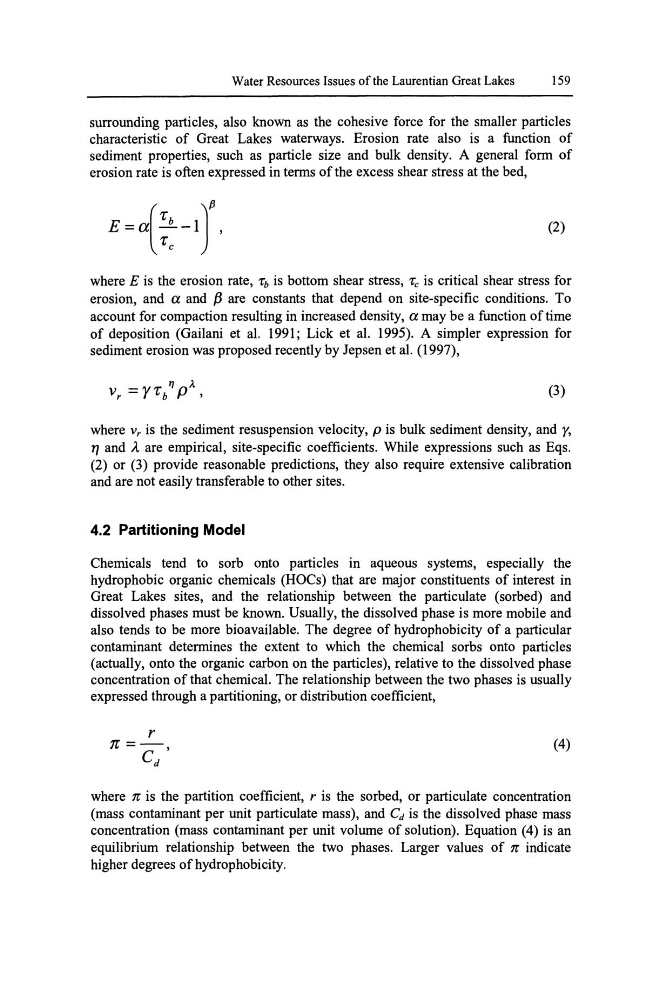
erosion rate is often expressed in terms of the excess shear stress at the bed,
(2)
where E is the erosion rate, 'rb is bottom shear stress, 'rc is critical shear stress for
erosion, and a and f3 are constants that depend on site-specific conditions. To
account for compaction resulting in increased density, a may be a function of time
of deposition (Gailani et al. 1991; Lick et al. 1995). A simpler expression for
sediment erosion was proposed recently by Jepsen et al. (1997),
(3)
where Vr is the sediment resuspension velocity, p is bulk sediment density, and y,
TJ and A are empirical, site-specific coefficients. While expressions such as Eqs.
(2) or (3) provide reasonable predictions, they also require extensive calibration
and are not easily transferable to other sites.
4.2 Partitioning Model
Chemicals tend to sorb onto particles in aqueous systems, especially the
hydrophobic organic chemicals (HOCs) that are major constituents of interest in
Great Lakes sites, and the relationship between the particulate (sorbed) and
dissolved phases must be known. Usually, the dissolved phase is more mobile and
also tends to be more bioavailable. The degree of hydrophobicity of a particular
contaminant determines the extent to which the chemical sorbs onto particles
(actually, onto the organic carbon on the particles), relative to the dissolved phase
concentration of that chemical. The relationship between the two phases is usually
expressed through a partitioning, or distribution coefficient,
r
77:=C' d
(4)
where 11: is the partition coefficient, r is the sorbed, or particulate concentration
(mass contaminant per unit particulate mass), and Cd is the dissolved phase mass
concentration (mass contaminant per unit volume of solution). Equation (4) is an
equilibrium relationship between the two phases. Larger values of 11: indicate
higher degrees of hydrophobicity.
159
surrounding particles, also known as the cohesive force for the smaller particles
characteristic of Great Lakes waterways. Erosion rate also is a function of
sediment properties, such as particle size and bulk density. A general form of
erosion rate is often expressed in terms of the excess shear stress at the bed,
(2)
where E is the erosion rate, 'rb is bottom shear stress, 'rc is critical shear stress for
erosion, and a and f3 are constants that depend on site-specific conditions. To
account for compaction resulting in increased density, a may be a function of time
of deposition (Gailani et al. 1991; Lick et al. 1995). A simpler expression for
sediment erosion was proposed recently by Jepsen et al. (1997),
(3)
where Vr is the sediment resuspension velocity, p is bulk sediment density, and y,
TJ and A are empirical, site-specific coefficients. While expressions such as Eqs.
(2) or (3) provide reasonable predictions, they also require extensive calibration
and are not easily transferable to other sites.
4.2 Partitioning Model
Chemicals tend to sorb onto particles in aqueous systems, especially the
hydrophobic organic chemicals (HOCs) that are major constituents of interest in
Great Lakes sites, and the relationship between the particulate (sorbed) and
dissolved phases must be known. Usually, the dissolved phase is more mobile and
also tends to be more bioavailable. The degree of hydrophobicity of a particular
contaminant determines the extent to which the chemical sorbs onto particles
(actually, onto the organic carbon on the particles), relative to the dissolved phase
concentration of that chemical. The relationship between the two phases is usually
expressed through a partitioning, or distribution coefficient,
r
77:=C' d
(4)
where 11: is the partition coefficient, r is the sorbed, or particulate concentration
(mass contaminant per unit particulate mass), and Cd is the dissolved phase mass
concentration (mass contaminant per unit volume of solution). Equation (4) is an
equilibrium relationship between the two phases. Larger values of 11: indicate
higher degrees of hydrophobicity.