

158
J. Atkinson
has significantly declined in recent years, but a legacy of this activity remains in
the sediments. Even without erosion, contaminants may diffuse from underlying
sediments into the water column and then be carried to other parts of the system.
4.1 Resuspension
A major question for sites with contaminated sediments is to determine potential
resuspension rates as a function of various driving processes. Erosion is generally
related to storm events, with increased shear stresses due to storm-induced flows,
but resuspension also can be driven by shipping traffic, either by direct contact
with the ship's hull, by waves generated by the ship passage, or through stirring by
propellers (sediment also may be released during dredging operations, but here the
focus will be on storm-related events). Because of the great variety of sediment
characteristics, resuspension and erosion rates often are calculated using empirical
or semi empirical models. In the Great Lakes Basin, significant efforts have been
made to study sediment properties in the Buffalo River, the Fox River, the
Saginaw River, the Detroit River, and in Green Bay.
Flow
0
0
Particulate
phase
\
0
\
0
0
Dissolved
phase
d,,,,,,,tion 1 G
•
...
sorption
0
o
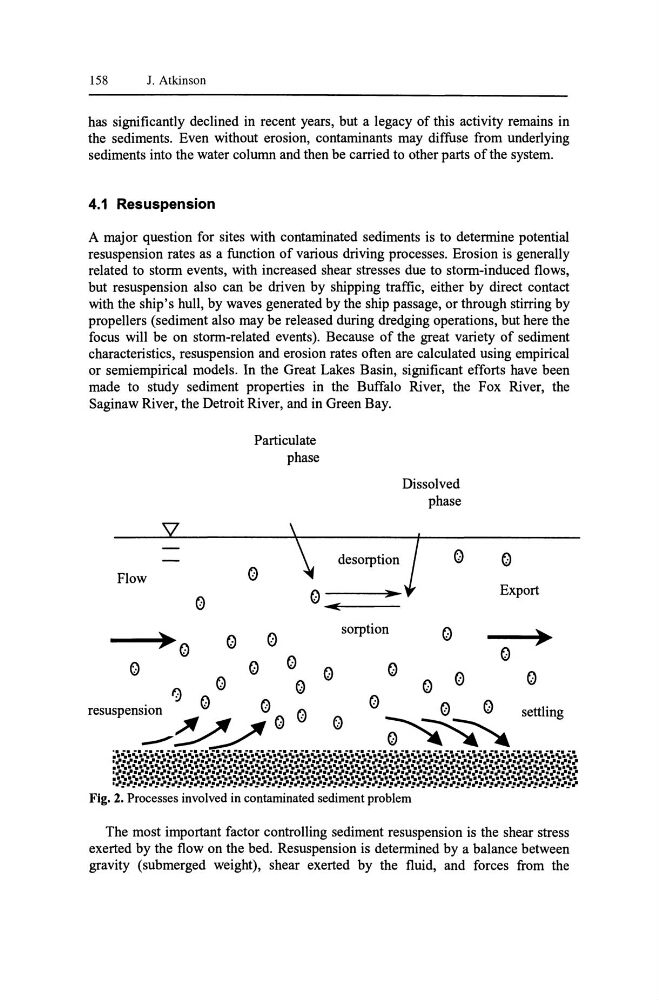
Fig. 2. Processes involved in contaminated sediment problem
Export
settling
The most important factor controlling sediment resuspension is the shear stress
exerted by the flow on the bed. Resuspension is determined by a balance between
gravity (submerged weight), shear exerted by the fluid, and forces from the
J. Atkinson
has significantly declined in recent years, but a legacy of this activity remains in
the sediments. Even without erosion, contaminants may diffuse from underlying
sediments into the water column and then be carried to other parts of the system.
4.1 Resuspension
A major question for sites with contaminated sediments is to determine potential
resuspension rates as a function of various driving processes. Erosion is generally
related to storm events, with increased shear stresses due to storm-induced flows,
but resuspension also can be driven by shipping traffic, either by direct contact
with the ship's hull, by waves generated by the ship passage, or through stirring by
propellers (sediment also may be released during dredging operations, but here the
focus will be on storm-related events). Because of the great variety of sediment
characteristics, resuspension and erosion rates often are calculated using empirical
or semi empirical models. In the Great Lakes Basin, significant efforts have been
made to study sediment properties in the Buffalo River, the Fox River, the
Saginaw River, the Detroit River, and in Green Bay.
Flow
0
0
Particulate
phase
\
0
\
0
0
Dissolved
phase
d,,,,,,,tion 1 G
•
...
sorption
0
o
Fig. 2. Processes involved in contaminated sediment problem
Export
settling
The most important factor controlling sediment resuspension is the shear stress
exerted by the flow on the bed. Resuspension is determined by a balance between
gravity (submerged weight), shear exerted by the fluid, and forces from the