

160
1. Atkinson
The assumption of equilibrium is probably appropriate for sediments in the
bed, which may have been in contact with the pore water for some period of time.
However, when bottom sediments are resuspended, they are put into an
environment with much lower Cd, and some time may elapse before equilibrium is
established in the water column. This effect was examined by Cheng et al. (1995),
who used the radial sorption/desorption model of Wu and Gschwend (1986) to
show that, depending on the values of n and other input, equilibrium is reached
only after a period of time ranging from about 0.25 h up to 100 days. Figure 3
shows the general results, in terms of time required to reach different percentages
of equilibrium concentrations as a function of chemical and particle charcteristics.
Song (2001) recently extended the work of Cheng et al. (1995) by developing
a two-compartment sorption/desorption model designed to simulate different
stages of behavior, in particular the relatively fast initial sorption or desorption,
followed by a relatively slow final approach to equilibrium (Fig. 4). In this
approach the sorption/desorption process is modeled using two first-order
reactions, one compartment having a relatively large reaction rate and the other a
smaller rate. Song (2001) reached conclusions similar to Cheng et al. (1995)
regarding the time required to reach equilibrium.
4.3 Export of Contaminants
Transport of contaminants deriving from contaminated sediments out of a
particular river reach depends on the relative time scales for desorption and
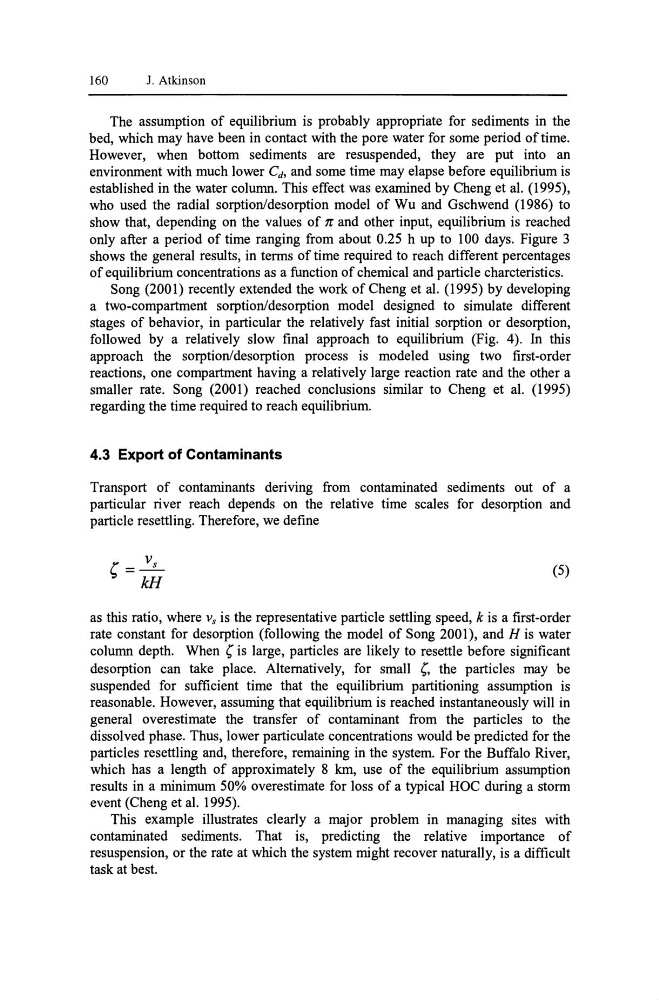
particle resettling. Therefore, we define
,=~
kH
(5)
as this ratio, where Vs is the representative particle settling speed, k is a first-order
rate constant for desorption (following the model of Song 2001), and H is water
column depth. When S is large, particles are likely to resettle before significant
desorption can take place. Alternatively, for small S, the particles may be
suspended for sufficient time that the equilibrium partitioning assumption is
reasonable. However, assuming that equilibrium is reached instantaneously will in
general overestimate the transfer of contaminant from the particles to the
dissolved phase. Thus, lower particulate concentrations would be predicted for the
particles resettling and, therefore, remaining in the system. For the Buffalo River,
which has a length of approximately 8 km, use of the equilibrium assumption
results in a minimum 50% overestimate for loss of a typical HOC during a storm
event (Cheng et al. 1995).
This example illustrates clearly a major problem in managing sites with
contaminated sediments. That is, predicting the relative importance of
resuspension, or the rate at which the system might recover naturally, is a difficult
task at best.
1. Atkinson
The assumption of equilibrium is probably appropriate for sediments in the
bed, which may have been in contact with the pore water for some period of time.
However, when bottom sediments are resuspended, they are put into an
environment with much lower Cd, and some time may elapse before equilibrium is
established in the water column. This effect was examined by Cheng et al. (1995),
who used the radial sorption/desorption model of Wu and Gschwend (1986) to
show that, depending on the values of n and other input, equilibrium is reached
only after a period of time ranging from about 0.25 h up to 100 days. Figure 3
shows the general results, in terms of time required to reach different percentages
of equilibrium concentrations as a function of chemical and particle charcteristics.
Song (2001) recently extended the work of Cheng et al. (1995) by developing
a two-compartment sorption/desorption model designed to simulate different
stages of behavior, in particular the relatively fast initial sorption or desorption,
followed by a relatively slow final approach to equilibrium (Fig. 4). In this
approach the sorption/desorption process is modeled using two first-order
reactions, one compartment having a relatively large reaction rate and the other a
smaller rate. Song (2001) reached conclusions similar to Cheng et al. (1995)
regarding the time required to reach equilibrium.
4.3 Export of Contaminants
Transport of contaminants deriving from contaminated sediments out of a
particular river reach depends on the relative time scales for desorption and
particle resettling. Therefore, we define
,=~
kH
(5)
as this ratio, where Vs is the representative particle settling speed, k is a first-order
rate constant for desorption (following the model of Song 2001), and H is water
column depth. When S is large, particles are likely to resettle before significant
desorption can take place. Alternatively, for small S, the particles may be
suspended for sufficient time that the equilibrium partitioning assumption is
reasonable. However, assuming that equilibrium is reached instantaneously will in
general overestimate the transfer of contaminant from the particles to the
dissolved phase. Thus, lower particulate concentrations would be predicted for the
particles resettling and, therefore, remaining in the system. For the Buffalo River,
which has a length of approximately 8 km, use of the equilibrium assumption
results in a minimum 50% overestimate for loss of a typical HOC during a storm
event (Cheng et al. 1995).
This example illustrates clearly a major problem in managing sites with
contaminated sediments. That is, predicting the relative importance of
resuspension, or the rate at which the system might recover naturally, is a difficult
task at best.