

136
U. Shavit et al.
Yannouk flow into the river along its banks and add water with a specific
chemical composition. The western surface inflows have relatively low SOJCI,
NalCI, Mg/CI, and B/CI, as well as high CalCI ratios. These ratios are not
consistent with our mass-balance calculations, and hence, the chemical shift
observed in the upper zone cannot be derived from the western surface inflow.
Moreover, the freshwater inflows from the east (e.g., Wadi Arab) or even a
mixture of western saline and eastern freshwater inflows cannot explain the
chemical variations as the dissolved salts are too low and are not consistent with
the increase of Mg, S04, and B contents. We expect that during winter floods this
salinity would be even lower, as indicated by the flood flow composition along
wadis in the Jordan Valley (Salameh 1996).
500 -r----------i --*-Sept-99
--II--- March-OO
400 "'~.----------j --e- May-OO
--I:r- Aug-OO
~ 300 +----'t.I_._-------i • Sept-OO
.5
~'Dec-OO
~
1 _______ ~~~~~8~~'F~e~b~-O~1==~~~~::~~~~~--~
U 200 i
100 +-------~------r_------r_----~------~--~
o
20
40
60
80
100
Distance from Alumot (km)
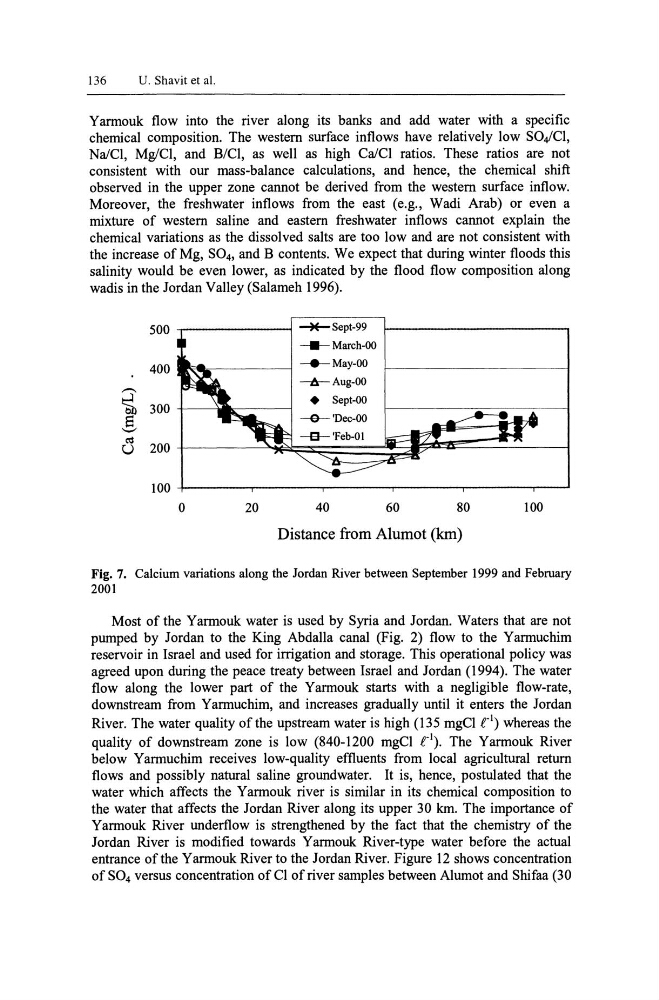
Fig. 7. Calcium variations along the Jordan River between September 1999 and February
2001
Most of the Yannouk water is used by Syria and Jordan. Waters that are not
pumped by Jordan to the King Abdalla canal (Fig. 2) flow to the Yannuchim
reservoir in Israel and used for irrigation and storage. This operational policy was
agreed upon during the peace treaty between Israel and Jordan (1994). The water
flow along the lower part of the Yannouk starts with a negligible flow-rate,
downstream from Yannuchim, and increases gradually until it enters the Jordan
River. The water quality of the upstream water is high (135 mgCI e- 1 ) whereas the
quality of downstream zone is low (840-1200 mgCI e- 1 ). The Yannouk River
below Yannuchim receives low-quality effluents from local agricultural return
flows and possibly natural saline groundwater. It is, hence, postulated that the
water which affects the Yannouk river is similar in its chemical composition to
the water that affects the Jordan River along its upper 30 km. The importance of
Yannouk River underflow is strengthened by the fact that the chemistry of the
Jordan River is modified towards Yannouk River-type water before the actual
entrance of the Yannouk River to the Jordan River. Figure 12 shows concentration
of S04 versus concentration of CI of river samples between Alumot and Shifaa (30
U. Shavit et al.
Yannouk flow into the river along its banks and add water with a specific
chemical composition. The western surface inflows have relatively low SOJCI,
NalCI, Mg/CI, and B/CI, as well as high CalCI ratios. These ratios are not
consistent with our mass-balance calculations, and hence, the chemical shift
observed in the upper zone cannot be derived from the western surface inflow.
Moreover, the freshwater inflows from the east (e.g., Wadi Arab) or even a
mixture of western saline and eastern freshwater inflows cannot explain the
chemical variations as the dissolved salts are too low and are not consistent with
the increase of Mg, S04, and B contents. We expect that during winter floods this
salinity would be even lower, as indicated by the flood flow composition along
wadis in the Jordan Valley (Salameh 1996).
500 -r----------i --*-Sept-99
--II--- March-OO
400 "'~.----------j --e- May-OO
--I:r- Aug-OO
~ 300 +----'t.I_._-------i • Sept-OO
.5
~'Dec-OO
~
1 _______ ~~~~~8~~'F~e~b~-O~1==~~~~::~~~~~--~
U 200 i
100 +-------~------r_------r_----~------~--~
o
20
40
60
80
100
Distance from Alumot (km)
Fig. 7. Calcium variations along the Jordan River between September 1999 and February
2001
Most of the Yannouk water is used by Syria and Jordan. Waters that are not
pumped by Jordan to the King Abdalla canal (Fig. 2) flow to the Yannuchim
reservoir in Israel and used for irrigation and storage. This operational policy was
agreed upon during the peace treaty between Israel and Jordan (1994). The water
flow along the lower part of the Yannouk starts with a negligible flow-rate,
downstream from Yannuchim, and increases gradually until it enters the Jordan
River. The water quality of the upstream water is high (135 mgCI e- 1 ) whereas the
quality of downstream zone is low (840-1200 mgCI e- 1 ). The Yannouk River
below Yannuchim receives low-quality effluents from local agricultural return
flows and possibly natural saline groundwater. It is, hence, postulated that the
water which affects the Yannouk river is similar in its chemical composition to
the water that affects the Jordan River along its upper 30 km. The importance of
Yannouk River underflow is strengthened by the fact that the chemistry of the
Jordan River is modified towards Yannouk River-type water before the actual
entrance of the Yannouk River to the Jordan River. Figure 12 shows concentration
of S04 versus concentration of CI of river samples between Alumot and Shifaa (30