

122
T. Gremm et al.
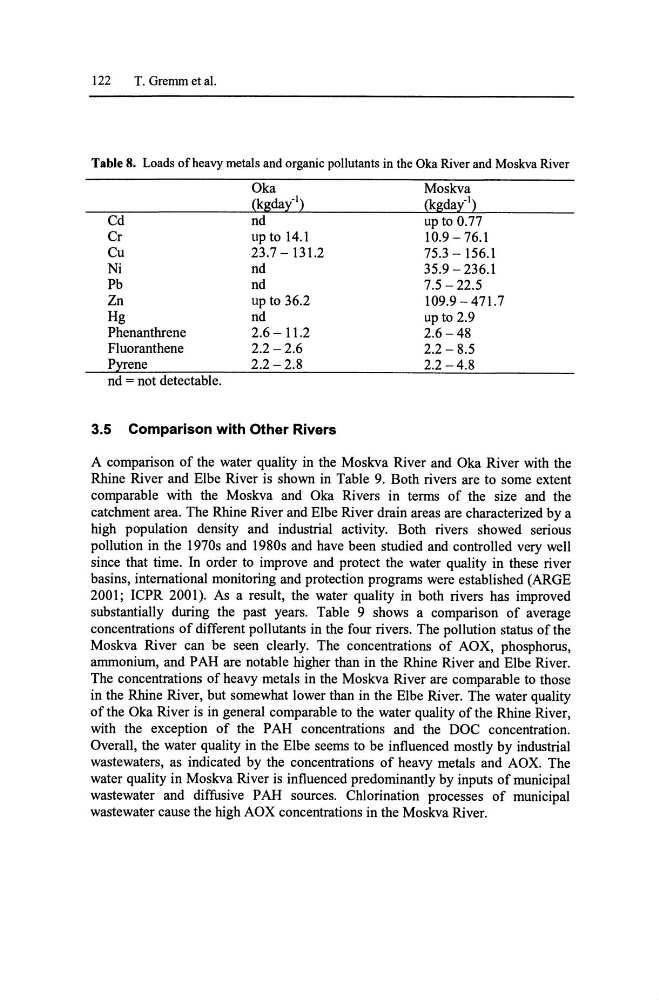
Table 8. Loads of heavy metals and organic pollutants in the Oka River and Moskva River
Cd
Cr
Cu
Ni
Pb
Zn
Hg
Phenanthrene
Fluoranthene
Pyrene
nd = not detectable.
Oka
(kgdail)
nd
up to 14.1
23.7 -131.2
nd
nd
up to 36.2
nd
2.6 -11.2
2.2 -2.6
2.2-2.8
3.5 Comparison with Other Rivers
Moskva
(kgdail)
up to 0.77
10.9 -76.1
75.3 -156.1
35.9 - 236.1
7.5 - 22.5
109.9 - 471.7
up to 2.9
2.6 - 48
2.2 - 8.5
2.2 -4.8
A comparison of the water quality in the Moskva River and Oka River with the
Rhine River and Elbe River is shown in Table 9. Both rivers are to some extent
comparable with the Moskva and Oka Rivers in terms of the size and the
catchment area. The Rhine River and Elbe River drain areas are characterized by a
high population density and industrial activity. Both rivers showed serious
pollution in the 1970s and 1980s and have been studied and controlled very well
since that time. In order to improve and protect the water quality in these river
basins, international monitoring and protection programs were established (ARGE
2001; ICPR 2001). As a result, the water quality in both rivers has improved
substantially during the past years. Table 9 shows a comparison of average
concentrations of different pollutants in the four rivers. The pollution status of the
Moskva River can be seen clearly. The concentrations of AOX, phosphorus,
ammonium, and P AH are notable higher than in the Rhine River and Elbe River.
The concentrations of heavy metals in the Moskva River are comparable to those
in the Rhine River, but somewhat lower than in the Elbe River. The water quality
of the Oka River is in general comparable to the water quality of the Rhine River,
with the exception of the P AH concentrations and the DOC concentration.
Overall, the water quality in the Elbe seems to be influenced mostly by industrial
wastewaters, as indicated by the concentrations of heavy metals and AOX. The
water quality in Moskva River is influenced predominantly by inputs of municipal
wastewater and diffusive P AH sources. Chlorination processes of municipal
wastewater cause the high AOX concentrations in the Moskva River.
T. Gremm et al.
Table 8. Loads of heavy metals and organic pollutants in the Oka River and Moskva River
Cd
Cr
Cu
Ni
Pb
Zn
Hg
Phenanthrene
Fluoranthene
Pyrene
nd = not detectable.
Oka
(kgdail)
nd
up to 14.1
23.7 -131.2
nd
nd
up to 36.2
nd
2.6 -11.2
2.2 -2.6
2.2-2.8
3.5 Comparison with Other Rivers
Moskva
(kgdail)
up to 0.77
10.9 -76.1
75.3 -156.1
35.9 - 236.1
7.5 - 22.5
109.9 - 471.7
up to 2.9
2.6 - 48
2.2 - 8.5
2.2 -4.8
A comparison of the water quality in the Moskva River and Oka River with the
Rhine River and Elbe River is shown in Table 9. Both rivers are to some extent
comparable with the Moskva and Oka Rivers in terms of the size and the
catchment area. The Rhine River and Elbe River drain areas are characterized by a
high population density and industrial activity. Both rivers showed serious
pollution in the 1970s and 1980s and have been studied and controlled very well
since that time. In order to improve and protect the water quality in these river
basins, international monitoring and protection programs were established (ARGE
2001; ICPR 2001). As a result, the water quality in both rivers has improved
substantially during the past years. Table 9 shows a comparison of average
concentrations of different pollutants in the four rivers. The pollution status of the
Moskva River can be seen clearly. The concentrations of AOX, phosphorus,
ammonium, and P AH are notable higher than in the Rhine River and Elbe River.
The concentrations of heavy metals in the Moskva River are comparable to those
in the Rhine River, but somewhat lower than in the Elbe River. The water quality
of the Oka River is in general comparable to the water quality of the Rhine River,
with the exception of the P AH concentrations and the DOC concentration.
Overall, the water quality in the Elbe seems to be influenced mostly by industrial
wastewaters, as indicated by the concentrations of heavy metals and AOX. The
water quality in Moskva River is influenced predominantly by inputs of municipal
wastewater and diffusive P AH sources. Chlorination processes of municipal
wastewater cause the high AOX concentrations in the Moskva River.