

Water Quality Monitoring in Russian Rivers
123
4 Summary and Conclusions
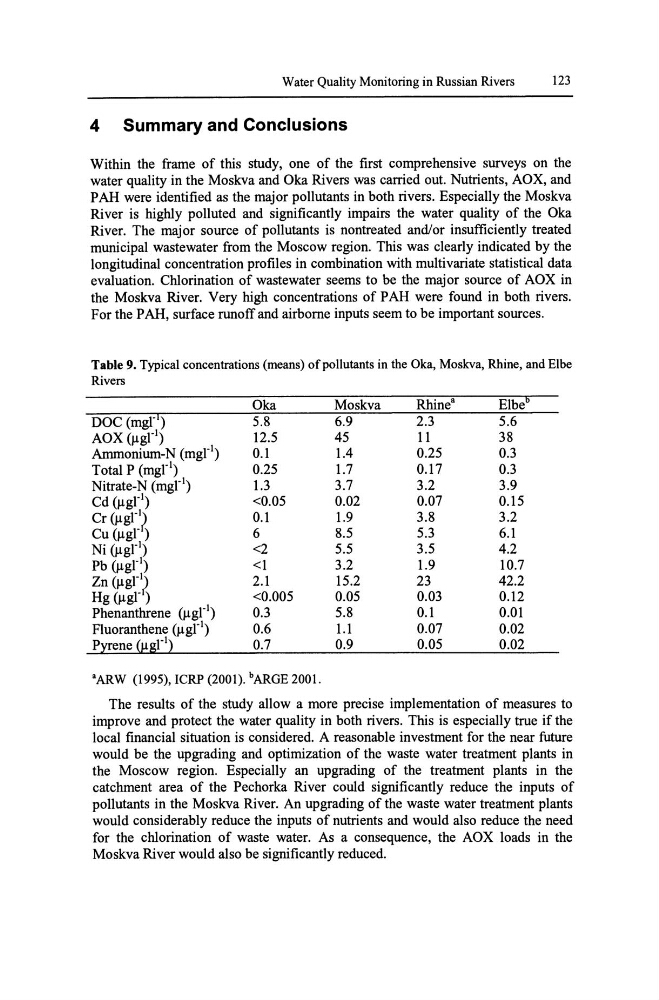
Within the frame of this study, one of the first comprehensive surveys on the
water quality in the Moskva and Oka Rivers was carried out. Nutrients, AOX, and
P AH were identified as the major pollutants in both rivers. Especially the Moskva
River is highly polluted and significantly impairs the water quality of the Oka
River. The major source of pollutants is nontreated and/or insufficiently treated
municipal wastewater from the Moscow region. This was clearly indicated by the
longitudinal concentration profiles in combination with multivariate statistical data
evaluation. Chlorination of wastewater seems to be the major source of AOX in
the Moskva River. Very high concentrations of PAH were found in both rivers.
F or the P AH, surface runoff and airborne inputs seem to be important sources.
Table 9. Typical concentrations (means) of pollutants in the Oka, Moskva, Rhine, and Elbe
Rivers
Oka
Moskva
Rhine"
Elbe 6
DOC (mgr l )
5.8
6.9
2.3
5.6
AOX(J.1gr 1 )
12.5
45
11
38
Ammonium-N (mgr 1 )
0.1
1.4
0.25
0.3
Total P (mgrl)
0.25
1.7
0.17
0.3
Nitrate-N (mgr 1 )
1.3
3.7
3.2
3.9
Cd (J.1gr 1 )
<0.05
0.02
0.07
0.15
Cr (J.1gr 1 ?,
0.1
1.9
3.8
3.2
Cu (J.1gr)
6
8.5
5.3
6.1
Ni (J.1gr 1 )
<2
5.5
3.5
4.2
Pb (J.1gr 1 )
<1
3.2
1.9
10.7
Zn (J.1gr 1 ?,
2.1
15.2
23
42.2
Hg (J.1gr)
<0.005
0.05
0.03
0.12
Phenanthrene (J.1gr 1 )
0.3
5.8
0.1
0.Ql
Fluoranthene (J.1gr 1 )
0.6
1.1
0.07
0.02
Pyrene {!:!:grI2
0.7
0.9
0.05
0.02
aARW (1995), ICRP (2001). bARGE 2001.
The results of the study allow a more precise implementation of measures to
improve and protect the water quality in both rivers. This is especially true if the
local financial situation is considered. A reasonable investment for the near future
would be the upgrading and optimization of the waste water treatment plants in
the Moscow region. Especially an upgrading of the treatment plants in the
catchment area of the Pechorka River could significantly reduce the inputs of
pollutants in the Moskva River. An upgrading of the waste water treatment plants
would considerably reduce the inputs of nutrients and would also reduce the need
for the chlorination of waste water. As a consequence, the AOX loads in the
Moskva River would also be significantly reduced.
123
4 Summary and Conclusions
Within the frame of this study, one of the first comprehensive surveys on the
water quality in the Moskva and Oka Rivers was carried out. Nutrients, AOX, and
P AH were identified as the major pollutants in both rivers. Especially the Moskva
River is highly polluted and significantly impairs the water quality of the Oka
River. The major source of pollutants is nontreated and/or insufficiently treated
municipal wastewater from the Moscow region. This was clearly indicated by the
longitudinal concentration profiles in combination with multivariate statistical data
evaluation. Chlorination of wastewater seems to be the major source of AOX in
the Moskva River. Very high concentrations of PAH were found in both rivers.
F or the P AH, surface runoff and airborne inputs seem to be important sources.
Table 9. Typical concentrations (means) of pollutants in the Oka, Moskva, Rhine, and Elbe
Rivers
Oka
Moskva
Rhine"
Elbe 6
DOC (mgr l )
5.8
6.9
2.3
5.6
AOX(J.1gr 1 )
12.5
45
11
38
Ammonium-N (mgr 1 )
0.1
1.4
0.25
0.3
Total P (mgrl)
0.25
1.7
0.17
0.3
Nitrate-N (mgr 1 )
1.3
3.7
3.2
3.9
Cd (J.1gr 1 )
<0.05
0.02
0.07
0.15
Cr (J.1gr 1 ?,
0.1
1.9
3.8
3.2
Cu (J.1gr)
6
8.5
5.3
6.1
Ni (J.1gr 1 )
<2
5.5
3.5
4.2
Pb (J.1gr 1 )
<1
3.2
1.9
10.7
Zn (J.1gr 1 ?,
2.1
15.2
23
42.2
Hg (J.1gr)
<0.005
0.05
0.03
0.12
Phenanthrene (J.1gr 1 )
0.3
5.8
0.1
0.Ql
Fluoranthene (J.1gr 1 )
0.6
1.1
0.07
0.02
Pyrene {!:!:grI2
0.7
0.9
0.05
0.02
aARW (1995), ICRP (2001). bARGE 2001.
The results of the study allow a more precise implementation of measures to
improve and protect the water quality in both rivers. This is especially true if the
local financial situation is considered. A reasonable investment for the near future
would be the upgrading and optimization of the waste water treatment plants in
the Moscow region. Especially an upgrading of the treatment plants in the
catchment area of the Pechorka River could significantly reduce the inputs of
pollutants in the Moskva River. An upgrading of the waste water treatment plants
would considerably reduce the inputs of nutrients and would also reduce the need
for the chlorination of waste water. As a consequence, the AOX loads in the
Moskva River would also be significantly reduced.