

112
T. Gremrn et al.
140
1,4
120
....I 100
C,
:l.
c:
o
.. f!
- c:
c:
o
o
x
o c:(
80
60
40
20
I
•
•
•
AOX
... Total·P
I
T
•
1
1.2
1.0
....I
0.8 C,
E
a,
0.6 iii
- o
I0.4
0.2
o I.-....I... ...... -------------------_....J O. O
Ok. aA
Moskva 0
Moskva E
OkaB
OkaC
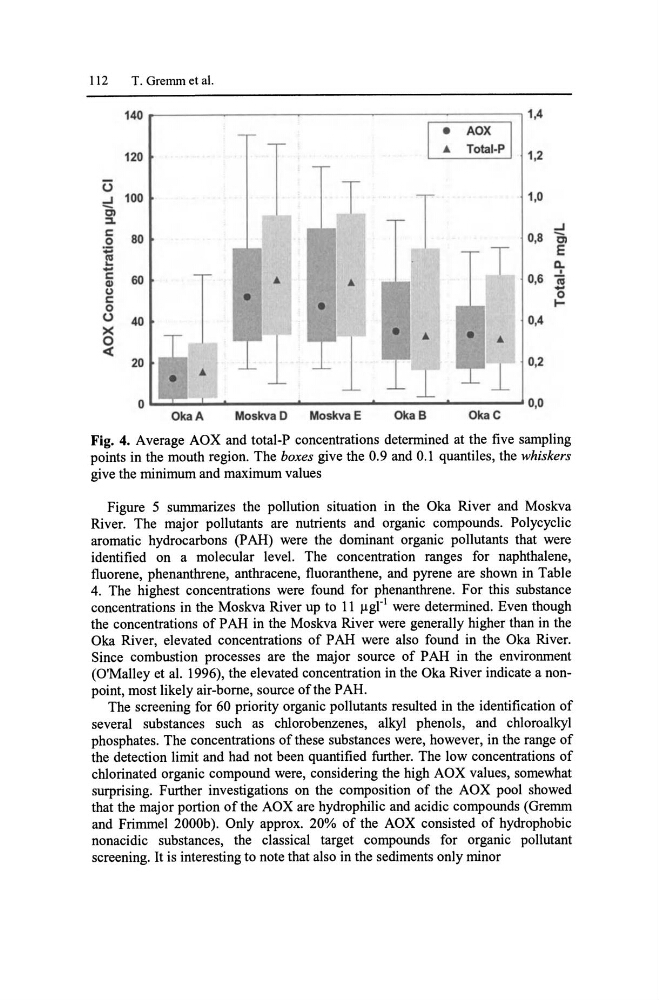
Fig. 4. Average AOX and total-P concentrations determined at the five sampling
points in the mouth region. The boxes give the 0.9 and 0.1 quantiles, the whiskers
give the minimum and maximum values
Figure 5 summarizes the pollution situation in the Oka River and Moskva
River. The major pollutants are nutrients and organic compounds. Polycyclic
aromatic hydrocarbons (P AH) were the dominant organic pollutants that were
identified on a molecular level. The concentration ranges for naphthalene,
fluorene, phenanthrene, anthracene, fluoranthene, and pyrene are shown in Table
4. The highest concentrations were found for phenanthrene. For this substance
concentrations in the Moskva River up to 11 Ilgr1 were determined. Even though
the concentrations of PAH in the Moskva River were generally higher than in the
Oka River, elevated concentrations of P AH were also found in the Oka River.
Since combustion processes are the major source of PAR in the environment
(O'Malley et al. 1996), the elevated concentration in the Oka River indicate a nonpoint, most likely air-borne, source of the PAR.
The screening for 60 priority organic pollutants resulted in the identification of
several substances such as chlorobenzenes, alkyl phenols, and chloroalkyl
phosphates. The concentrations of these substances were, however, in the range of
the detection limit and had not been quantified further. The low concentrations of
chlorinated organic compound were, considering the high AOX values, somewhat
surprising. Further investigations on the composition of the AOX pool showed
that the major portion of the AOX are hydrophilic and acidic compounds (Gremm
and Frimmel 2000b). Only approx. 20% of the AOX consisted of hydrophobic
nonacidic substances, the classical target compounds for organic pollutant
screening. It is interesting to note that also in the sediments only minor
T. Gremrn et al.
140
1,4
120
....I 100
C,
:l.
c:
o
.. f!
- c:
c:
o
o
x
o c:(
80
60
40
20
I
•
•
•
AOX
... Total·P
I
T
•
1
1.2
1.0
....I
0.8 C,
E
a,
0.6 iii
- o
I0.4
0.2
o I.-....I... ...... -------------------_....J O. O
Ok. aA
Moskva 0
Moskva E
OkaB
OkaC
Fig. 4. Average AOX and total-P concentrations determined at the five sampling
points in the mouth region. The boxes give the 0.9 and 0.1 quantiles, the whiskers
give the minimum and maximum values
Figure 5 summarizes the pollution situation in the Oka River and Moskva
River. The major pollutants are nutrients and organic compounds. Polycyclic
aromatic hydrocarbons (P AH) were the dominant organic pollutants that were
identified on a molecular level. The concentration ranges for naphthalene,
fluorene, phenanthrene, anthracene, fluoranthene, and pyrene are shown in Table
4. The highest concentrations were found for phenanthrene. For this substance
concentrations in the Moskva River up to 11 Ilgr1 were determined. Even though
the concentrations of PAH in the Moskva River were generally higher than in the
Oka River, elevated concentrations of P AH were also found in the Oka River.
Since combustion processes are the major source of PAR in the environment
(O'Malley et al. 1996), the elevated concentration in the Oka River indicate a nonpoint, most likely air-borne, source of the PAR.
The screening for 60 priority organic pollutants resulted in the identification of
several substances such as chlorobenzenes, alkyl phenols, and chloroalkyl
phosphates. The concentrations of these substances were, however, in the range of
the detection limit and had not been quantified further. The low concentrations of
chlorinated organic compound were, considering the high AOX values, somewhat
surprising. Further investigations on the composition of the AOX pool showed
that the major portion of the AOX are hydrophilic and acidic compounds (Gremm
and Frimmel 2000b). Only approx. 20% of the AOX consisted of hydrophobic
nonacidic substances, the classical target compounds for organic pollutant
screening. It is interesting to note that also in the sediments only minor