

Water Quality Monitoring in Russian Rivers
107
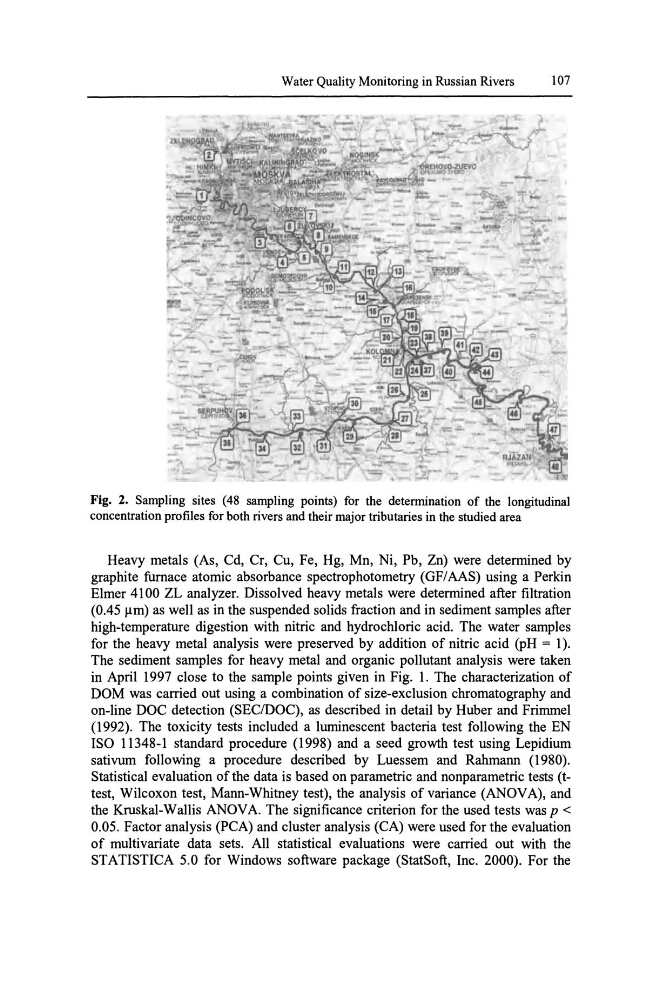
Fig. 2. Sampling sites (48 sampling points) for the determination of the longitudinal
concentration profiles for both rivers and their major tributaries in the studied area
Heavy metals (As, Cd, Cr, Cu, Fe, Hg, Mn, Ni, Pb, Zn) were determined by
graphite furnace atomic absorbance spectrophotometry (GF/AAS) using a Perkin
Elmer 4100 ZL analyzer. Dissolved heavy metals were determined after filtration
(0.45 flm) as well as in the suspended solids fraction and in sediment samples after
high-temperature digestion with nitric and hydrochloric acid. The water samples
for the heavy metal analysis were preserved by addition of nitric acid (PH = 1).
The sediment samples for heavy metal and organic pollutant analysis were taken
in April 1997 close to the sample points given in Fig. 1. The characterization of
DOM was carried out using a combination of size-exclusion chromatography and
on-line DOC detection (SECIDOC), as described in detail by Huber and Frimmel
(1992). The toxicity tests included a luminescent bacteria test following the EN
ISO 11348-1 standard procedure (1998) and a seed growth test using Lepidium
sativum following a procedure described by Luessem and Rahmann (1980).
Statistical evaluation of the data is based on parametric and nonparametric tests (ttest, Wilcoxon test, Mann-Whitney test), the analysis of variance (ANOYA), and
the Kruskal-Wallis ANOYA. The significance criterion for the used tests was p <
0.05. Factor analysis (PCA) and cluster analysis (CA) were used for the evaluation
of multivariate data sets. All statistical evaluations were carried out with the
STATISTICA 5.0 for Windows software package (StatSoft, Inc. 2000). For the
107
Fig. 2. Sampling sites (48 sampling points) for the determination of the longitudinal
concentration profiles for both rivers and their major tributaries in the studied area
Heavy metals (As, Cd, Cr, Cu, Fe, Hg, Mn, Ni, Pb, Zn) were determined by
graphite furnace atomic absorbance spectrophotometry (GF/AAS) using a Perkin
Elmer 4100 ZL analyzer. Dissolved heavy metals were determined after filtration
(0.45 flm) as well as in the suspended solids fraction and in sediment samples after
high-temperature digestion with nitric and hydrochloric acid. The water samples
for the heavy metal analysis were preserved by addition of nitric acid (PH = 1).
The sediment samples for heavy metal and organic pollutant analysis were taken
in April 1997 close to the sample points given in Fig. 1. The characterization of
DOM was carried out using a combination of size-exclusion chromatography and
on-line DOC detection (SECIDOC), as described in detail by Huber and Frimmel
(1992). The toxicity tests included a luminescent bacteria test following the EN
ISO 11348-1 standard procedure (1998) and a seed growth test using Lepidium
sativum following a procedure described by Luessem and Rahmann (1980).
Statistical evaluation of the data is based on parametric and nonparametric tests (ttest, Wilcoxon test, Mann-Whitney test), the analysis of variance (ANOYA), and
the Kruskal-Wallis ANOYA. The significance criterion for the used tests was p <
0.05. Factor analysis (PCA) and cluster analysis (CA) were used for the evaluation
of multivariate data sets. All statistical evaluations were carried out with the
STATISTICA 5.0 for Windows software package (StatSoft, Inc. 2000). For the