

106
T. Gremm et a\.
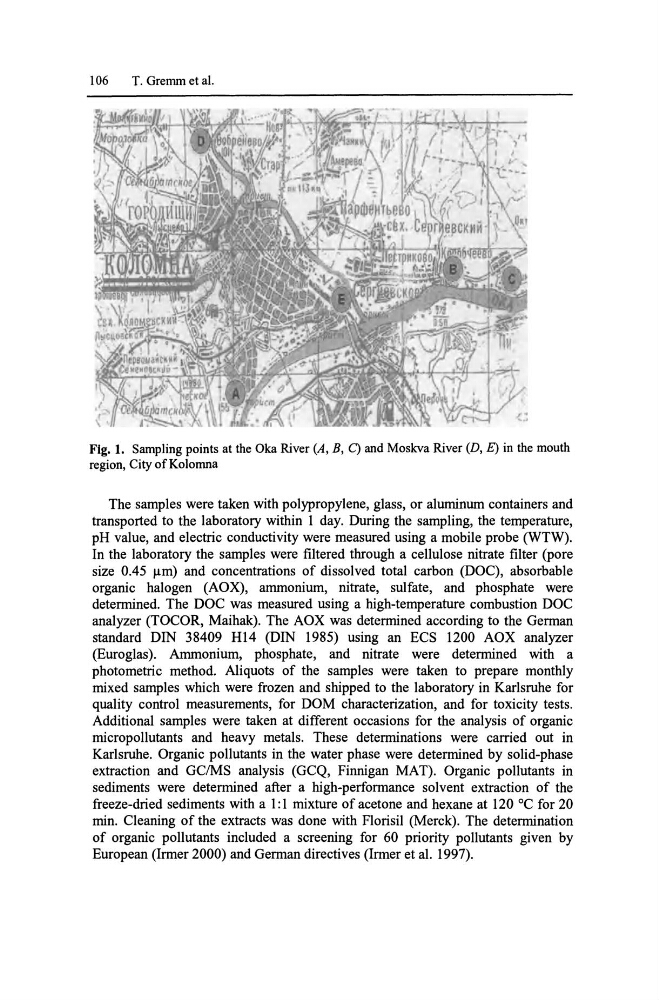
Fig. 1. Sampling points at the Oka River (A, D, C) and Moskva River (D, E) in the mouth
region, City of Kolornna
The samples were taken with polypropylene, glass, or aluminum containers and
transported to the laboratory within 1 day. During the sampling, the temperature,
pH value, and electric conductivity were measured using a mobile probe (WTW).
In the laboratory the samples were filtered through a cellulose nitrate filter (pore
size 0.45 11m) and concentrations of dissolved total carbon (DOC), absorbable
organic halogen (AOX) , ammonium, nitrate, sulfate, and phosphate were
determined. The DOC was measured using a high-temperature combustion DOC
analyzer (TOCOR, Maihak). The AOX was determined according to the German
standard DIN 38409 H14 (DIN 1985) using an ECS 1200 AOX analyzer
(Euroglas). Ammonium, phosphate, and nitrate were determined with a
photometric method. Aliquots of the samples were taken to prepare monthly
mixed samples which were frozen and shipped to the laboratory in Karlsruhe for
quality control measurements, for DOM characterization, and for toxicity tests.
Additional samples were taken at different occasions for the analysis of organic
micropollutants and heavy metals. These determinations were carried out in
Karlsruhe. Organic pollutants in the water phase were determined by solid-phase
extraction and GCIMS analysis (GCQ, Finnigan MAT). Organic pollutants in
sediments were determined after a high-performance solvent extraction of the
freeze-dried sediments with a 1: 1 mixture of acetone and hexane at 120°C for 20
min. Cleaning of the extracts was done with Flonsil (Merck). The determination
of organic pollutants included a screening for 60 priority pollutants given by
European (Irmer 2000) and German directives (Irmer et al. 1997).
T. Gremm et a\.
Fig. 1. Sampling points at the Oka River (A, D, C) and Moskva River (D, E) in the mouth
region, City of Kolornna
The samples were taken with polypropylene, glass, or aluminum containers and
transported to the laboratory within 1 day. During the sampling, the temperature,
pH value, and electric conductivity were measured using a mobile probe (WTW).
In the laboratory the samples were filtered through a cellulose nitrate filter (pore
size 0.45 11m) and concentrations of dissolved total carbon (DOC), absorbable
organic halogen (AOX) , ammonium, nitrate, sulfate, and phosphate were
determined. The DOC was measured using a high-temperature combustion DOC
analyzer (TOCOR, Maihak). The AOX was determined according to the German
standard DIN 38409 H14 (DIN 1985) using an ECS 1200 AOX analyzer
(Euroglas). Ammonium, phosphate, and nitrate were determined with a
photometric method. Aliquots of the samples were taken to prepare monthly
mixed samples which were frozen and shipped to the laboratory in Karlsruhe for
quality control measurements, for DOM characterization, and for toxicity tests.
Additional samples were taken at different occasions for the analysis of organic
micropollutants and heavy metals. These determinations were carried out in
Karlsruhe. Organic pollutants in the water phase were determined by solid-phase
extraction and GCIMS analysis (GCQ, Finnigan MAT). Organic pollutants in
sediments were determined after a high-performance solvent extraction of the
freeze-dried sediments with a 1: 1 mixture of acetone and hexane at 120°C for 20
min. Cleaning of the extracts was done with Flonsil (Merck). The determination
of organic pollutants included a screening for 60 priority pollutants given by
European (Irmer 2000) and German directives (Irmer et al. 1997).