

3.5.2
Mercury
Organometallic Compounds
77
Jensen and Jernelou [240] reported that both mono and dimethylmercury (CH 3 Hg+
and (CH3)2Hg) can be produced in lake sediments and in fish. The gases evolved from
incubated sediment samples were analysed for monomethyl mercury by conversion to
methyl mercury halide by means of gas chromatography, using electron capture and
mass spectrometric detection.
3.5.3
Tin
Muller [241] has described a comprehensive method for determining traces of mono,
di, tri and some tetrasubstituted organotin compounds in lake sediments. The ionic
compounds are extracted from acidified sediment as chlorides using ethereal tropalone solution. The extracted organotin compounds are ethylated using a Grignard
reagent (EtMgBr) and analysed by high resolution gas chromatography with flame
photometric and mass spectrometric detection. Ethylation using ethyl magnesium
bromide was chosen for conversion of the various mono, di and trisubstituted organotin compounds in sediments into tetrasubstituted ones. Ethylation was preferred
over either methylation or alkylation using a larger alkyl group because methylation
of tin (IV) and butyltin species seems to occur in the environment leading to methyltins and mixed methylalkyltins. Further methylation of these environmental metabolites in the derivatization step would exclude the possibility of determining these
conversion and degradation products. The ethylation reaction of these compounds
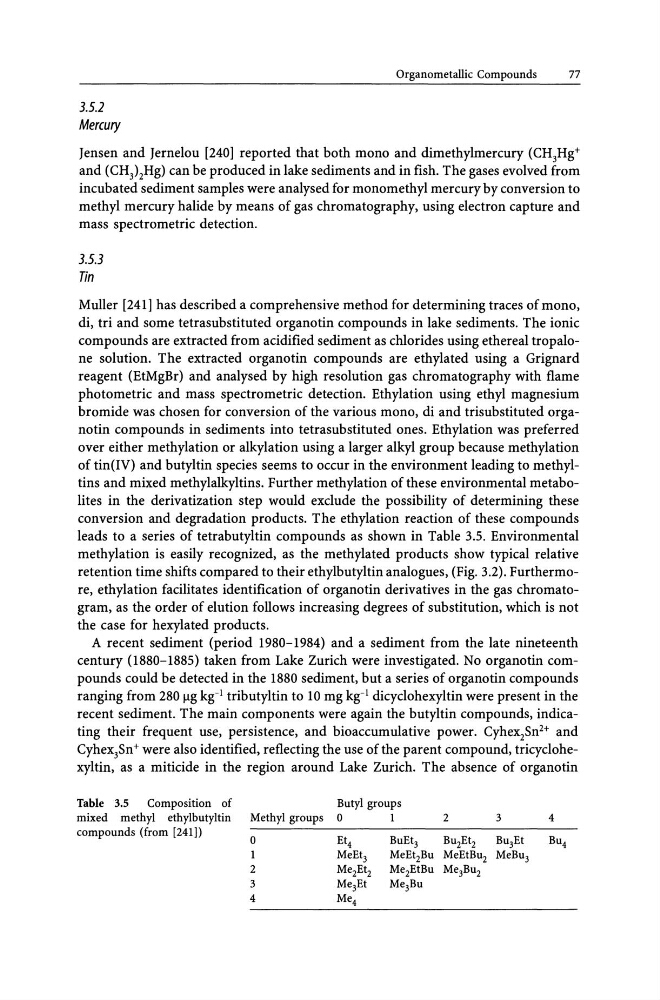
leads to a series of tetrabutyltin compounds as shown in Table 3.5. Environmental
methylation is easily recognized, as the methylated products show typical relative
retention time shifts compared to their ethylbutyltin analogues, (Fig. 3.2). Furthermore, ethylation facilitates identification of organotin derivatives in the gas chromatogram, as the order of elution follows increasing degrees of substitution, which is not
the case for hexylated products.
A recent sediment (period 1980-1984) and a sediment from the late nineteenth
century (1880-1885) taken from Lake Zurich were investigated. No organotin compounds could be detected in the 1880 sediment, but a series of organotin compounds
ranging from 280 I!S kg- 1 tributyltin to 10 mg kg-l dicyclohexyltin were present in the
recent sediment. The main components were again the butyltin compounds, indicating their frequent use, persistence, and bioaccumulative power. Cyhe~Sn2+ and
Cyhex 3 Sn+ were also identified, reflecting the use of the parent compound, tricyclohexyltin, as a miticide in the region around Lake Zurich. The absence of organotin
Table 3.5 Composition of
Butyl groups
mixed methyl ethylbutyltin Methyl groups 0
1
2
3
4
compounds (from (241))
0
Et4
BuEt 3
Bu 2 Et 2 Bu 3 Et
BU 4
MeEt3
MeEt 2 Bu MeEtBu 2 MeBu 3
2
Me 2 Et 2 Me 2 EtBu Me 3 Bu 2
3
Me 3 Et
Me 3 Bu
4
Me 4
Mercury
Organometallic Compounds
77
Jensen and Jernelou [240] reported that both mono and dimethylmercury (CH 3 Hg+
and (CH3)2Hg) can be produced in lake sediments and in fish. The gases evolved from
incubated sediment samples were analysed for monomethyl mercury by conversion to
methyl mercury halide by means of gas chromatography, using electron capture and
mass spectrometric detection.
3.5.3
Tin
Muller [241] has described a comprehensive method for determining traces of mono,
di, tri and some tetrasubstituted organotin compounds in lake sediments. The ionic
compounds are extracted from acidified sediment as chlorides using ethereal tropalone solution. The extracted organotin compounds are ethylated using a Grignard
reagent (EtMgBr) and analysed by high resolution gas chromatography with flame
photometric and mass spectrometric detection. Ethylation using ethyl magnesium
bromide was chosen for conversion of the various mono, di and trisubstituted organotin compounds in sediments into tetrasubstituted ones. Ethylation was preferred
over either methylation or alkylation using a larger alkyl group because methylation
of tin (IV) and butyltin species seems to occur in the environment leading to methyltins and mixed methylalkyltins. Further methylation of these environmental metabolites in the derivatization step would exclude the possibility of determining these
conversion and degradation products. The ethylation reaction of these compounds
leads to a series of tetrabutyltin compounds as shown in Table 3.5. Environmental
methylation is easily recognized, as the methylated products show typical relative
retention time shifts compared to their ethylbutyltin analogues, (Fig. 3.2). Furthermore, ethylation facilitates identification of organotin derivatives in the gas chromatogram, as the order of elution follows increasing degrees of substitution, which is not
the case for hexylated products.
A recent sediment (period 1980-1984) and a sediment from the late nineteenth
century (1880-1885) taken from Lake Zurich were investigated. No organotin compounds could be detected in the 1880 sediment, but a series of organotin compounds
ranging from 280 I!S kg- 1 tributyltin to 10 mg kg-l dicyclohexyltin were present in the
recent sediment. The main components were again the butyltin compounds, indicating their frequent use, persistence, and bioaccumulative power. Cyhe~Sn2+ and
Cyhex 3 Sn+ were also identified, reflecting the use of the parent compound, tricyclohexyltin, as a miticide in the region around Lake Zurich. The absence of organotin
Table 3.5 Composition of
Butyl groups
mixed methyl ethylbutyltin Methyl groups 0
1
2
3
4
compounds (from (241))
0
Et4
BuEt 3
Bu 2 Et 2 Bu 3 Et
BU 4
MeEt3
MeEt 2 Bu MeEtBu 2 MeBu 3
2
Me 2 Et 2 Me 2 EtBu Me 3 Bu 2
3
Me 3 Et
Me 3 Bu
4
Me 4