

76
Lake and Pond Sediments
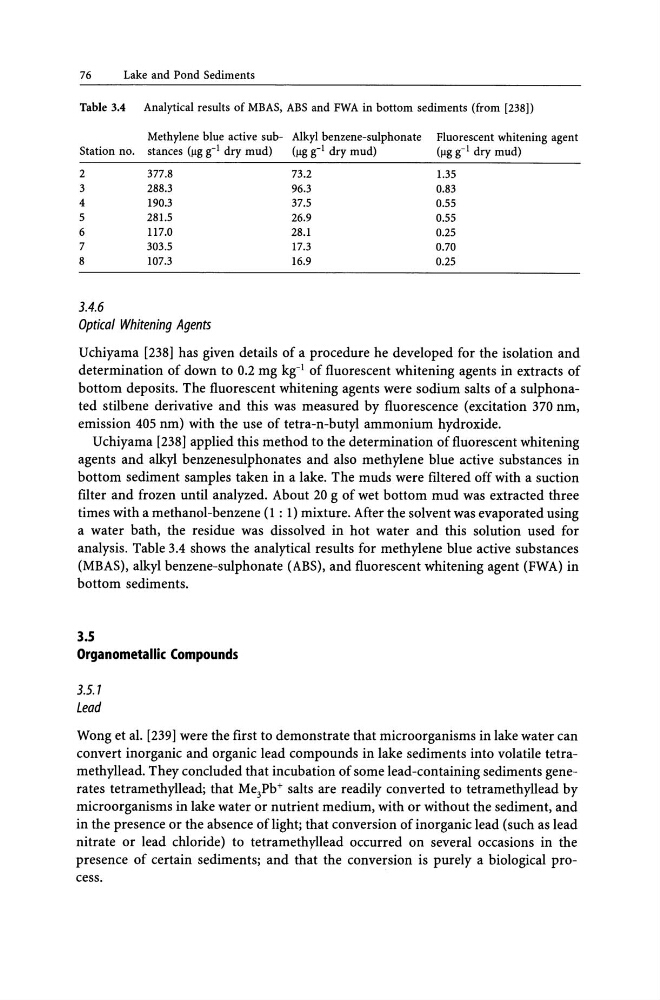
Table 3.4
Analytical results of MBAS, ABS and FWA in bottom sediments (from [238])
Methylene blue active sub- Alkyl benzene-sulphonate
Station no. stances (J.1g g-l dry mud)
(J.1g g-l dry mud)
2
377.8
73.2
3
288.3
96.3
4
190.3
37.5
5
281.5
26.9
6
117.0
28.1
7
303.5
17.3
8
107.3
16.9
3.4.6
Optical Whitening Agents
Fluorescent whitening agent
(J.1g g-l dry mud)
1.35
0.83
0.55
0.55
0.25
0.70
0.25
Uchiyama [238] has given details of a procedure he developed for the isolation and
determination of down to 0.2 mg kg- 1 of fluorescent whitening agents in extracts of
bottom deposits. The fluorescent whitening agents were sodium salts of a sulphonated stilbene derivative and this was measured by fluorescence (excitation 370 nm,
emission 405 nm) with the use of tetra-n-butyl ammonium hydroxide.
Uchiyama [238] applied this method to the determination of fluorescent whitening
agents and alkyl benzenesulphonates and also methylene blue active substances in
bottom sediment samples taken in a lake. The muds were filtered off with a suction
filter and frozen until analyzed. About 20 g of wet bottom mud was extracted three
times with a methanol-benzene (1 : l) mixture. After the solvent was evaporated using
a water bath, the residue was dissolved in hot water and this solution used for
analysis. Table 3.4 shows the analytical results for methylene blue active substances
(MBAS), alkyl benzene-sulphonate (ABS), and fluorescent whitening agent (FWA) in
bottom sediments.
3.S
Organometallic Compounds
3.5.7
Lead
Wong et a1. [239] were the first to demonstrate that microorganisms in lake water can
convert inorganic and organic lead compounds in lake sediments into volatile tetramethyllead. They concluded that incubation of some lead-containing sediments generates tetramethyllead; that Me 3 Pb+ salts are readily converted to tetramethyllead by
microorganisms in lake water or nutrient medium, with or without the sediment, and
in the presence or the absence oflight; that conversion of inorganic lead (such as lead
nitrate or lead chloride) to tetramethyllead occurred on several occasions in the
presence of certain sediments; and that the conversion is purely a biological process.
Lake and Pond Sediments
Table 3.4
Analytical results of MBAS, ABS and FWA in bottom sediments (from [238])
Methylene blue active sub- Alkyl benzene-sulphonate
Station no. stances (J.1g g-l dry mud)
(J.1g g-l dry mud)
2
377.8
73.2
3
288.3
96.3
4
190.3
37.5
5
281.5
26.9
6
117.0
28.1
7
303.5
17.3
8
107.3
16.9
3.4.6
Optical Whitening Agents
Fluorescent whitening agent
(J.1g g-l dry mud)
1.35
0.83
0.55
0.55
0.25
0.70
0.25
Uchiyama [238] has given details of a procedure he developed for the isolation and
determination of down to 0.2 mg kg- 1 of fluorescent whitening agents in extracts of
bottom deposits. The fluorescent whitening agents were sodium salts of a sulphonated stilbene derivative and this was measured by fluorescence (excitation 370 nm,
emission 405 nm) with the use of tetra-n-butyl ammonium hydroxide.
Uchiyama [238] applied this method to the determination of fluorescent whitening
agents and alkyl benzenesulphonates and also methylene blue active substances in
bottom sediment samples taken in a lake. The muds were filtered off with a suction
filter and frozen until analyzed. About 20 g of wet bottom mud was extracted three
times with a methanol-benzene (1 : l) mixture. After the solvent was evaporated using
a water bath, the residue was dissolved in hot water and this solution used for
analysis. Table 3.4 shows the analytical results for methylene blue active substances
(MBAS), alkyl benzene-sulphonate (ABS), and fluorescent whitening agent (FWA) in
bottom sediments.
3.S
Organometallic Compounds
3.5.7
Lead
Wong et a1. [239] were the first to demonstrate that microorganisms in lake water can
convert inorganic and organic lead compounds in lake sediments into volatile tetramethyllead. They concluded that incubation of some lead-containing sediments generates tetramethyllead; that Me 3 Pb+ salts are readily converted to tetramethyllead by
microorganisms in lake water or nutrient medium, with or without the sediment, and
in the presence or the absence oflight; that conversion of inorganic lead (such as lead
nitrate or lead chloride) to tetramethyllead occurred on several occasions in the
presence of certain sediments; and that the conversion is purely a biological process.