

78
Lake and Pond Sediments
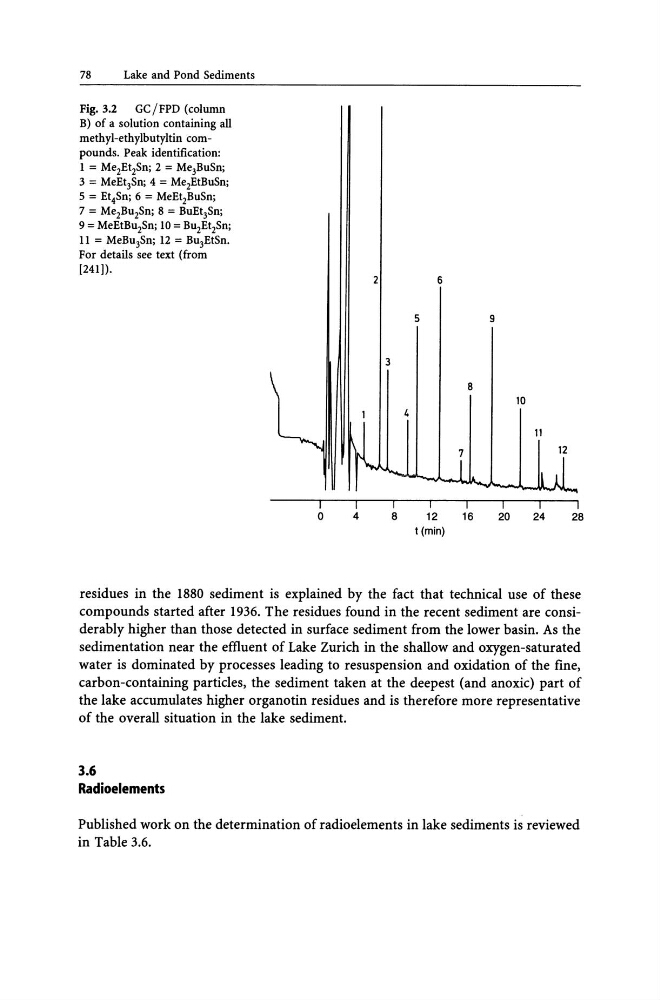
Fig. 3.2
GC/FPD (column
B) of a solution containing all
methyl-ethylbutyltin compounds. Peak identification:
1 = Me 2 Et 2 Sn; 2 = Me 3 BuSn;
3 = MeEt 3 Sn; 4 = Me 2 EtBuSn;
5 = Et 4 Sn; 6 = MeEt 2 BuSn;
7 = Me 2 Bu 2 Sn; 8 = BuEt 3 Sn;
9 = MeEtBu 2 Sn; 10 = Bu 2 Et 2 Sn;
11 = MeBu 3 Sn; 12 = Bu 3 EtSn.
For details see text (from
[241]).
~ ~
I
I
0
4
6
5
3
4
I........
I
I
8
12
t(min)
9
8
10
11
I
12
II J .....
I
I
I
I
16
20
24
28
residues in the 1880 sediment is explained by the fact that technical use of these
compounds started after 1936. The residues found in the recent sediment are considerably higher than those detected in surface sediment from the lower basin. As the
sedimentation near the effluent of Lake Zurich in the shallow and oxygen-saturated
water is dominated by processes leading to resuspension and oxidation of the fine,
carbon-containing particles, the sediment taken at the deepest (and anoxic) part of
the lake accumulates higher organotin residues and is therefore more representative
of the overall situation in the lake sediment.
3.6
Radioelements
Published work on the determination of radioelements in lake sediments is reviewed
in Table 3.6.
Lake and Pond Sediments
Fig. 3.2
GC/FPD (column
B) of a solution containing all
methyl-ethylbutyltin compounds. Peak identification:
1 = Me 2 Et 2 Sn; 2 = Me 3 BuSn;
3 = MeEt 3 Sn; 4 = Me 2 EtBuSn;
5 = Et 4 Sn; 6 = MeEt 2 BuSn;
7 = Me 2 Bu 2 Sn; 8 = BuEt 3 Sn;
9 = MeEtBu 2 Sn; 10 = Bu 2 Et 2 Sn;
11 = MeBu 3 Sn; 12 = Bu 3 EtSn.
For details see text (from
[241]).
~ ~
I
I
0
4
6
5
3
4
I........
I
I
8
12
t(min)
9
8
10
11
I
12
II J .....
I
I
I
I
16
20
24
28
residues in the 1880 sediment is explained by the fact that technical use of these
compounds started after 1936. The residues found in the recent sediment are considerably higher than those detected in surface sediment from the lower basin. As the
sedimentation near the effluent of Lake Zurich in the shallow and oxygen-saturated
water is dominated by processes leading to resuspension and oxidation of the fine,
carbon-containing particles, the sediment taken at the deepest (and anoxic) part of
the lake accumulates higher organotin residues and is therefore more representative
of the overall situation in the lake sediment.
3.6
Radioelements
Published work on the determination of radioelements in lake sediments is reviewed
in Table 3.6.