

40
River and Stream Sediments
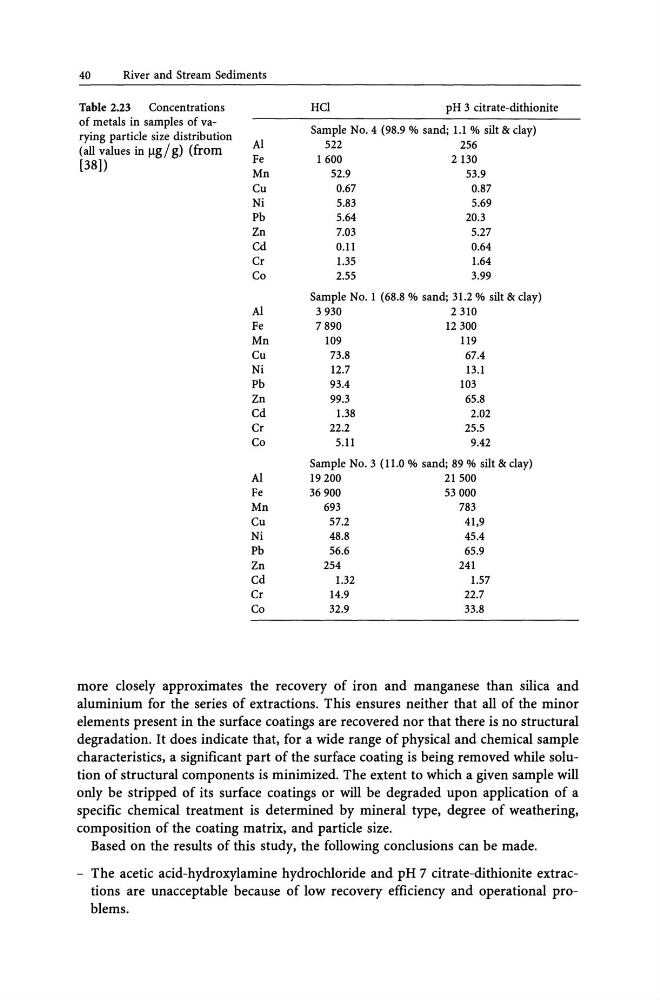
Table 2.23
Concentrations
of metals in samples of varying particle size distribution
(all values in Ilgj g) (from
[38])
AI
Fe
Mn
Cu
Ni
Pb
Zn
Cd
Cr
Co
HCI
pH 3 citrate-dithionite
Sample No.4 (98.9 % sand; l.l % silt & clay)
522
256
1600
2130
52.9
53.9
0.67
0.87
5.83
5.69
5.64
20.3
7.03
5.27
0.11
0.64
1.35
1.64
2.55
3.99
Sample No.1 (68.8 % sand; 31.2 % silt & clay)
Al
3930
2310
Fe
Mn
Cu
Ni
Pb
Zn
Cd
Cr
Co
7890
12300
109
119
73.8
67.4
12.7
13.1
93.4
103
99.3
65.8
1.38
2.02
22.2
25.5
5.11
9.42
Sample No.3 (I 1.0 % sand; 89 % silt & clay)
AI
19200
21 500
Fe
Mn
Cu
Ni
Pb
Zn
Cd
Cr
Co
36900
693
57.2
48.8
56.6
254
1.32
14.9
32.9
53000
783
41,9
45.4
65.9
241
1.57
22.7
33.8
more closely approximates the recovery of iron and manganese than silica and
aluminium for the series of extractions. This ensures neither that all of the minor
elements present in the surface coatings are recovered nor that there is no structural
degradation. It does indicate that, for a wide range of physical and chemical sample
characteristics, a significant part of the surface coating is being removed while solution of structural components is minimized. The extent to which a given sample will
only be stripped of its surface coatings or will be degraded upon application of a
specific chemical treatment is determined by mineral type, degree of weathering,
composition of the coating matrix, and particle size.
Based on the results of this study, the following conclusions can be made.
- The acetic acid-hydroxylamine hydrochloride and pH 7 citrate-dithionite extractions are unacceptable because of low recovery efficiency and operational problems.
River and Stream Sediments
Table 2.23
Concentrations
of metals in samples of varying particle size distribution
(all values in Ilgj g) (from
[38])
AI
Fe
Mn
Cu
Ni
Pb
Zn
Cd
Cr
Co
HCI
pH 3 citrate-dithionite
Sample No.4 (98.9 % sand; l.l % silt & clay)
522
256
1600
2130
52.9
53.9
0.67
0.87
5.83
5.69
5.64
20.3
7.03
5.27
0.11
0.64
1.35
1.64
2.55
3.99
Sample No.1 (68.8 % sand; 31.2 % silt & clay)
Al
3930
2310
Fe
Mn
Cu
Ni
Pb
Zn
Cd
Cr
Co
7890
12300
109
119
73.8
67.4
12.7
13.1
93.4
103
99.3
65.8
1.38
2.02
22.2
25.5
5.11
9.42
Sample No.3 (I 1.0 % sand; 89 % silt & clay)
AI
19200
21 500
Fe
Mn
Cu
Ni
Pb
Zn
Cd
Cr
Co
36900
693
57.2
48.8
56.6
254
1.32
14.9
32.9
53000
783
41,9
45.4
65.9
241
1.57
22.7
33.8
more closely approximates the recovery of iron and manganese than silica and
aluminium for the series of extractions. This ensures neither that all of the minor
elements present in the surface coatings are recovered nor that there is no structural
degradation. It does indicate that, for a wide range of physical and chemical sample
characteristics, a significant part of the surface coating is being removed while solution of structural components is minimized. The extent to which a given sample will
only be stripped of its surface coatings or will be degraded upon application of a
specific chemical treatment is determined by mineral type, degree of weathering,
composition of the coating matrix, and particle size.
Based on the results of this study, the following conclusions can be made.
- The acetic acid-hydroxylamine hydrochloride and pH 7 citrate-dithionite extractions are unacceptable because of low recovery efficiency and operational problems.