

100~~==================J
80
Cl
c: 60
'2
'iii
E
!!!
"E Q)
e
~ 40
20
o~--------~~~==~====----~
o
2
3
Extraction number
Metals
41
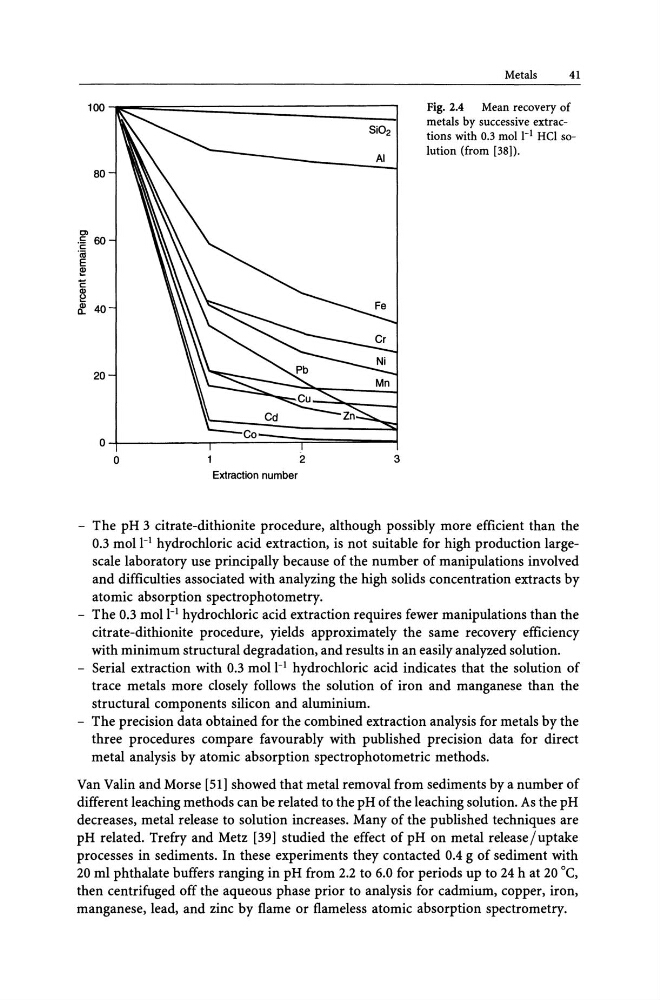
Fig. 2.4 Mean recovery of
metals by successive extractions with 0.3 mol I-I Hel solution (from [38]).
- The pH 3 citrate-dithionite procedure, although possibly more efficient than the
0.3 mol 1-1 hydrochloric acid extraction, is not suitable for high production largescale laboratory use principally because of the number of manipulations involved
and difficulties associated with analyzing the high solids concentration extracts by
atomic absorption spectrophotometry.
- The 0.3 mol 1-1 hydrochloric acid extraction requires fewer manipulations than the
citrate-dithionite procedure, yields approximately the same recovery efficiency
with minimum structural degradation, and results in an easily analyzed solution.
- Serial extraction with 0.3 mol 1-1 hydrochloric acid indicates that the solution of
trace metals more closely follows the solution of iron and manganese than the
structural components silicon and aluminium.
- The precision data obtained for the combined extraction analysis for metals by the
three procedures compare favourably with published precision data for direct
metal analysis by atomic absorption spectrophotometric methods.
Van Valin and Morse [51] showed that metal removal from sediments by a number of
different leaching methods can be related to the pH of the leaching solution. As the pH
decreases, metal release to solution increases. Many of the published techniques are
pH related. Trefry and Metz [39] studied the effect of pH on metal release / uptake
processes in sediments. In these experiments they contacted 0.4 g of sediment with
20 ml phthalate buffers ranging in pH from 2.2 to 6.0 for periods up to 24 h at 20°C,
then centrifuged off the aqueous phase prior to analysis for cadmium, copper, iron,
manganese, lead, and zinc by flame or flameless atomic absorption spectrometry.
80
Cl
c: 60
'2
'iii
E
!!!
"E Q)
e
~ 40
20
o~--------~~~==~====----~
o
2
3
Extraction number
Metals
41
Fig. 2.4 Mean recovery of
metals by successive extractions with 0.3 mol I-I Hel solution (from [38]).
- The pH 3 citrate-dithionite procedure, although possibly more efficient than the
0.3 mol 1-1 hydrochloric acid extraction, is not suitable for high production largescale laboratory use principally because of the number of manipulations involved
and difficulties associated with analyzing the high solids concentration extracts by
atomic absorption spectrophotometry.
- The 0.3 mol 1-1 hydrochloric acid extraction requires fewer manipulations than the
citrate-dithionite procedure, yields approximately the same recovery efficiency
with minimum structural degradation, and results in an easily analyzed solution.
- Serial extraction with 0.3 mol 1-1 hydrochloric acid indicates that the solution of
trace metals more closely follows the solution of iron and manganese than the
structural components silicon and aluminium.
- The precision data obtained for the combined extraction analysis for metals by the
three procedures compare favourably with published precision data for direct
metal analysis by atomic absorption spectrophotometric methods.
Van Valin and Morse [51] showed that metal removal from sediments by a number of
different leaching methods can be related to the pH of the leaching solution. As the pH
decreases, metal release to solution increases. Many of the published techniques are
pH related. Trefry and Metz [39] studied the effect of pH on metal release / uptake
processes in sediments. In these experiments they contacted 0.4 g of sediment with
20 ml phthalate buffers ranging in pH from 2.2 to 6.0 for periods up to 24 h at 20°C,
then centrifuged off the aqueous phase prior to analysis for cadmium, copper, iron,
manganese, lead, and zinc by flame or flameless atomic absorption spectrometry.