

8.2.11
Coprostanol
Organics
209
Matusik et al. [613] used capillary column gas chromatography to separated coprostanol, and mass spectrometry in the electron ionization mode was used to confirm its
identity at the 75 ng level in sewage-contaminated crustacea.
8.2.12
Arsenobetaine
Francesconi et al. [614] give details of equipment and a procedure to identify and
determine arsenic compounds in species of crab, Alaskan King crab (Paralithodes
camtschatica), Alaskan snow crab (Chinocetee bairdii), and Dungeness crab (Cancer
Magister), using high performance liquid chromatography and inductively coupled
plasma atomic emission spectrometry. The only water-soluble arsenic compound in
the crabs was the organic compound, arsenobetaine.
8.2.13
Neutral Priority Pollutants
The extraction gas chromatographic procedure [316] for determining neutral priority
pollutants, described under neutral priority pollutants in Sect. 7.3.24, has been used to
determine these substances in mussel homogenates. The tissue was macerated with
distilled water in a blender, anhydrous sodium sulphate was added, and the mixture
ground until dry and powdery. The powder was sonified with acetonitrile and the
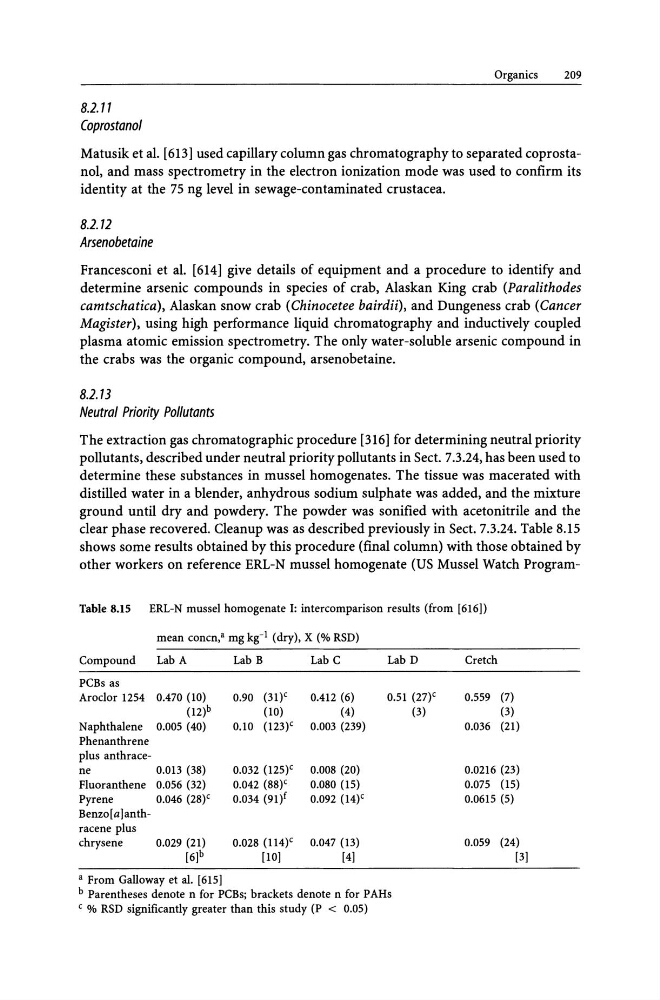
clear phase recovered. Cleanup was as described previously in Sect. 7.3.24. Table 8.15
shows some results obtained by this procedure (fmal column) with those obtained by
other workers on reference ERL-N mussel homogenate (US Mussel Watch ProgramTable 8.15
ERL-N mussel homogenate I: intercomparison results (from [616])
mean concn,· mg kg- 1 (dry), X (% RSD)
Compound
Lab A
Lab B
Lab C
Lab D
PCBs as
Aroclor 1254 0.470 (10)
0.90 (31)C
0.412 (6)
0.51 (27)C
(12)b
(10)
(4)
(3)
Naphthalene 0.005 (40)
0.10 (123)C
0.003 (239)
Phenanthrene
plus anthracene
0.013 (38)
0.032 (125)C
0.008 (20)
Fluoranthene 0.056 (32)
0.042 (88)C
0.080 (15)
Pyrene
0.046 (28)C
0.034 (91)f
0.092 (14)C
Benzo[a)anthracene plus
chrysene
0.029 (21)
0.028 (114)C
0.047 (13)
(6)b
(10)
(4)
• From Galloway et al. (615)
b Parentheses denote n for PCBs; brackets denote n for P AHs
C % RSD significantly greater than this study (P < 0.05)
Cretch
0.559 (7)
(3)
0.036 (21)
0.0216 (23)
0.075 (15)
0.0615 (5)
0.059 (24)
(3)
Coprostanol
Organics
209
Matusik et al. [613] used capillary column gas chromatography to separated coprostanol, and mass spectrometry in the electron ionization mode was used to confirm its
identity at the 75 ng level in sewage-contaminated crustacea.
8.2.12
Arsenobetaine
Francesconi et al. [614] give details of equipment and a procedure to identify and
determine arsenic compounds in species of crab, Alaskan King crab (Paralithodes
camtschatica), Alaskan snow crab (Chinocetee bairdii), and Dungeness crab (Cancer
Magister), using high performance liquid chromatography and inductively coupled
plasma atomic emission spectrometry. The only water-soluble arsenic compound in
the crabs was the organic compound, arsenobetaine.
8.2.13
Neutral Priority Pollutants
The extraction gas chromatographic procedure [316] for determining neutral priority
pollutants, described under neutral priority pollutants in Sect. 7.3.24, has been used to
determine these substances in mussel homogenates. The tissue was macerated with
distilled water in a blender, anhydrous sodium sulphate was added, and the mixture
ground until dry and powdery. The powder was sonified with acetonitrile and the
clear phase recovered. Cleanup was as described previously in Sect. 7.3.24. Table 8.15
shows some results obtained by this procedure (fmal column) with those obtained by
other workers on reference ERL-N mussel homogenate (US Mussel Watch ProgramTable 8.15
ERL-N mussel homogenate I: intercomparison results (from [616])
mean concn,· mg kg- 1 (dry), X (% RSD)
Compound
Lab A
Lab B
Lab C
Lab D
PCBs as
Aroclor 1254 0.470 (10)
0.90 (31)C
0.412 (6)
0.51 (27)C
(12)b
(10)
(4)
(3)
Naphthalene 0.005 (40)
0.10 (123)C
0.003 (239)
Phenanthrene
plus anthracene
0.013 (38)
0.032 (125)C
0.008 (20)
Fluoranthene 0.056 (32)
0.042 (88)C
0.080 (15)
Pyrene
0.046 (28)C
0.034 (91)f
0.092 (14)C
Benzo[a)anthracene plus
chrysene
0.029 (21)
0.028 (114)C
0.047 (13)
(6)b
(10)
(4)
• From Galloway et al. (615)
b Parentheses denote n for PCBs; brackets denote n for P AHs
C % RSD significantly greater than this study (P < 0.05)
Cretch
0.559 (7)
(3)
0.036 (21)
0.0216 (23)
0.075 (15)
0.0615 (5)
0.059 (24)
(3)