

210
Crustacea and Molluscs
me sample). With the exception of benzo(a)anthracene plus chrysene, the mean
concentrations obtained by Ozretich et al. [316] were within the range of mean values
reported by the laboratories involved in the intercomparison study [615].
8.2.14
Ascorbic Acid-2-sulphate
Wels et al. [742] determined this substance by solid phase extraction of the cystis of
the brine shrimp Artemia franciscona.
8.2.15
Miscellaneous Organic Compounds
Siriaks et al. [744] used chelation ion chromatography.
8.3
Organometallic Compounds
8.3.1
Lead
Birnie and Hodges [616] have described the combination of solvent extraction and
differential pulse anodic scanning voltammetric techniques for the isolation and
determination of trialkyllead (Et 3 Pb+, Me 3 Pb+) and dialkyllead (Et 2 Pb2+ Me 2 Pb2+)
species in oyster and macuma.
In this method, the sample is homogenised in the presence of a mixture of salts
(lead nitrate, sodium benzoate, potassium iodide, sodium chloride) which effectively
releases the di- and trialkyllead species present and facilitates their transfer to toluene
as a preliminary to back extraction into dilute nitric acid. The differentiation and
determination of the alkyl lead species is achieved by differential pulse anodic stripping voltammetry. The efficiency of the extraction procedure was examined at alkyl
lead concentrations up to 2 mg kg- 1 as lead, and a detection limit of 0.01 mg kg- 1 was
established. The recovery of ionic diethyllead and the two trialkyllead species from
various marine vertebrates and molluscs was in the range 80-90 % whilst that of
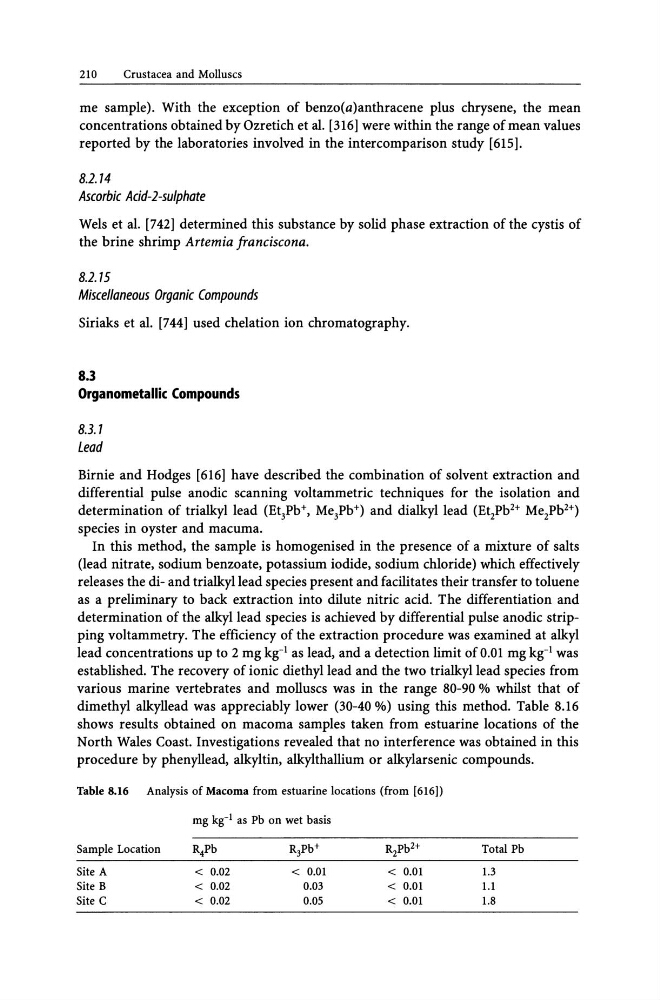
dimethyl alkyllead was appreciably lower (30-40 %) using this method. Table 8.16
shows results obtained on macoma samples taken from estuarine locations of the
North Wales Coast. Investigations revealed that no interference was obtained in this
procedure by phenyllead, alkyltin, alkylthallium or alkylarsenic compounds.
Table 8.16 Analysis of Macoma from estuarine locations (from [616])
Sample Location
Site A
Site B
Site C
mg kg- 1 as Pb on wet basis
< 0.02
< 0.02
< 0.02
< 0.01
0.03
0.05
< 0.01
< 0.01
1.3
1.1
1.8
Crustacea and Molluscs
me sample). With the exception of benzo(a)anthracene plus chrysene, the mean
concentrations obtained by Ozretich et al. [316] were within the range of mean values
reported by the laboratories involved in the intercomparison study [615].
8.2.14
Ascorbic Acid-2-sulphate
Wels et al. [742] determined this substance by solid phase extraction of the cystis of
the brine shrimp Artemia franciscona.
8.2.15
Miscellaneous Organic Compounds
Siriaks et al. [744] used chelation ion chromatography.
8.3
Organometallic Compounds
8.3.1
Lead
Birnie and Hodges [616] have described the combination of solvent extraction and
differential pulse anodic scanning voltammetric techniques for the isolation and
determination of trialkyllead (Et 3 Pb+, Me 3 Pb+) and dialkyllead (Et 2 Pb2+ Me 2 Pb2+)
species in oyster and macuma.
In this method, the sample is homogenised in the presence of a mixture of salts
(lead nitrate, sodium benzoate, potassium iodide, sodium chloride) which effectively
releases the di- and trialkyllead species present and facilitates their transfer to toluene
as a preliminary to back extraction into dilute nitric acid. The differentiation and
determination of the alkyl lead species is achieved by differential pulse anodic stripping voltammetry. The efficiency of the extraction procedure was examined at alkyl
lead concentrations up to 2 mg kg- 1 as lead, and a detection limit of 0.01 mg kg- 1 was
established. The recovery of ionic diethyllead and the two trialkyllead species from
various marine vertebrates and molluscs was in the range 80-90 % whilst that of
dimethyl alkyllead was appreciably lower (30-40 %) using this method. Table 8.16
shows results obtained on macoma samples taken from estuarine locations of the
North Wales Coast. Investigations revealed that no interference was obtained in this
procedure by phenyllead, alkyltin, alkylthallium or alkylarsenic compounds.
Table 8.16 Analysis of Macoma from estuarine locations (from [616])
Sample Location
Site A
Site B
Site C
mg kg- 1 as Pb on wet basis
< 0.02
< 0.02
< 0.02
< 0.01
0.03
0.05
< 0.01
< 0.01
1.3
1.1
1.8