

172
Fish
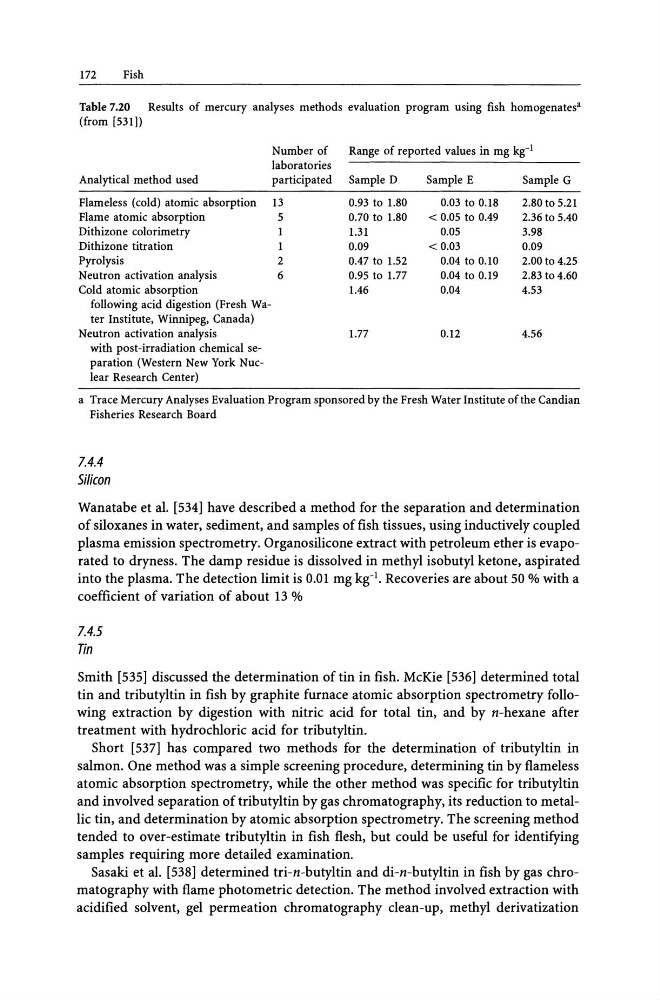
Table 7.20 Results of mercury analyses methods evaluation program using fish homogenates'
(from [531])
Number of
laboratories
Analytical method used
participated
Flameless (cold) atomic absorption 13
Flame atomic absorption
5
Dithizone colorimetry
1
Dithizone titration
Pyrolysis
2
Neutron activation analysis
6
Cold atomic absorption
following acid digestion (Fresh Water Institute, Winnipeg, Canada)
Neutron activation analysis
with post-irradiation chemical separation (Western New York Nuclear Research Center)
Range of reported values in mg kg- 1
Sample D
Sample E
Sample G
0.93 to 1.80
0.03 to 0.18
2.80 to 5.21
0.70 to 1.80
< 0.05 to 0.49
2.36 to 5.40
1.31
0.05
3.98
0.09
< 0.03
0.09
0.47 to 1.52
0.04 to 0.10
2.00 to 4.25
0.95 to 1.77
0.04 to 0.19
2.83 to 4.60
1.46
0.04
4.53
1.77
0.12
4.56
a Trace Mercury Analyses Evaluation Program sponsored by the Fresh Water Institute of the Candian
Fisheries Research Board
7.4.4
Silicon
Wanatabe et al. [534] have described a method for the separation and determination
of siloxanes in water, sediment, and samples of fish tissues, using inductively coupled
plasma emission spectrometry. Organosilicone extract with petroleum ether is evaporated to dryness. The damp residue is dissolved in methyl isobutyl ketone, aspirated
into the plasma. The detection limit is 0.01 mg kg-I. Recoveries are about 50 % with a
coefficient of variation of about 13 %
7.4.5
Tin
Smith [535] discussed the determination of tin in fish. McKie [536] determined total
tin and tributyltin in fish by graphite furnace atomic absorption spectrometry following extraction by digestion with nitric acid for total tin, and by n-hexane after
treatment with hydrochloric acid for tributyltin.
Short [537] has compared two methods for the determination of tributyltin in
salmon. One method was a simple screening procedure, determining tin by flameless
atomic absorption spectrometry, while the other method was specific for tributyltin
and involved separation of tributyltin by gas chromatography, its reduction to metallic tin, and determination by atomic absorption spectrometry. The screening method
tended to over-estimate tributyltin in fish flesh, but could be useful for identifying
samples requiring more detailed examination.
Sasaki et al. [538] determined tri-n-butyltin and di-n-butyltin in fish by gas chromatography with flame photometric detection. The method involved extraction with
acidified solvent, gel permeation chromatography clean-up, methyl derivatization
Fish
Table 7.20 Results of mercury analyses methods evaluation program using fish homogenates'
(from [531])
Number of
laboratories
Analytical method used
participated
Flameless (cold) atomic absorption 13
Flame atomic absorption
5
Dithizone colorimetry
1
Dithizone titration
Pyrolysis
2
Neutron activation analysis
6
Cold atomic absorption
following acid digestion (Fresh Water Institute, Winnipeg, Canada)
Neutron activation analysis
with post-irradiation chemical separation (Western New York Nuclear Research Center)
Range of reported values in mg kg- 1
Sample D
Sample E
Sample G
0.93 to 1.80
0.03 to 0.18
2.80 to 5.21
0.70 to 1.80
< 0.05 to 0.49
2.36 to 5.40
1.31
0.05
3.98
0.09
< 0.03
0.09
0.47 to 1.52
0.04 to 0.10
2.00 to 4.25
0.95 to 1.77
0.04 to 0.19
2.83 to 4.60
1.46
0.04
4.53
1.77
0.12
4.56
a Trace Mercury Analyses Evaluation Program sponsored by the Fresh Water Institute of the Candian
Fisheries Research Board
7.4.4
Silicon
Wanatabe et al. [534] have described a method for the separation and determination
of siloxanes in water, sediment, and samples of fish tissues, using inductively coupled
plasma emission spectrometry. Organosilicone extract with petroleum ether is evaporated to dryness. The damp residue is dissolved in methyl isobutyl ketone, aspirated
into the plasma. The detection limit is 0.01 mg kg-I. Recoveries are about 50 % with a
coefficient of variation of about 13 %
7.4.5
Tin
Smith [535] discussed the determination of tin in fish. McKie [536] determined total
tin and tributyltin in fish by graphite furnace atomic absorption spectrometry following extraction by digestion with nitric acid for total tin, and by n-hexane after
treatment with hydrochloric acid for tributyltin.
Short [537] has compared two methods for the determination of tributyltin in
salmon. One method was a simple screening procedure, determining tin by flameless
atomic absorption spectrometry, while the other method was specific for tributyltin
and involved separation of tributyltin by gas chromatography, its reduction to metallic tin, and determination by atomic absorption spectrometry. The screening method
tended to over-estimate tributyltin in fish flesh, but could be useful for identifying
samples requiring more detailed examination.
Sasaki et al. [538] determined tri-n-butyltin and di-n-butyltin in fish by gas chromatography with flame photometric detection. The method involved extraction with
acidified solvent, gel permeation chromatography clean-up, methyl derivatization