

108
Marine Sediments
lead) to 12 mg kg (dimethyldiethyllead and tetraethyllead) and recoveries in spiking
experiments were between 81 and 84 %.
4.5.3
Tin
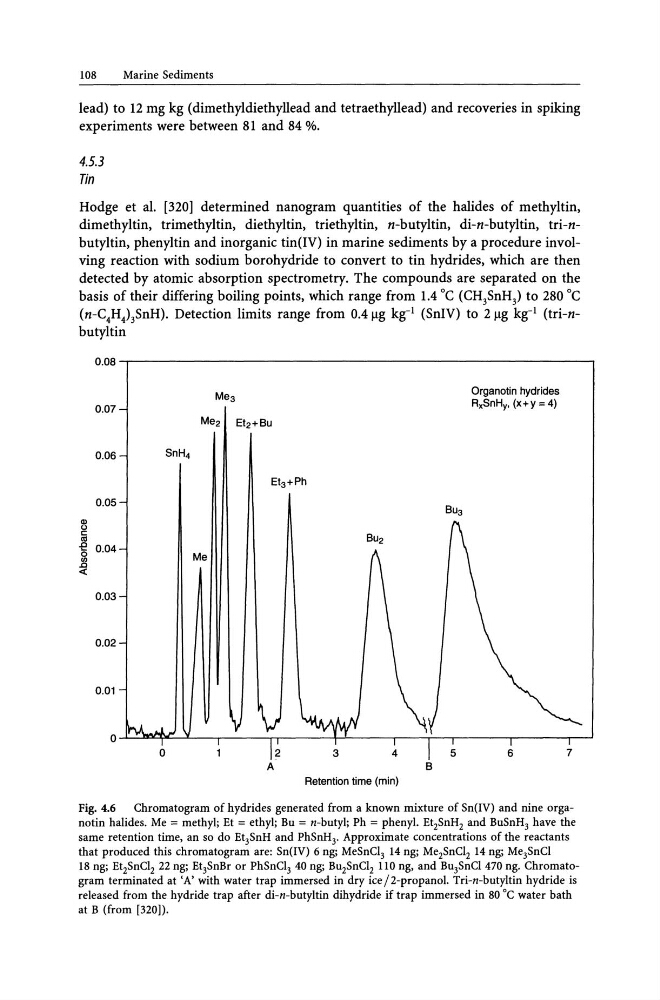
Hodge et al. [320] determined nanogram quantities of the halides of methyltin,
dimethyltin, trimethyltin, diethyltin, triethyltin, n-butyltin, di-n-butyltin, tri-nbutyltin, phenyltin and inorganic tin(IV) in marine sediments by a procedure involving reaction with sodium borohydride to convert to tin hydrides, which are then
detected by atomic absorption spectrometry. The compounds are separated on the
basis of their differing boiling points, which range from 1.4 °c (CH 3 SnH 3 ) to 280°C
(n-C4H4)3SnH). Detection limits range from O.4l1g kg- 1 (SnIV) to 2 I1g kg- 1 (tri-nbutyltin
0.08
0.07
0.06
SnH4
0.05
CD
(J
c:
os
-e 0.04
0
II)
.c
<
0.03
0.02
0.01
0
Me3
Me2 Et2+Bu
Et3+Ph
Retention time (min)
BU3
B
Organotin hydrides
RxSnHy. (x+y = 4)
Fig. 4.6
Chromatogram of hydrides generated from a known mixture of Sn(IV) and nine organotin halides. Me = methyl; Et = ethyl; Bu = n-butyl; Ph = phenyl. Et 2 SnH 2 and BuSnH 3 have the
same retention time, an so do Et3SnH and PhSnH 3 . Approximate concentrations of the reactants
that produced this chromatogram are: Sn(IV) 6 ng; MeSnCl 3 14 ng; Me 2 SnCl 2 14 ng; Me 3 SnCI
18 ng; Et 2 SnC1 2 22 ng; Et 3 SnBr or PhSnCl 3 40 ng; Bu 2 SnC1 2 110 ng, and Bu 3 SnCI 470 ng. Chromatogram terminated at 'A' with water trap immersed in dry ice/2-propanol. Tri-n-butyltin hydride is
released from the hydride trap after di-n-butyltin dihydride if trap immersed in 80 ·C water bath
at B (from [320]).
Marine Sediments
lead) to 12 mg kg (dimethyldiethyllead and tetraethyllead) and recoveries in spiking
experiments were between 81 and 84 %.
4.5.3
Tin
Hodge et al. [320] determined nanogram quantities of the halides of methyltin,
dimethyltin, trimethyltin, diethyltin, triethyltin, n-butyltin, di-n-butyltin, tri-nbutyltin, phenyltin and inorganic tin(IV) in marine sediments by a procedure involving reaction with sodium borohydride to convert to tin hydrides, which are then
detected by atomic absorption spectrometry. The compounds are separated on the
basis of their differing boiling points, which range from 1.4 °c (CH 3 SnH 3 ) to 280°C
(n-C4H4)3SnH). Detection limits range from O.4l1g kg- 1 (SnIV) to 2 I1g kg- 1 (tri-nbutyltin
0.08
0.07
0.06
SnH4
0.05
CD
(J
c:
os
-e 0.04
0
II)
.c
<
0.03
0.02
0.01
0
Me3
Me2 Et2+Bu
Et3+Ph
Retention time (min)
BU3
B
Organotin hydrides
RxSnHy. (x+y = 4)
Fig. 4.6
Chromatogram of hydrides generated from a known mixture of Sn(IV) and nine organotin halides. Me = methyl; Et = ethyl; Bu = n-butyl; Ph = phenyl. Et 2 SnH 2 and BuSnH 3 have the
same retention time, an so do Et3SnH and PhSnH 3 . Approximate concentrations of the reactants
that produced this chromatogram are: Sn(IV) 6 ng; MeSnCl 3 14 ng; Me 2 SnCl 2 14 ng; Me 3 SnCI
18 ng; Et 2 SnC1 2 22 ng; Et 3 SnBr or PhSnCl 3 40 ng; Bu 2 SnC1 2 110 ng, and Bu 3 SnCI 470 ng. Chromatogram terminated at 'A' with water trap immersed in dry ice/2-propanol. Tri-n-butyltin hydride is
released from the hydride trap after di-n-butyltin dihydride if trap immersed in 80 ·C water bath
at B (from [320]).