

Organometallic Compounds
107
4.4.77
Priority Pollutants
Ozretich and Schroeder [316] developed an extraction procedure, utilizing sonication
with acetonitrile, and cleanup using aminopropyl and / or C-18 bonded phase columns, to prepare marine sediments for priority organic pollutant analysis by gas
chromatography. Recoveries from standard reference and interlaboratory comparison sediments and tissue preparations compared favourably to published mean values. Mean recoveries of 22 priority organic pollutants from the sediments ranged
from 0 % to 84 % with a median recovery of 71 % and an average percent relative
standard deviation (%RSD) of 9 %. The effects of sediment type and storage method
on the spike recoveries are discussed. Some typical results and recoveries obtained by
this procedure are quoted in Table 4.8.
4.5
Organometallic Compounds
4.5.7
Arsenic
Maher [318] has described ion exchange chromatographic-hydride generation atomic
absorption and spectrometric methods for the determination of inorganic arsenic,
monomethylarsinic, and dimethylarsinic in marine sediments. Sediments were initially digested by a procedure involving digestion with 6 N hydrochloric acid and recovery of the supernatant layer, followed by further digestion of undissolved solids with
boiling sodium hydroxide-sodium chloride to prevent an alkaline extract. Both extracts were analysed.
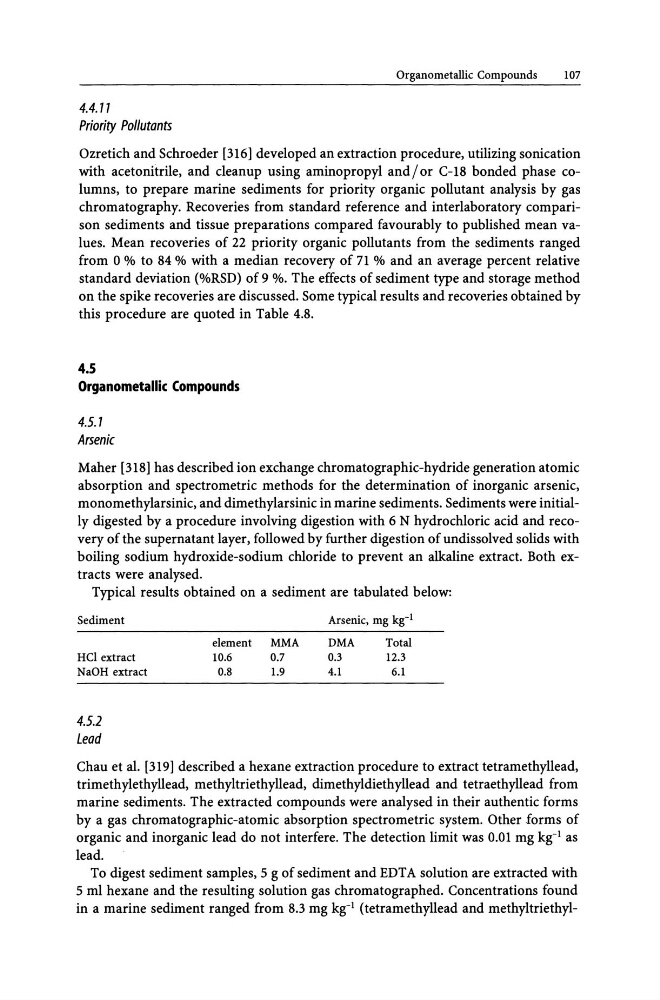
Typical results obtained on a sediment are tabulated below:
Sediment
HCl extract
NaOH extract
4.5.2
Lead
element
MMA
10.6
0.7
0.8
1.9
Arsenic, mg kg- 1
DMA
Total
0.3
12.3
4.1
6.1
Chau et al. [319] described a hexane extraction procedure to extract tetramethyllead,
trimethylethyllead, methyltriethyllead, dimethyldiethyllead and tetraethyllead from
marine sediments. The extracted compounds were analysed in their authentic forms
by a gas chromatographic-atomic absorption spectrometric system. Other .forms of
organic and inorganic lead do not interfere. The detection limit was 0.01 mg kg- 1 as
lead.
To digest sediment samples,S g of sediment and EDTA solution are extracted with
5 ml hexane and the resulting solution gas chromatographed. Concentrations found
in a marine sediment ranged from 8.3 mg kg- 1 (tetramethyllead and methyltriethyl-
107
4.4.77
Priority Pollutants
Ozretich and Schroeder [316] developed an extraction procedure, utilizing sonication
with acetonitrile, and cleanup using aminopropyl and / or C-18 bonded phase columns, to prepare marine sediments for priority organic pollutant analysis by gas
chromatography. Recoveries from standard reference and interlaboratory comparison sediments and tissue preparations compared favourably to published mean values. Mean recoveries of 22 priority organic pollutants from the sediments ranged
from 0 % to 84 % with a median recovery of 71 % and an average percent relative
standard deviation (%RSD) of 9 %. The effects of sediment type and storage method
on the spike recoveries are discussed. Some typical results and recoveries obtained by
this procedure are quoted in Table 4.8.
4.5
Organometallic Compounds
4.5.7
Arsenic
Maher [318] has described ion exchange chromatographic-hydride generation atomic
absorption and spectrometric methods for the determination of inorganic arsenic,
monomethylarsinic, and dimethylarsinic in marine sediments. Sediments were initially digested by a procedure involving digestion with 6 N hydrochloric acid and recovery of the supernatant layer, followed by further digestion of undissolved solids with
boiling sodium hydroxide-sodium chloride to prevent an alkaline extract. Both extracts were analysed.
Typical results obtained on a sediment are tabulated below:
Sediment
HCl extract
NaOH extract
4.5.2
Lead
element
MMA
10.6
0.7
0.8
1.9
Arsenic, mg kg- 1
DMA
Total
0.3
12.3
4.1
6.1
Chau et al. [319] described a hexane extraction procedure to extract tetramethyllead,
trimethylethyllead, methyltriethyllead, dimethyldiethyllead and tetraethyllead from
marine sediments. The extracted compounds were analysed in their authentic forms
by a gas chromatographic-atomic absorption spectrometric system. Other .forms of
organic and inorganic lead do not interfere. The detection limit was 0.01 mg kg- 1 as
lead.
To digest sediment samples,S g of sediment and EDTA solution are extracted with
5 ml hexane and the resulting solution gas chromatographed. Concentrations found
in a marine sediment ranged from 8.3 mg kg- 1 (tetramethyllead and methyltriethyl-