

Radioelements
109
chloride). To digest the sediment sample, 1 g of oven dried material was digested with
nitric acid, perchloric acid and hydrofluoric-hydrochloric acid and the digest made up
to 50 ml. This solution was injected directly into the hydride generator. Figure 4.6
shows that stannane and the organotin hydrides evolve from the hydride trap in such
a manner that they can be identified by a "retention time". Tin levels in core samples
taken in Narragonsett Bay, USA (expressed as total tin) ranged from 1 mg kg- 1 (pre
1 900) to 20 mg kg- 1 in present day samples.
Gilmour et al. [321] have developed an extremely sensitive purge and trap method
for the determination of methyltin compounds as methylstannanes in marine sediments. Hydride derivatives were prepared with sodium borohydride in a closed, flow
through system consisting of a purge vessel, gas chromatograph and mass spectrometer. Borate buffer added to samples generated hydrogen from sodium borohydride,
resulting in high purge efficiencies for mono-, di-, and trimethyltin. Selected ion
mode monitoring with the mass spectrometer gave detection limits for methyltins of
3-5 pg as tin. The concentration detection limits for a 5-g sediment sample were in
the sub-Ilg kg-l level, with a standard deviation of 6-18 %, depending upon the
methyltin species and sample type. The method is both selective and specific, eliminating most interferences while permitting positive identification of individual methyltin species. Sample weights were typically 5 g and these were treated directly with the
borate buffered sodium borohydride reagent.
The recovery of methyltins from sediments was tested by using anoxic, sulfidic clay
sediments from a mid-salinity region of Chesapeake Bay. Monomethyltin (11.2 ng)
and dimethyltin (11.5 ng) were completely recovered from sediment. However, recovery of 10 ng of trimethyltin chloride from sediment was only about 70 %.
4.6
Radioelements
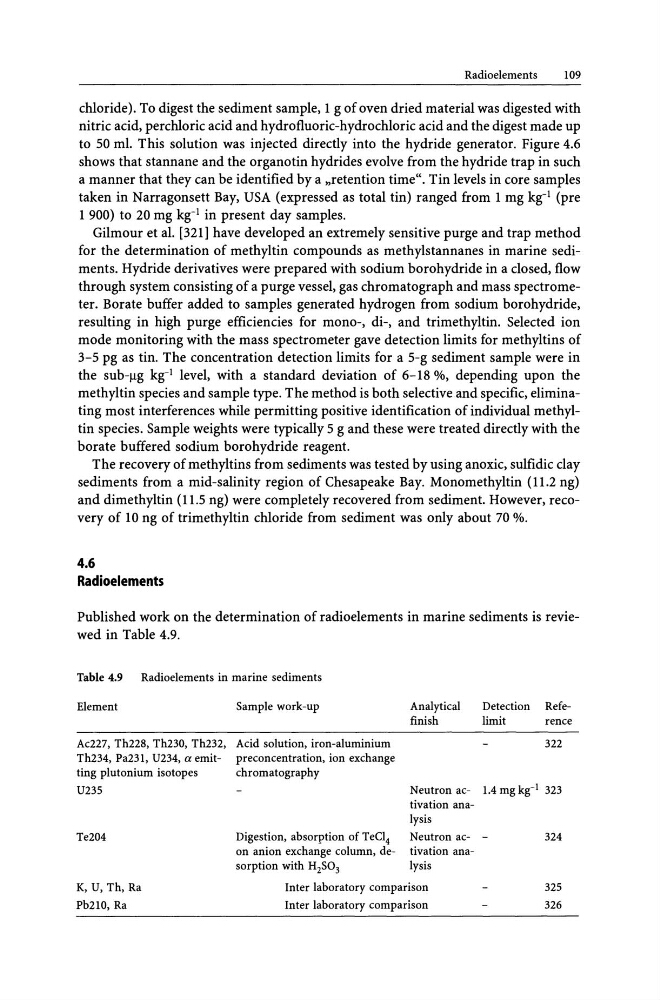
Published work on the determination of radioelements in marine sediments is reviewed in Table 4.9.
Table 4.9
Radioelements in marine sediments
Element
Sample work-up
Analytical
Detection Refefinish
limit
rence
Ac227, Th228, Th230, Th232, Acid solution, iron-aluminium
322
Th234, Pa231, U234, a emit- preconcentration, ion exchange
ting plutonium isotopes
chromatography
U235
Neutron ac- 1.4 mg kg- 1 323
Te204
K, U,Th,Ra
Pb210, Ra
Digestion, absorption of TeCl 4
on anion exchange column, desorption with H 2 S0 3
tivation analysis
Neutron ac- -
tivation analysis
Inter laboratory comparison
Inter laboratory comparison
324
325
326
109
chloride). To digest the sediment sample, 1 g of oven dried material was digested with
nitric acid, perchloric acid and hydrofluoric-hydrochloric acid and the digest made up
to 50 ml. This solution was injected directly into the hydride generator. Figure 4.6
shows that stannane and the organotin hydrides evolve from the hydride trap in such
a manner that they can be identified by a "retention time". Tin levels in core samples
taken in Narragonsett Bay, USA (expressed as total tin) ranged from 1 mg kg- 1 (pre
1 900) to 20 mg kg- 1 in present day samples.
Gilmour et al. [321] have developed an extremely sensitive purge and trap method
for the determination of methyltin compounds as methylstannanes in marine sediments. Hydride derivatives were prepared with sodium borohydride in a closed, flow
through system consisting of a purge vessel, gas chromatograph and mass spectrometer. Borate buffer added to samples generated hydrogen from sodium borohydride,
resulting in high purge efficiencies for mono-, di-, and trimethyltin. Selected ion
mode monitoring with the mass spectrometer gave detection limits for methyltins of
3-5 pg as tin. The concentration detection limits for a 5-g sediment sample were in
the sub-Ilg kg-l level, with a standard deviation of 6-18 %, depending upon the
methyltin species and sample type. The method is both selective and specific, eliminating most interferences while permitting positive identification of individual methyltin species. Sample weights were typically 5 g and these were treated directly with the
borate buffered sodium borohydride reagent.
The recovery of methyltins from sediments was tested by using anoxic, sulfidic clay
sediments from a mid-salinity region of Chesapeake Bay. Monomethyltin (11.2 ng)
and dimethyltin (11.5 ng) were completely recovered from sediment. However, recovery of 10 ng of trimethyltin chloride from sediment was only about 70 %.
4.6
Radioelements
Published work on the determination of radioelements in marine sediments is reviewed in Table 4.9.
Table 4.9
Radioelements in marine sediments
Element
Sample work-up
Analytical
Detection Refefinish
limit
rence
Ac227, Th228, Th230, Th232, Acid solution, iron-aluminium
322
Th234, Pa231, U234, a emit- preconcentration, ion exchange
ting plutonium isotopes
chromatography
U235
Neutron ac- 1.4 mg kg- 1 323
Te204
K, U,Th,Ra
Pb210, Ra
Digestion, absorption of TeCl 4
on anion exchange column, desorption with H 2 S0 3
tivation analysis
Neutron ac- -
tivation analysis
Inter laboratory comparison
Inter laboratory comparison
324
325
326