

86
Marine Sediments
Table 4.2
Fractionated desorption of spike material from a silanized porous glass column
(from [128])
Solvent
Water
Ethanol-water
(1: 10)
Ethanol-water
0:1)
Ethanol
n-Pentane
Colour of extract
Slightly green
Slightly green
Slightly green-yellow
Slightly yellow
Colourless
Spike material desorbed (%) (total recovery
is taken as 100 %)
Phthalates
n-Alkanes
Not measured
Not measured
0
92
6-12
3-4
84
0-4
0- 4
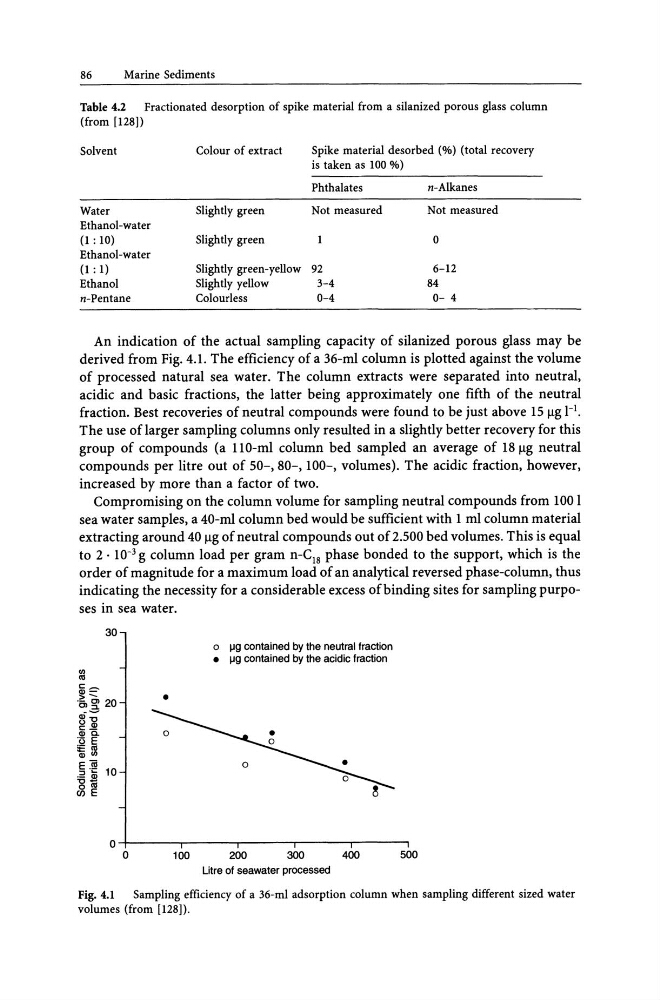
An indication of the actual sampling capacity of silanized porous glass may be
derived from Fig. 4.1. The efficiency of a 36-ml column is plotted against the volume
of processed natural sea water. The column extracts were separated into neutral,
acidic and basic fractions, the latter being approximately one fifth of the neutral
fraction. Best recoveries of neutral compounds were found to be just above 15 Ilg I-I.
The use of larger sampling columns only resulted in a slightly better recovery for this
group of compounds (a 1l0-ml column bed sampled an average of 18 Ilg neutral
compounds per litre out of 50-, 80-,100-, volumes). The acidic fraction, however,
increased by more than a factor of two.
Compromising on the column volume for sampling neutral compounds from 1001
sea water samples, a 40-ml column bed would be sufficient with 1 ml column material
extracting around 40 Ilg of neutral compounds out of 2.500 bed volumes. This is equal
to 2 . 10- 3 g column load per gram n-C Is phase bonded to the support, which is the
order of magnitude for a maximum load of an analytical reversed phase-column, thus
indicating the necessity for a considerable excess of binding sites for sampling purposes in sea water.
30
•
o 1)9 contained by the neutral fraction
• 1)9 contained by the acidic fraction
01------.------.------.------.-----~
o
100
200
300
400
500
Litre of seawater processed
Fig. 4.1
Sampling efficiency of a 36-ml adsorption column when sampling different sized water
volumes (from [128]).
Marine Sediments
Table 4.2
Fractionated desorption of spike material from a silanized porous glass column
(from [128])
Solvent
Water
Ethanol-water
(1: 10)
Ethanol-water
0:1)
Ethanol
n-Pentane
Colour of extract
Slightly green
Slightly green
Slightly green-yellow
Slightly yellow
Colourless
Spike material desorbed (%) (total recovery
is taken as 100 %)
Phthalates
n-Alkanes
Not measured
Not measured
0
92
6-12
3-4
84
0-4
0- 4
An indication of the actual sampling capacity of silanized porous glass may be
derived from Fig. 4.1. The efficiency of a 36-ml column is plotted against the volume
of processed natural sea water. The column extracts were separated into neutral,
acidic and basic fractions, the latter being approximately one fifth of the neutral
fraction. Best recoveries of neutral compounds were found to be just above 15 Ilg I-I.
The use of larger sampling columns only resulted in a slightly better recovery for this
group of compounds (a 1l0-ml column bed sampled an average of 18 Ilg neutral
compounds per litre out of 50-, 80-,100-, volumes). The acidic fraction, however,
increased by more than a factor of two.
Compromising on the column volume for sampling neutral compounds from 1001
sea water samples, a 40-ml column bed would be sufficient with 1 ml column material
extracting around 40 Ilg of neutral compounds out of 2.500 bed volumes. This is equal
to 2 . 10- 3 g column load per gram n-C Is phase bonded to the support, which is the
order of magnitude for a maximum load of an analytical reversed phase-column, thus
indicating the necessity for a considerable excess of binding sites for sampling purposes in sea water.
30
•
o 1)9 contained by the neutral fraction
• 1)9 contained by the acidic fraction
01------.------.------.------.-----~
o
100
200
300
400
500
Litre of seawater processed
Fig. 4.1
Sampling efficiency of a 36-ml adsorption column when sampling different sized water
volumes (from [128]).