

Separation and Fractionation of Sediments from Seawater
87
500
•
400
•
::::
en
.:;
"0
Q)
Q.
E 300
as
'" c: 0
€
as
u
~
'0
c: 200
100
0
~
-a,
c:
Q)
80 .:;
u
c:
'"
0
c:
t)
0
60
~
100
'0
40 c:
0
neutral fraction
~ c:
20
Q)
0:)
au
-4-c:
A
0
t)
0
0
2
3
4
5
6
7
8
9
pH
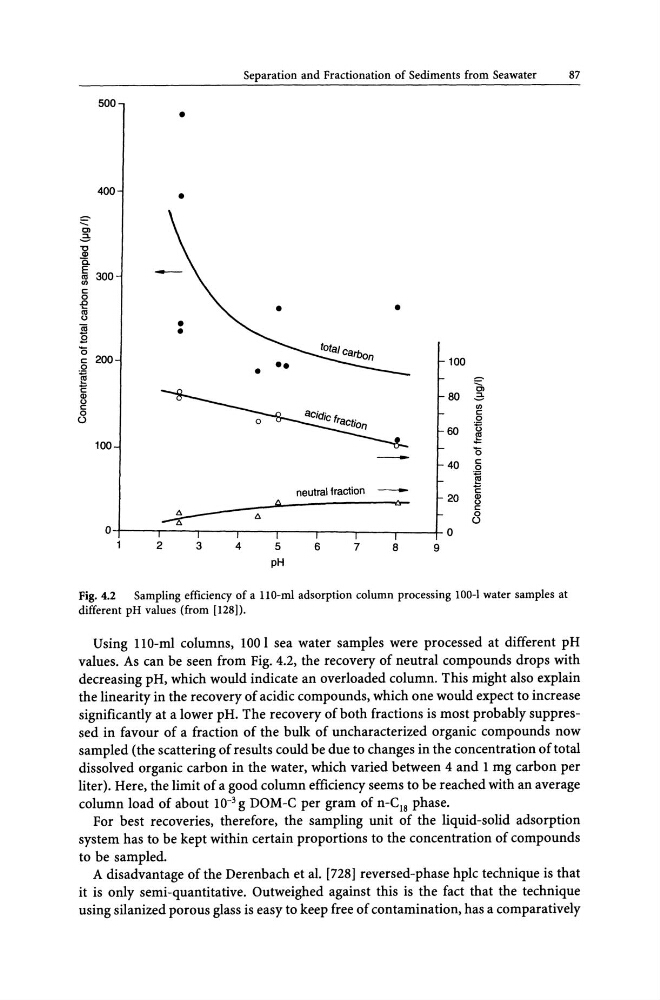
Fig. 4.2
Sampling efficiency of a llO-ml adsorption column processing 100-1 water samples at
different pH values (from [128)).
Using 1I0-ml columns, 100 I sea water samples were processed at different pH
values. As can be seen from Fig. 4.2, the recovery of neutral compounds drops with
decreasing pH, which would indicate an overloaded column. This might also explain
the linearity in the recovery of acidic compounds, which one would expect to increase
significantly at a lower pH. The recovery of both fractions is most probably suppressed in favour of a fraction of the bulk of uncharacterized organic compounds now
sampled (the scattering of results could be due to changes in the concentration of total
dissolved organic carbon in the water, which varied between 4 and 1 mg carbon per
liter). Here, the limit of a good column efficiency seems to be reached with an average
column load of about 10- 3 g DOM-C per gram of n-C 18 phase.
For best recoveries, therefore, the sampling unit of the liquid-solid adsorption
system has to be kept within certain proportions to the concentration of compounds
to be sampled.
A disadvantage of the Derenbach et al. [728) reversed-phase hplc technique is that
it is only semi-quantitative. Outweighed against this is the fact that the technique
using silanized porous glass is easy to keep free of contamination, has a comparatively
87
500
•
400
•
::::
en
.:;
"0
Q)
Q.
E 300
as
'" c: 0
€
as
u
~
'0
c: 200
100
0
~
-a,
c:
Q)
80 .:;
u
c:
'"
0
c:
t)
0
60
~
100
'0
40 c:
0
neutral fraction
~ c:
20
Q)
0:)
au
-4-c:
A
0
t)
0
0
2
3
4
5
6
7
8
9
pH
Fig. 4.2
Sampling efficiency of a llO-ml adsorption column processing 100-1 water samples at
different pH values (from [128)).
Using 1I0-ml columns, 100 I sea water samples were processed at different pH
values. As can be seen from Fig. 4.2, the recovery of neutral compounds drops with
decreasing pH, which would indicate an overloaded column. This might also explain
the linearity in the recovery of acidic compounds, which one would expect to increase
significantly at a lower pH. The recovery of both fractions is most probably suppressed in favour of a fraction of the bulk of uncharacterized organic compounds now
sampled (the scattering of results could be due to changes in the concentration of total
dissolved organic carbon in the water, which varied between 4 and 1 mg carbon per
liter). Here, the limit of a good column efficiency seems to be reached with an average
column load of about 10- 3 g DOM-C per gram of n-C 18 phase.
For best recoveries, therefore, the sampling unit of the liquid-solid adsorption
system has to be kept within certain proportions to the concentration of compounds
to be sampled.
A disadvantage of the Derenbach et al. [728) reversed-phase hplc technique is that
it is only semi-quantitative. Outweighed against this is the fact that the technique
using silanized porous glass is easy to keep free of contamination, has a comparatively