

Separation and Fractionation of Sediments from Seawater
85
Table 4.1
Average spike recovery from 251 samples given in % (spike concentration added to the
sample is taken as 1000/0) (from [728])
Spike
Recovery by liquid- Recovery by liq.-sol. adsorption onto:
Recovery by glasscompound
liquid extraction
XAD-2
silanized
silanized
fibre fllters
porous glass glass beads
n-Alkanes
71 ± 8
7± 2
6± 2
-5
13± 2
Phthaiates
103± 5
67±28
73±36
14± 12
5± 4
DDT, DDE,
DDMU
74±30
47± 16
50±21
47±35
8±12
Dieldrin, Endrin
7l±13
65± 4
68±15
26± 15
1± 2
Amberlite XAD-2. Columns and fIlters were then Soxhlet extracted for approximately
8 h with methanol-water or acetone-water (v Iv 3: 2). After evaporating a major
portion of the organic solvent (as above), the remaining extract was partitioned into
hexane and dried over anhydrous sodium sulphate.
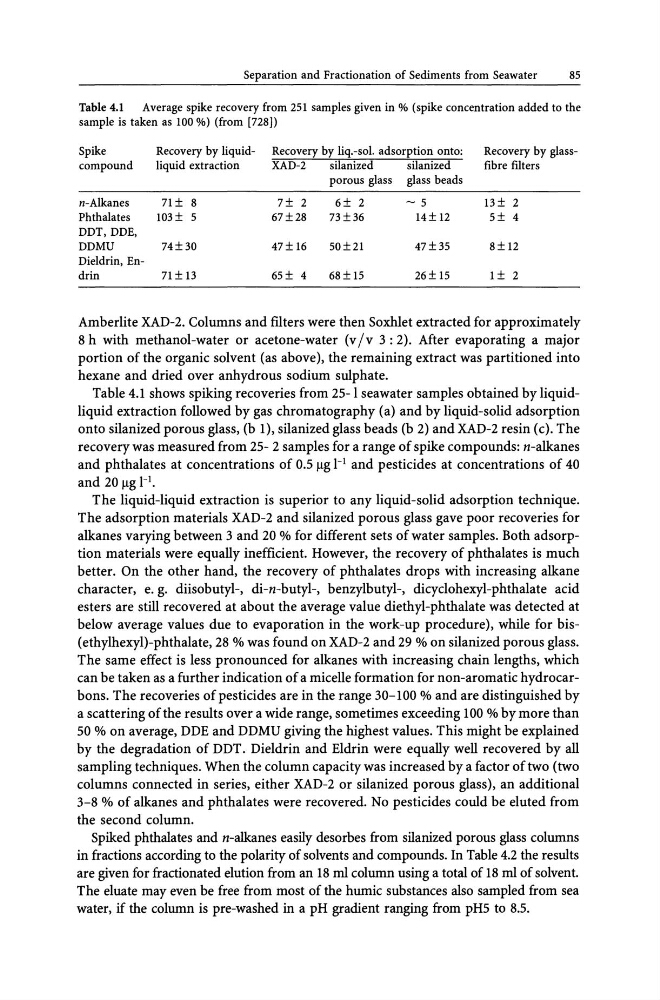
Table 4.1 shows spiking recoveries from 25-1 seawater samples obtained by liquidliquid extraction followed by gas chromatography (a) and by liquid-solid adsorption
onto silanized porous glass, (b 1), silanized glass beads (b 2) and XAD-2 resin (c). The
recovery was measured from 25- 2 samples for a range of spike compounds: n-alkanes
and phthalates at concentrations of 0.5 IlS 1-1 and pesticides at concentrations of 40
and 20 Ilg 1-1.
The liquid-liquid extraction is superior to any liquid-solid adsorption technique.
The adsorption materials XAD-2 and silanized porous glass gave poor recoveries for
alkanes varying between 3 and 20 % for different sets of water samples. Both adsorption materials were equally inefficient. However, the recovery of phthalates is much
better. On the other hand, the recovery of phthalates drops with increasing alkane
character, e. g. diisobutyl-, di-n-butyl-, benzylbutyl-, dicyclohexyl-phthalate acid
esters are still recovered at about the average value diethyl-phthalate was detected at
below average values due to evaporation in the work-up procedure), while for bis(ethylhexyl)-phthalate, 28 % was found on XAD-2 and 29 % on silanized porous glass.
The same effect is less pronounced for alkanes with increasing chain lengths, which
can be taken as a further indication of a micelle formation for non-aromatic hydrocarbons. The recoveries of pesticides are in the range 30-100 % and are distinguished by
a scattering of the results over a wide range, sometimes exceeding 100 % by more than
50 % on average, DDE and DDMU giving the highest values. This might be explained
by the degradation of DDT. Dieldrin and Eldrin were equally well recovered by all
sampling techniques. When the column capacity was increased by a factor of two (two
columns connected in series, either XAD-2 or silanized porous glass), an additional
3-8 % of alkanes and phthalates were recovered. No pesticides could be eluted from
the second column.
Spiked phthalates and n-alkanes easily desorbes from silanized porous glass columns
in fractions according to the polarity of solvents and compounds. In Table 4.2 the results
are given for fractionated elution from an 18 ml column using a total of 18 ml of solvent.
The eluate may even be free from most of the humic substances also sampled from sea
water, if the column is pre-washed in a pH gradient ranging from pHS to 8.5.
85
Table 4.1
Average spike recovery from 251 samples given in % (spike concentration added to the
sample is taken as 1000/0) (from [728])
Spike
Recovery by liquid- Recovery by liq.-sol. adsorption onto:
Recovery by glasscompound
liquid extraction
XAD-2
silanized
silanized
fibre fllters
porous glass glass beads
n-Alkanes
71 ± 8
7± 2
6± 2
-5
13± 2
Phthaiates
103± 5
67±28
73±36
14± 12
5± 4
DDT, DDE,
DDMU
74±30
47± 16
50±21
47±35
8±12
Dieldrin, Endrin
7l±13
65± 4
68±15
26± 15
1± 2
Amberlite XAD-2. Columns and fIlters were then Soxhlet extracted for approximately
8 h with methanol-water or acetone-water (v Iv 3: 2). After evaporating a major
portion of the organic solvent (as above), the remaining extract was partitioned into
hexane and dried over anhydrous sodium sulphate.
Table 4.1 shows spiking recoveries from 25-1 seawater samples obtained by liquidliquid extraction followed by gas chromatography (a) and by liquid-solid adsorption
onto silanized porous glass, (b 1), silanized glass beads (b 2) and XAD-2 resin (c). The
recovery was measured from 25- 2 samples for a range of spike compounds: n-alkanes
and phthalates at concentrations of 0.5 IlS 1-1 and pesticides at concentrations of 40
and 20 Ilg 1-1.
The liquid-liquid extraction is superior to any liquid-solid adsorption technique.
The adsorption materials XAD-2 and silanized porous glass gave poor recoveries for
alkanes varying between 3 and 20 % for different sets of water samples. Both adsorption materials were equally inefficient. However, the recovery of phthalates is much
better. On the other hand, the recovery of phthalates drops with increasing alkane
character, e. g. diisobutyl-, di-n-butyl-, benzylbutyl-, dicyclohexyl-phthalate acid
esters are still recovered at about the average value diethyl-phthalate was detected at
below average values due to evaporation in the work-up procedure), while for bis(ethylhexyl)-phthalate, 28 % was found on XAD-2 and 29 % on silanized porous glass.
The same effect is less pronounced for alkanes with increasing chain lengths, which
can be taken as a further indication of a micelle formation for non-aromatic hydrocarbons. The recoveries of pesticides are in the range 30-100 % and are distinguished by
a scattering of the results over a wide range, sometimes exceeding 100 % by more than
50 % on average, DDE and DDMU giving the highest values. This might be explained
by the degradation of DDT. Dieldrin and Eldrin were equally well recovered by all
sampling techniques. When the column capacity was increased by a factor of two (two
columns connected in series, either XAD-2 or silanized porous glass), an additional
3-8 % of alkanes and phthalates were recovered. No pesticides could be eluted from
the second column.
Spiked phthalates and n-alkanes easily desorbes from silanized porous glass columns
in fractions according to the polarity of solvents and compounds. In Table 4.2 the results
are given for fractionated elution from an 18 ml column using a total of 18 ml of solvent.
The eluate may even be free from most of the humic substances also sampled from sea
water, if the column is pre-washed in a pH gradient ranging from pHS to 8.5.