

A. Greenberg: Cautionary Comments Concerning the Use of (PAR)
279
Table 3. Winter/Summer ratios for selected PAR relative to benzo[b lfluoranthene. 16
PAH
Pyrene (9)
Benz[a]anthracene (12)
Cyclopenta[cd]pyrene (16)
Benzo[k]fluoranthene (23)
Benzo[a]pyrene (18)
Indenofl,2,3-cdlpyrene (24)
W/S PAHIB[b]F
2.75
1.64
3.35
0.90
1.26
0.90
Table 4. Ratios of selected PAR to B[eJP from residential wood combustion (adapted from
ref. 5).
Seasoned Oak
Seasoned Pine
Side
Up
Down High
Side
Fire
Draft
Draft
Draft
Turbulence
Draft
Box
Pyrene (9)
3.0
1.7
69
10.8
1.3
3.7
B[b]F (21)
B[j]F (22)
4.0
4.3
6.9
1.9
3.0
B[k]F (23)
B[e]P (19)
1.0
1.0
1.0
1.0
1.0
1.0
B[a]P (18)
1.4
3.0
0.49
1.0
1.8
0.9
Perylene (20)
0.16
0.19
0.33
1.0
0.26
0.11
Another factor which diminishes the utility of C[cd]P as a marker is that it is
generated in many combustion/pyrolysis scenarios. For example, we have found
substantial levels of C[ cd]P in charbroiled hamburger [17] further confirming that
gasoline combustion is not a unique source.
Deep-sea thermal vents have been shown to generate petroleum de novo as well as
accompanying PAH [18]. One of the most interesting associated findings is the
high relative concentration of perylene (20) in these mixtures [18]. Perylene is a
highly reactive PAH and this is, in part, reflected in its relatively low concentrations
in ambient air (Table 2). Its high levels in these deep-sea sediments reflect a
probable biotic source (a biological pigment perhaps) but perhaps as important,
the reducing nature of the unique environment which thus effectively "preserves"
perylene much as cyclopenta[cd]pyrene may be "preserved" in a tunnel which
minimizes atmospheric photochemistry.
Since summer time atmospheric chemistry and photochemistry decompose PAH
so as to "lose the memory" of the source profile, what of the earlier-cited
suggestion to apply PAH profiles to source apportionment in winter only? Here we
note the irony that, in New Jersey at least, residential wood combustion is estimated
to account for about 6100 kg of the estimated 6300 kg of B[a]P emitted in the
State during heating season, [19] and that the aforementioned review [5] notes that
the PAH profiles derived from wood combustion are far more variable than those
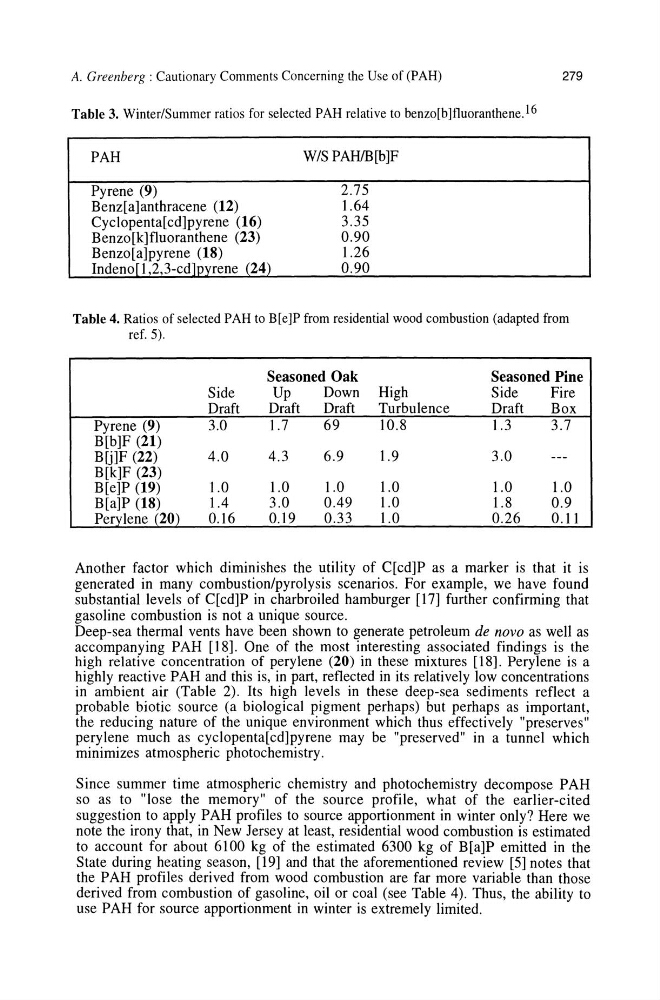
derived from combustion of gasoline, oil or coal (see Table 4). Thus, the ability to
use PAH for source apportionment in winter is extremely limited.
279
Table 3. Winter/Summer ratios for selected PAR relative to benzo[b lfluoranthene. 16
PAH
Pyrene (9)
Benz[a]anthracene (12)
Cyclopenta[cd]pyrene (16)
Benzo[k]fluoranthene (23)
Benzo[a]pyrene (18)
Indenofl,2,3-cdlpyrene (24)
W/S PAHIB[b]F
2.75
1.64
3.35
0.90
1.26
0.90
Table 4. Ratios of selected PAR to B[eJP from residential wood combustion (adapted from
ref. 5).
Seasoned Oak
Seasoned Pine
Side
Up
Down High
Side
Fire
Draft
Draft
Draft
Turbulence
Draft
Box
Pyrene (9)
3.0
1.7
69
10.8
1.3
3.7
B[b]F (21)
B[j]F (22)
4.0
4.3
6.9
1.9
3.0
B[k]F (23)
B[e]P (19)
1.0
1.0
1.0
1.0
1.0
1.0
B[a]P (18)
1.4
3.0
0.49
1.0
1.8
0.9
Perylene (20)
0.16
0.19
0.33
1.0
0.26
0.11
Another factor which diminishes the utility of C[cd]P as a marker is that it is
generated in many combustion/pyrolysis scenarios. For example, we have found
substantial levels of C[ cd]P in charbroiled hamburger [17] further confirming that
gasoline combustion is not a unique source.
Deep-sea thermal vents have been shown to generate petroleum de novo as well as
accompanying PAH [18]. One of the most interesting associated findings is the
high relative concentration of perylene (20) in these mixtures [18]. Perylene is a
highly reactive PAH and this is, in part, reflected in its relatively low concentrations
in ambient air (Table 2). Its high levels in these deep-sea sediments reflect a
probable biotic source (a biological pigment perhaps) but perhaps as important,
the reducing nature of the unique environment which thus effectively "preserves"
perylene much as cyclopenta[cd]pyrene may be "preserved" in a tunnel which
minimizes atmospheric photochemistry.
Since summer time atmospheric chemistry and photochemistry decompose PAH
so as to "lose the memory" of the source profile, what of the earlier-cited
suggestion to apply PAH profiles to source apportionment in winter only? Here we
note the irony that, in New Jersey at least, residential wood combustion is estimated
to account for about 6100 kg of the estimated 6300 kg of B[a]P emitted in the
State during heating season, [19] and that the aforementioned review [5] notes that
the PAH profiles derived from wood combustion are far more variable than those
derived from combustion of gasoline, oil or coal (see Table 4). Thus, the ability to
use PAH for source apportionment in winter is extremely limited.