

278
Ecotoxicological Issues
Table 2. Ratios of selected C20R 12 PAR to benzo[e]pyrene (B[e]P) as well as to
benzo[b]fluoranthene (B[b]F) for Summer, 1982 and Winter, 1983 studies in
Newark, New Jersey.13
Summer, 1982
Winter, 1983
ReI. Bfe]P ReI. Bfb]F ReI. BfeJP
ReI. Bfb]F
Benzo[b ]fluoranthene
2.1
1.0
0.6
1.0
Benzo[k ]fluoranthene
1.0
0.5
0.3
0.5
Benzo[j]fluoranthene
1.3
0.6
0.6
1.0
Benzo[ e ]pyrene
1.0
0.5
l.0
l.7
Benzo[a]pyrene
1.3
0.6
0.6
l.0
Perylene
0.06
0.03
0.05
0.08
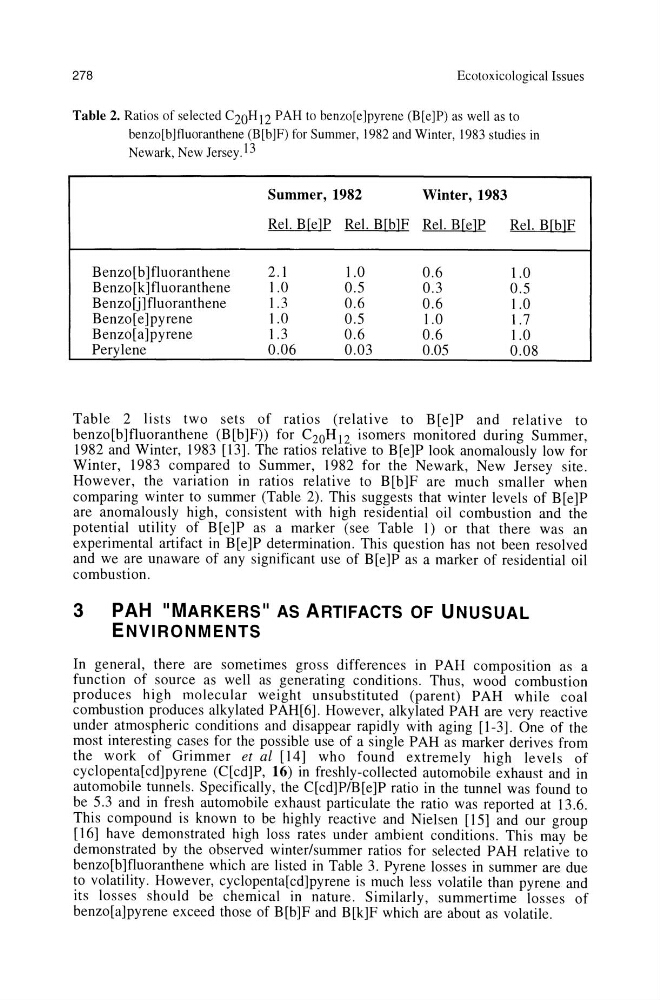
Table 2 lists two sets of ratios (relative to B[e]P and relative to
benzo[b]fluoranthene (B[b]F)) for C 2o H 12 isomers monitored during Summer,
1982 and Winter, 1983 [13]. The ratios relative to B[e]P look anomalously low for
Winter, 1983 compared to Summer, 1982 for the Newark, New Jersey site.
However, the variation in ratios relative to B[b]F are much smaller when
comparing winter to summer (Table 2). This suggests that winter levels of B[e]P
are anomalously high, consistent with high residential oil combustion and the
potential utility of B[e]P as a marker (see Table 1) or that there was an
experimental artifact in B[e]P determination. This question has not been resolved
and we are unaware of any significant use of B[e]P as a marker of residential oil
combustion.
3
PAH "MARKERS" AS ARTIFACTS OF UNUSUAL
ENVIRONMENTS
In general, there are sometimes gross differences in PAH composltlOn as a
function of source as well as generating conditions. Thus, wood combustion
produces high molecular weight unsubstituted (parent) PAH while coal
combustion produces alkylated PAH[6]. However, alkylated PAH are very reactive
under atmospheric conditions and disappear rapidly with aging [1-3]. One of the
most interesting cases for the possible use of a single PAH as marker derives from
the work of Grimmer et al [14] who found extremely high levels of
cyclopenta[cd]pyrene (C[cd]P, 16) in freshly-collected automobile exhaust and in
automobile tunnels. Specifically, the C[cd]P/B[e]P ratio in the tunnel was found to
be 5.3 and in fresh automobile exhaust particulate the ratio was reported at 13.6.
This compound is known to be highly reactive and Nielsen [15] and our group
[16] have demonstrated high loss rates under ambient conditions. This may be
demonstrated by the observed winter/summer ratios for selected PAH relative to
benzo[b]fluoranthene which are listed in Table 3. Pyrene losses in summer are due
to volatility. However, cyclopenta[cd]pyrene is much less volatile than pyrene and
its losses should be chemical in nature. Similarly, summertime losses of
benzo[a]pyrene exceed those of B[b]F and B[k]F which are about as volatile.
Ecotoxicological Issues
Table 2. Ratios of selected C20R 12 PAR to benzo[e]pyrene (B[e]P) as well as to
benzo[b]fluoranthene (B[b]F) for Summer, 1982 and Winter, 1983 studies in
Newark, New Jersey.13
Summer, 1982
Winter, 1983
ReI. Bfe]P ReI. Bfb]F ReI. BfeJP
ReI. Bfb]F
Benzo[b ]fluoranthene
2.1
1.0
0.6
1.0
Benzo[k ]fluoranthene
1.0
0.5
0.3
0.5
Benzo[j]fluoranthene
1.3
0.6
0.6
1.0
Benzo[ e ]pyrene
1.0
0.5
l.0
l.7
Benzo[a]pyrene
1.3
0.6
0.6
l.0
Perylene
0.06
0.03
0.05
0.08
Table 2 lists two sets of ratios (relative to B[e]P and relative to
benzo[b]fluoranthene (B[b]F)) for C 2o H 12 isomers monitored during Summer,
1982 and Winter, 1983 [13]. The ratios relative to B[e]P look anomalously low for
Winter, 1983 compared to Summer, 1982 for the Newark, New Jersey site.
However, the variation in ratios relative to B[b]F are much smaller when
comparing winter to summer (Table 2). This suggests that winter levels of B[e]P
are anomalously high, consistent with high residential oil combustion and the
potential utility of B[e]P as a marker (see Table 1) or that there was an
experimental artifact in B[e]P determination. This question has not been resolved
and we are unaware of any significant use of B[e]P as a marker of residential oil
combustion.
3
PAH "MARKERS" AS ARTIFACTS OF UNUSUAL
ENVIRONMENTS
In general, there are sometimes gross differences in PAH composltlOn as a
function of source as well as generating conditions. Thus, wood combustion
produces high molecular weight unsubstituted (parent) PAH while coal
combustion produces alkylated PAH[6]. However, alkylated PAH are very reactive
under atmospheric conditions and disappear rapidly with aging [1-3]. One of the
most interesting cases for the possible use of a single PAH as marker derives from
the work of Grimmer et al [14] who found extremely high levels of
cyclopenta[cd]pyrene (C[cd]P, 16) in freshly-collected automobile exhaust and in
automobile tunnels. Specifically, the C[cd]P/B[e]P ratio in the tunnel was found to
be 5.3 and in fresh automobile exhaust particulate the ratio was reported at 13.6.
This compound is known to be highly reactive and Nielsen [15] and our group
[16] have demonstrated high loss rates under ambient conditions. This may be
demonstrated by the observed winter/summer ratios for selected PAH relative to
benzo[b]fluoranthene which are listed in Table 3. Pyrene losses in summer are due
to volatility. However, cyclopenta[cd]pyrene is much less volatile than pyrene and
its losses should be chemical in nature. Similarly, summertime losses of
benzo[a]pyrene exceed those of B[b]F and B[k]F which are about as volatile.