

A. Greenberg: Cautionary Comments Concerning the Use of (PAR)
277
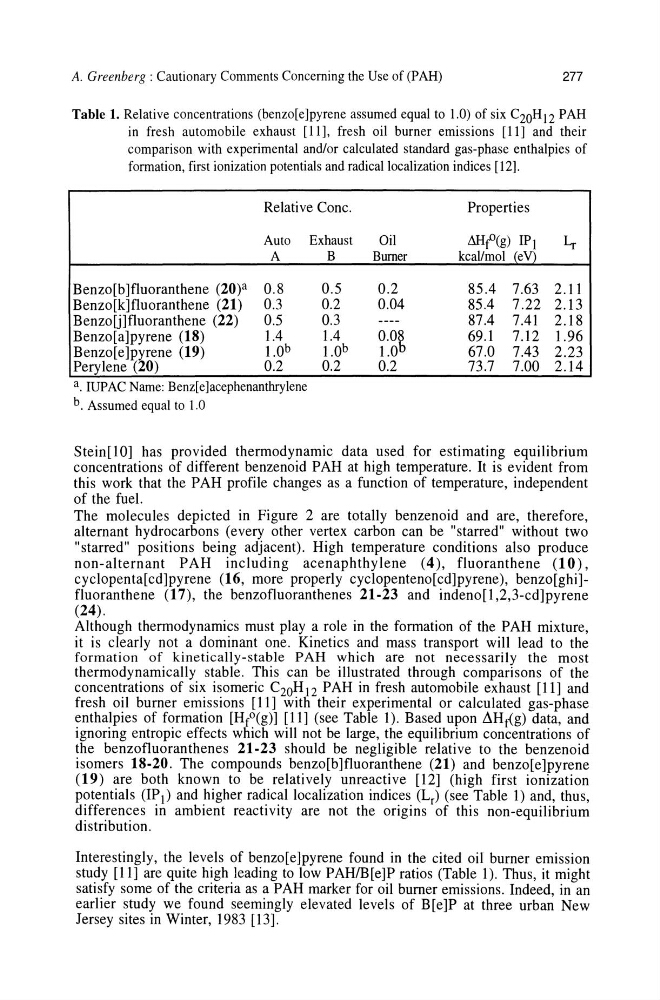
Table 1. Relative concentrations (benzo[e]pyrene assumed equal to 1.0) of six C 20 R 12 PAR
in fresh automobile exhaust [11], fresh oil burner emissions [II] and their
comparison with experimental andlor calculated standard gas-phase enthalpies of
formation, first ionization potentials and radical localization indices [12].
Relative Cone.
Properties
Auto Exhaust
Oil
Lllif(g) IPI
Lr
A
B
Burner
kcal/mol _(ev)
Benzo[b]fluoranthene (20)a 0.8
0.5
0.2
85.4 7.63 2.11
Benzo[k]fluoranthene (21)
0.3
0.2
0.04
85.4 7.22 2.13
Benzo[j]fluoranthene (22)
0.5
0.3
---87.4 7.41 2.18
Benzo[a]pyrene (18)
1.4
1.4
O.O~
69.1 7.12 1.96
Benzo[e]pyrene (19)
LOb
LOb
1.0
67.0 7.43 2.23
Perylene (20)
0.2
0.2
0.2
73.7 7.00 2.14
a. IUPAC Name: Benz[e]acephenanthrylene
b. Assumed equal to 1.0
Stein[lO] has provided thermodynamic data used for estimating equilibrium
concentrations of different benzenoid PAH at high temperature. It is evident from
this work that the PAH profile changes as a function of temperature, independent
of the fuel.
The molecules depicted in Figure 2 are totally benzenoid and are, therefore,
altern ant hydrocarbons (every other vertex carbon can be "starred" without two
"starred" positions being adjacent). High temperature conditions also produce
non-alternant PAH including acenaphthylene (4), fluoranthene (10),
cyclopenta[cd]pyrene (16, more properly cyclopenteno[cd]pyrene), benzo[ghi]fluoranthene (17), the benzofluoranthenes 21-23 and indeno[1,2,3-cd]pyrene
(24).
Although thermodynamics must play a role in the formation of the P AH mixture,
it is clearly not a dominant one. Kinetics and mass transport will lead to the
formation of kinetically-stable PAH which are not necessarily the most
thermodynamically stable. This can be illustrated through comparisons of the
concentrations of six isomeric C 2o H l2 PAH in fresh automobile exhaust [11] and
fresh oil burner emissions [11] with their experimental or calculated gas-phase
enthalpies of formation [HfO(g)] [11] (see Table 1). Based upon AHt
the benzofluoranthenes 21-23 should be negligible relative to the benzenoid
isomers 18-20. The compounds benzo[b]fluoranthene (21) and benzo[e]pyrene
(19) are both known to be relatively unreactive [12] (high first ionization
potentials (IP l ) and higher radical localization indices (Lr) (see Table 1) and, thus,
differences in ambient reactivity are not the origins of this non-equilibrium
distribution.
Interestingly, the levels of benzo[e]pyrene found in the cited oil burner emission
study [11] are quite high leading to low PAHIB[e]P ratios (Table 1). Thus, it might
satisfy some of the criteria as a PAH marker for oil burner emissions. Indeed, in an
earlier study we found seemingly elevated levels of B[e]P at three urban New
Jersey sites in Winter, 1983 [13].
277
Table 1. Relative concentrations (benzo[e]pyrene assumed equal to 1.0) of six C 20 R 12 PAR
in fresh automobile exhaust [11], fresh oil burner emissions [II] and their
comparison with experimental andlor calculated standard gas-phase enthalpies of
formation, first ionization potentials and radical localization indices [12].
Relative Cone.
Properties
Auto Exhaust
Oil
Lllif(g) IPI
Lr
A
B
Burner
kcal/mol _(ev)
Benzo[b]fluoranthene (20)a 0.8
0.5
0.2
85.4 7.63 2.11
Benzo[k]fluoranthene (21)
0.3
0.2
0.04
85.4 7.22 2.13
Benzo[j]fluoranthene (22)
0.5
0.3
---87.4 7.41 2.18
Benzo[a]pyrene (18)
1.4
1.4
O.O~
69.1 7.12 1.96
Benzo[e]pyrene (19)
LOb
LOb
1.0
67.0 7.43 2.23
Perylene (20)
0.2
0.2
0.2
73.7 7.00 2.14
a. IUPAC Name: Benz[e]acephenanthrylene
b. Assumed equal to 1.0
Stein[lO] has provided thermodynamic data used for estimating equilibrium
concentrations of different benzenoid PAH at high temperature. It is evident from
this work that the PAH profile changes as a function of temperature, independent
of the fuel.
The molecules depicted in Figure 2 are totally benzenoid and are, therefore,
altern ant hydrocarbons (every other vertex carbon can be "starred" without two
"starred" positions being adjacent). High temperature conditions also produce
non-alternant PAH including acenaphthylene (4), fluoranthene (10),
cyclopenta[cd]pyrene (16, more properly cyclopenteno[cd]pyrene), benzo[ghi]fluoranthene (17), the benzofluoranthenes 21-23 and indeno[1,2,3-cd]pyrene
(24).
Although thermodynamics must play a role in the formation of the P AH mixture,
it is clearly not a dominant one. Kinetics and mass transport will lead to the
formation of kinetically-stable PAH which are not necessarily the most
thermodynamically stable. This can be illustrated through comparisons of the
concentrations of six isomeric C 2o H l2 PAH in fresh automobile exhaust [11] and
fresh oil burner emissions [11] with their experimental or calculated gas-phase
enthalpies of formation [HfO(g)] [11] (see Table 1). Based upon AHt
the benzofluoranthenes 21-23 should be negligible relative to the benzenoid
isomers 18-20. The compounds benzo[b]fluoranthene (21) and benzo[e]pyrene
(19) are both known to be relatively unreactive [12] (high first ionization
potentials (IP l ) and higher radical localization indices (Lr) (see Table 1) and, thus,
differences in ambient reactivity are not the origins of this non-equilibrium
distribution.
Interestingly, the levels of benzo[e]pyrene found in the cited oil burner emission
study [11] are quite high leading to low PAHIB[e]P ratios (Table 1). Thus, it might
satisfy some of the criteria as a PAH marker for oil burner emissions. Indeed, in an
earlier study we found seemingly elevated levels of B[e]P at three urban New
Jersey sites in Winter, 1983 [13].