

132
Global Atmospheric Evolution: Impact of Anthropogenic Activities
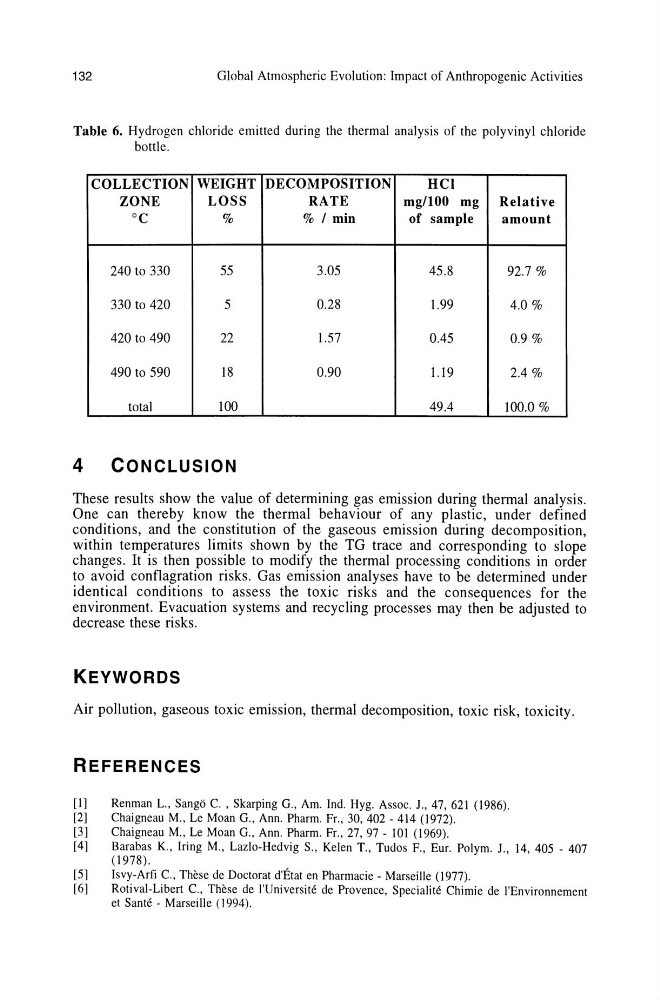
Table 6. Hydrogen chloride emitted during the thermal analysis of the polyvinyl chloride
bottle.
COLLECTION WEIGHT DECOMPOSITION
HCI
ZONE
LOSS
RATE
mg/lOO mg
Relative
°C
%
% / min
of sample
amount
240 to 330
55
3.05
45.8
92.7 %
330 to 420
5
0.28
1.99
4.0 %
420 to 490
22
1.57
0.45
0.9 %
490 to 590
18
0.90
1.19
2.4 %
total
100
49.4
100.0 %
4 CONCLUSION
These results show the value of determining gas emission during thermal analysis.
One can thereby know the thermal behaviour of any plastic, under defined
conditions, and the constitution of the gaseous emission during decomposition,
within temperatures limits shown by the TG trace and corresponding to slope
changes. It is then possible to modify the thermal processing conditions in order
to avoid conflagration risks. Gas emission analyses have to be determined under
identical conditions to assess the toxic risks and the consequences for the
environment. Evacuation systems and recycling processes may then be adjusted to
decrease these risks.
KEYWORDS
Air pollution, gaseous toxic emission, thermal decomposition, toxic risk, toxicity.
REFERENCES
[1]
Renman L., Sangd C. , Skarping G., Am. Ind. Hyg. Assoc. J., 47, 621 (1986).
[2]
Chaigneau M., Le Moan G., Ann. Pharm. Fr., 30, 402 - 414 (1972).
[3]
Chaigneau M., Le Moan G., Ann. Pharm. Fr., 27, 97 - 101 (1969).
[4]
Barabas K., Iring M., Lazlo-Hedvig S., Kelen T., Tudos F., Eur. Polym. J., 14, 405 - 407
(1978).
[5]
Isvy-Arfi c., These de Doctorat d'Etat en Pharmacie - Marseille (1977).
[6]
Rotival-Libert c., These de I'Universite de Provence, Specialite Chimie de l'Environnement
ct Sante - Marseille (1994).
Global Atmospheric Evolution: Impact of Anthropogenic Activities
Table 6. Hydrogen chloride emitted during the thermal analysis of the polyvinyl chloride
bottle.
COLLECTION WEIGHT DECOMPOSITION
HCI
ZONE
LOSS
RATE
mg/lOO mg
Relative
°C
%
% / min
of sample
amount
240 to 330
55
3.05
45.8
92.7 %
330 to 420
5
0.28
1.99
4.0 %
420 to 490
22
1.57
0.45
0.9 %
490 to 590
18
0.90
1.19
2.4 %
total
100
49.4
100.0 %
4 CONCLUSION
These results show the value of determining gas emission during thermal analysis.
One can thereby know the thermal behaviour of any plastic, under defined
conditions, and the constitution of the gaseous emission during decomposition,
within temperatures limits shown by the TG trace and corresponding to slope
changes. It is then possible to modify the thermal processing conditions in order
to avoid conflagration risks. Gas emission analyses have to be determined under
identical conditions to assess the toxic risks and the consequences for the
environment. Evacuation systems and recycling processes may then be adjusted to
decrease these risks.
KEYWORDS
Air pollution, gaseous toxic emission, thermal decomposition, toxic risk, toxicity.
REFERENCES
[1]
Renman L., Sangd C. , Skarping G., Am. Ind. Hyg. Assoc. J., 47, 621 (1986).
[2]
Chaigneau M., Le Moan G., Ann. Pharm. Fr., 30, 402 - 414 (1972).
[3]
Chaigneau M., Le Moan G., Ann. Pharm. Fr., 27, 97 - 101 (1969).
[4]
Barabas K., Iring M., Lazlo-Hedvig S., Kelen T., Tudos F., Eur. Polym. J., 14, 405 - 407
(1978).
[5]
Isvy-Arfi c., These de Doctorat d'Etat en Pharmacie - Marseille (1977).
[6]
Rotival-Libert c., These de I'Universite de Provence, Specialite Chimie de l'Environnement
ct Sante - Marseille (1994).