

C. Aifi et al. : Gaseous Toxic Emission from Plastic Materials
131
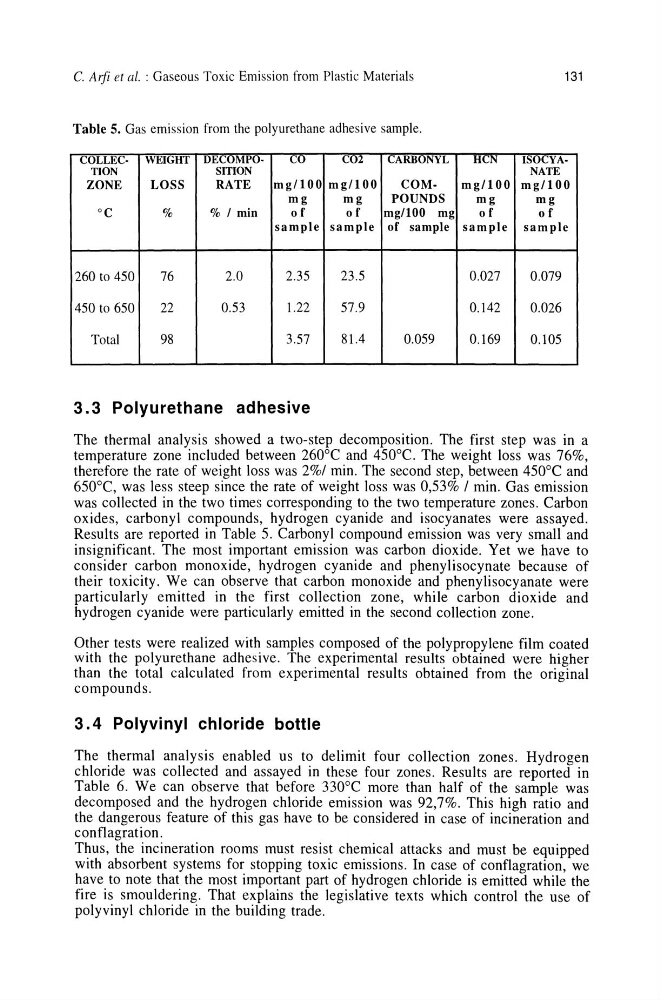
Table 5. Gas emission from the polyurethane adhesive sample.
COLLEC· WEIGIIT DECOMPO·
CO
CO2
CARBONYL
HCN
ISOCYA·
TION
SIDON
NATE
ZONE
LOSS
RATE
mg/lOO mg/lOO
COMmgllOO mg/lOO
mg
mg
POUNDS
mg
mg
°C
%
% I min
of
of
mg/lOO mg
of
of
sample sample of sample sample sample
260 to 450
76
2.0
2.35
23.5
0.027
0.079
450 to 650
22
0.53
1.22
57.9
0.142
0.026
Total
98
3.57
81.4
0.059
0.169
0.105
3.3 Polyurethane adhesive
The thermal analysis showed a two-step decomposition. The first step was in a
temperature zone included between 260°C and 450°C. The weight loss was 76%,
therefore the rate of weight loss was 2%/ min. The second step, between 450°C and
650°C, was less steep since the rate of weight loss was 0,53% / min. Gas emission
was collected in the two times corresponding to the two temperature zones. Carbon
oxides, carbonyl compounds, hydrogen cyanide and isocyanates were assayed.
Results are reported in Table 5. Carbonyl compound emission was very small and
insignificant. The most important emission was carbon dioxide. Yet we have to
consider carbon monoxide, hydrogen cyanide and phenylisocynate because of
their toxicity. We can observe that carbon monoxide and phenylisocyanate were
particularly emitted in the first collection zone, while carbon dioxide and
hydrogen cyanide were particularly emitted in the second collection zone.
Other tests were realized with samples composed of the polypropylene film coated
with the polyurethane adhesive. The experimental results obtained were higher
than the total calculated from experimental results obtained from the original
compounds.
3.4 Polyvinyl chloride bottle
The thermal analysis enabled us to delimit four collection zones. Hydrogen
chloride was collected and assayed in these four zones. Results are reported in
Table 6. We can observe that before 330°C more than half of the sample was
decomposed and the hydrogen chloride emission was 92,7%. This high ratio and
the dangerous feature of this gas have to be considered in case of incineration and
conflagration.
Thus, the incineration rooms must resist chemical attacks and must be equipped
with absorbent systems for stopping toxic emissions. In case of conflagration, we
have to note that the most important part of hydrogen chloride is emitted while the
fire is smouldering. That explains the legislative texts which control the use of
polyvinyl chloride in the building trade.
131
Table 5. Gas emission from the polyurethane adhesive sample.
COLLEC· WEIGIIT DECOMPO·
CO
CO2
CARBONYL
HCN
ISOCYA·
TION
SIDON
NATE
ZONE
LOSS
RATE
mg/lOO mg/lOO
COMmgllOO mg/lOO
mg
mg
POUNDS
mg
mg
°C
%
% I min
of
of
mg/lOO mg
of
of
sample sample of sample sample sample
260 to 450
76
2.0
2.35
23.5
0.027
0.079
450 to 650
22
0.53
1.22
57.9
0.142
0.026
Total
98
3.57
81.4
0.059
0.169
0.105
3.3 Polyurethane adhesive
The thermal analysis showed a two-step decomposition. The first step was in a
temperature zone included between 260°C and 450°C. The weight loss was 76%,
therefore the rate of weight loss was 2%/ min. The second step, between 450°C and
650°C, was less steep since the rate of weight loss was 0,53% / min. Gas emission
was collected in the two times corresponding to the two temperature zones. Carbon
oxides, carbonyl compounds, hydrogen cyanide and isocyanates were assayed.
Results are reported in Table 5. Carbonyl compound emission was very small and
insignificant. The most important emission was carbon dioxide. Yet we have to
consider carbon monoxide, hydrogen cyanide and phenylisocynate because of
their toxicity. We can observe that carbon monoxide and phenylisocyanate were
particularly emitted in the first collection zone, while carbon dioxide and
hydrogen cyanide were particularly emitted in the second collection zone.
Other tests were realized with samples composed of the polypropylene film coated
with the polyurethane adhesive. The experimental results obtained were higher
than the total calculated from experimental results obtained from the original
compounds.
3.4 Polyvinyl chloride bottle
The thermal analysis enabled us to delimit four collection zones. Hydrogen
chloride was collected and assayed in these four zones. Results are reported in
Table 6. We can observe that before 330°C more than half of the sample was
decomposed and the hydrogen chloride emission was 92,7%. This high ratio and
the dangerous feature of this gas have to be considered in case of incineration and
conflagration.
Thus, the incineration rooms must resist chemical attacks and must be equipped
with absorbent systems for stopping toxic emissions. In case of conflagration, we
have to note that the most important part of hydrogen chloride is emitted while the
fire is smouldering. That explains the legislative texts which control the use of
polyvinyl chloride in the building trade.