

geometric spreading loss are typically used to describe transmission loss in
its simplest form, namely spherical spreading and cylindrical spreading (also
see Urick 1983 for descriptions of “no spreading” and “time spreading”).
4.1.1. Spherical Spreading
Spherical spreading describes the reduction in intensity of a propagating
sound wave in a free field in which there are no boundaries, the medium is
homogeneous, and the distance over which the sound is spreading is large
compared with the source (see Richardson et al. 1995). Sound spreads uniformly in a spherical manner from a point source that can be easily modeled
as the center of a sphere. Because intensity is inversely proportional to area,
and the surface area of a sphere is 4pr
2 , where r represents the radius of a
sphere, intensity falls off by 1/r
2 with distance from the source; this is known
as the “inverse square law.”
For acoustic measurements, r translates into the ratio of two distances,
namely r x /r 0 , where r x is the distance of interest that represents the distance
from a reference point r 0 . Thus, intensity is inversely proportional to
1/(r x /r 0 )
2 . The standard reference distance is 1 meter so that for the purposes
of our discussion 1/(r x /r 0 )
2 reduces to 1/r
2 , where r represents r x . In decibels,
transmission loss for spherical spreading from a point source in a free field
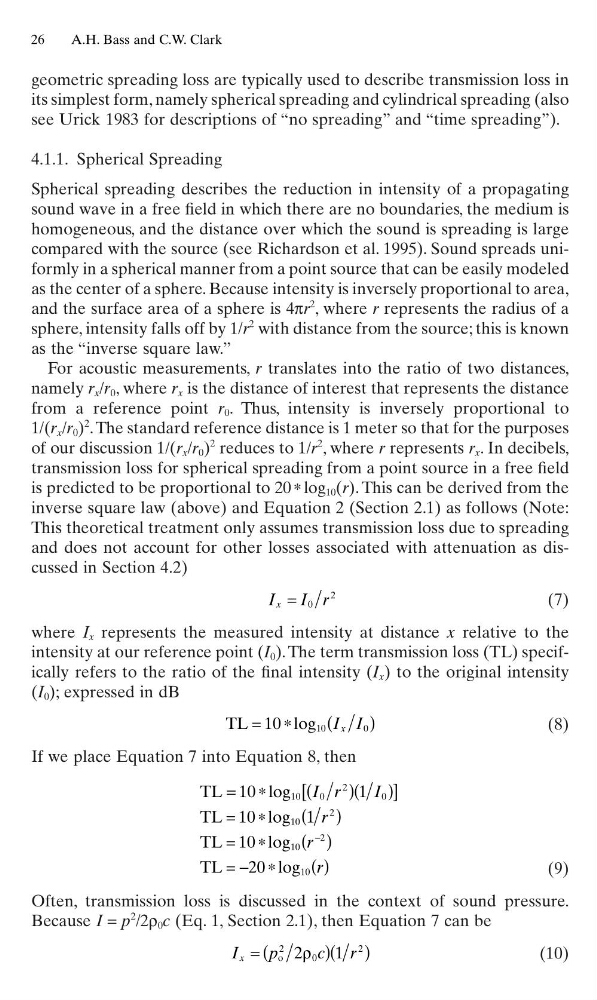
is predicted to be proportional to 20 * log 10 (r). This can be derived from the
inverse square law (above) and Equation 2 (Section 2.1) as follows (Note:
This theoretical treatment only assumes transmission loss due to spreading
and does not account for other losses associated with attenuation as discussed in Section 4.2)
(7)
where I x represents the measured intensity at distance x relative to the
intensity at our reference point (I 0 ). The term transmission loss (TL) specifically refers to the ratio of the final intensity (I x ) to the original intensity
(I 0 ); expressed in dB
(8)
If we place Equation 7 into Equation 8, then
(9)
Often, transmission loss is discussed in the context of sound pressure.
Because I = p
2 /2r 0 c (Eq. 1, Section 2.1), then Equation 7 can be
(10)
I
p
c
r
x = (
) (
)
o
2
0
2
2
1
r
TL
TL = 10 * log
TL = 10 * log
TL = 20 * log
10
10
10
=
(
)( )
[
]
(
)
( )
-
( )
-
10
1
1
10
0
2
0
2
2
* log I r
I
r
r
r
TL = 10 * log 10 I I
x
0
(
)
I
I r
x = 0
2
26
A.H. Bass and C.W. Clark
its simplest form, namely spherical spreading and cylindrical spreading (also
see Urick 1983 for descriptions of “no spreading” and “time spreading”).
4.1.1. Spherical Spreading
Spherical spreading describes the reduction in intensity of a propagating
sound wave in a free field in which there are no boundaries, the medium is
homogeneous, and the distance over which the sound is spreading is large
compared with the source (see Richardson et al. 1995). Sound spreads uniformly in a spherical manner from a point source that can be easily modeled
as the center of a sphere. Because intensity is inversely proportional to area,
and the surface area of a sphere is 4pr
2 , where r represents the radius of a
sphere, intensity falls off by 1/r
2 with distance from the source; this is known
as the “inverse square law.”
For acoustic measurements, r translates into the ratio of two distances,
namely r x /r 0 , where r x is the distance of interest that represents the distance
from a reference point r 0 . Thus, intensity is inversely proportional to
1/(r x /r 0 )
2 . The standard reference distance is 1 meter so that for the purposes
of our discussion 1/(r x /r 0 )
2 reduces to 1/r
2 , where r represents r x . In decibels,
transmission loss for spherical spreading from a point source in a free field
is predicted to be proportional to 20 * log 10 (r). This can be derived from the
inverse square law (above) and Equation 2 (Section 2.1) as follows (Note:
This theoretical treatment only assumes transmission loss due to spreading
and does not account for other losses associated with attenuation as discussed in Section 4.2)
(7)
where I x represents the measured intensity at distance x relative to the
intensity at our reference point (I 0 ). The term transmission loss (TL) specifically refers to the ratio of the final intensity (I x ) to the original intensity
(I 0 ); expressed in dB
(8)
If we place Equation 7 into Equation 8, then
(9)
Often, transmission loss is discussed in the context of sound pressure.
Because I = p
2 /2r 0 c (Eq. 1, Section 2.1), then Equation 7 can be
(10)
I
p
c
r
x = (
) (
)
o
2
0
2
2
1
r
TL
TL = 10 * log
TL = 10 * log
TL = 20 * log
10
10
10
=
(
)( )
[
]
(
)
( )
-
( )
-
10
1
1
10
0
2
0
2
2
* log I r
I
r
r
r
TL = 10 * log 10 I I
x
0
(
)
I
I r
x = 0
2
26
A.H. Bass and C.W. Clark