

the intermediate region dominates between l/2p and l/p; the propagating
sound wave then rules beyond l/p into the far field. Hence, the transition
point at which the propagating sound wave becomes the most influential
is at a farther distance from the source for a dipole than for a monopole.
Given these relationships, longer-wavelength (lower-frequency) sounds
will have more extensive near and intermediate fields than shorterwavelength (higher-frequency) ones, and the extent of these fields will vary
depending on whether the source is a monopole or a dipole. Because underwater sounds have an almost fivefold greater wavelength than airborne
sounds, the local flow region will extend farther and can therefore potentially play a more prominent role in underwater communication. By contrast, the much shorter wavelengths of sound in air, together with the more
pronounced drop-off in sound amplitude in the local flow field, mean that
the potential influence of the near field is limited to cases where animals
are within several body lengths of each other. Thus, the far field tends to
dominate the communication systems of most terrestrial species, with
insects being an exception to this condition (see Bailey 1991).
4. Transmission Loss
A number of factors influence the process of sound transmission in a nonideal, complex environment. Several terms are fundamental to this discussion, including transmission loss (TL), source level (SL), and received level
(RL) (the sound-velocity profile also influences this process; see Section
2.3). These terms are related in the simplest form as
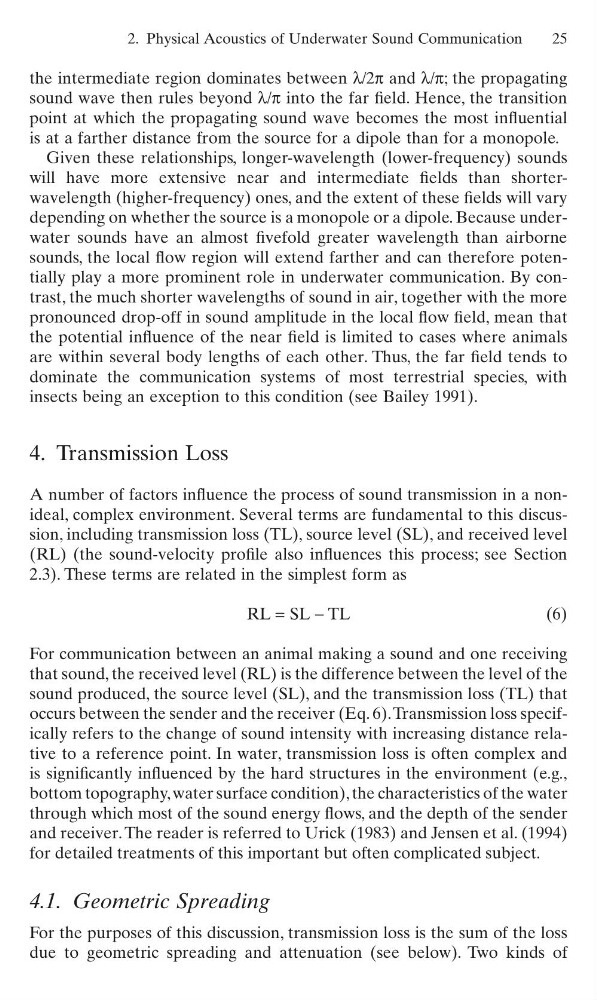
RL = SL - TL
(6)
For communication between an animal making a sound and one receiving
that sound, the received level (RL) is the difference between the level of the
sound produced, the source level (SL), and the transmission loss (TL) that
occurs between the sender and the receiver (Eq. 6).Transmission loss specifically refers to the change of sound intensity with increasing distance relative to a reference point. In water, transmission loss is often complex and
is significantly influenced by the hard structures in the environment (e.g.,
bottom topography, water surface condition), the characteristics of the water
through which most of the sound energy flows, and the depth of the sender
and receiver. The reader is referred to Urick (1983) and Jensen et al. (1994)
for detailed treatments of this important but often complicated subject.
4.1. Geometric Spreading
For the purposes of this discussion, transmission loss is the sum of the loss
due to geometric spreading and attenuation (see below). Two kinds of
2. Physical Acoustics of Underwater Sound Communication
25
sound wave then rules beyond l/p into the far field. Hence, the transition
point at which the propagating sound wave becomes the most influential
is at a farther distance from the source for a dipole than for a monopole.
Given these relationships, longer-wavelength (lower-frequency) sounds
will have more extensive near and intermediate fields than shorterwavelength (higher-frequency) ones, and the extent of these fields will vary
depending on whether the source is a monopole or a dipole. Because underwater sounds have an almost fivefold greater wavelength than airborne
sounds, the local flow region will extend farther and can therefore potentially play a more prominent role in underwater communication. By contrast, the much shorter wavelengths of sound in air, together with the more
pronounced drop-off in sound amplitude in the local flow field, mean that
the potential influence of the near field is limited to cases where animals
are within several body lengths of each other. Thus, the far field tends to
dominate the communication systems of most terrestrial species, with
insects being an exception to this condition (see Bailey 1991).
4. Transmission Loss
A number of factors influence the process of sound transmission in a nonideal, complex environment. Several terms are fundamental to this discussion, including transmission loss (TL), source level (SL), and received level
(RL) (the sound-velocity profile also influences this process; see Section
2.3). These terms are related in the simplest form as
RL = SL - TL
(6)
For communication between an animal making a sound and one receiving
that sound, the received level (RL) is the difference between the level of the
sound produced, the source level (SL), and the transmission loss (TL) that
occurs between the sender and the receiver (Eq. 6).Transmission loss specifically refers to the change of sound intensity with increasing distance relative to a reference point. In water, transmission loss is often complex and
is significantly influenced by the hard structures in the environment (e.g.,
bottom topography, water surface condition), the characteristics of the water
through which most of the sound energy flows, and the depth of the sender
and receiver. The reader is referred to Urick (1983) and Jensen et al. (1994)
for detailed treatments of this important but often complicated subject.
4.1. Geometric Spreading
For the purposes of this discussion, transmission loss is the sum of the loss
due to geometric spreading and attenuation (see below). Two kinds of
2. Physical Acoustics of Underwater Sound Communication
25