

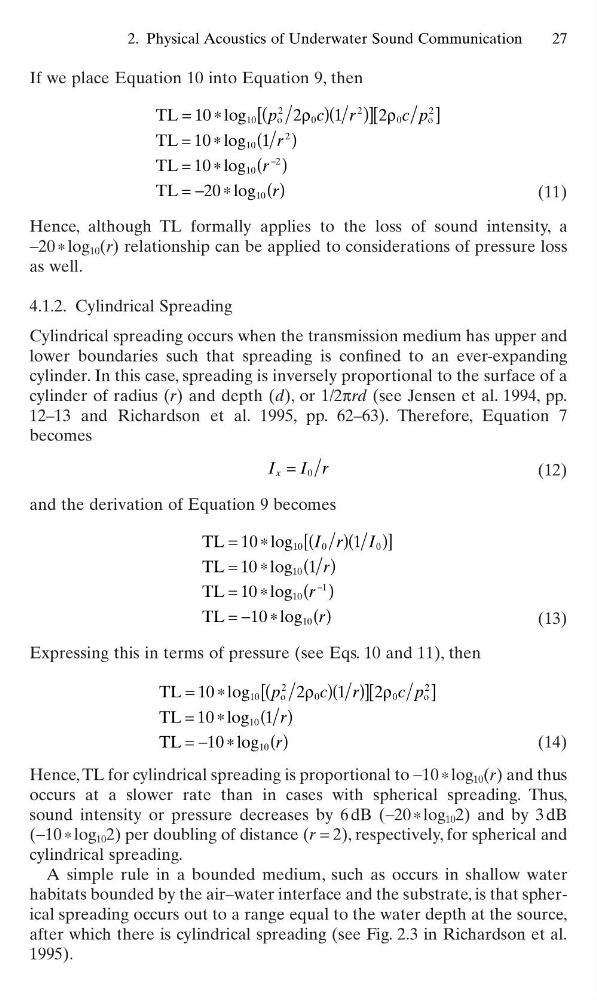
If we place Equation 10 into Equation 9, then
(11)
Hence, although TL formally applies to the loss of sound intensity, a
-20 * log 10 (r) relationship can be applied to considerations of pressure loss
as well.
4.1.2. Cylindrical Spreading
Cylindrical spreading occurs when the transmission medium has upper and
lower boundaries such that spreading is confined to an ever-expanding
cylinder. In this case, spreading is inversely proportional to the surface of a
cylinder of radius (r) and depth (d), or 1/2prd (see Jensen et al. 1994, pp.
12–13 and Richardson et al. 1995, pp. 62–63). Therefore, Equation 7
becomes
(12)
and the derivation of Equation 9 becomes
(13)
Expressing this in terms of pressure (see Eqs. 10 and 11), then
(14)
Hence, TL for cylindrical spreading is proportional to -10 * log 10 (r) and thus
occurs at a slower rate than in cases with spherical spreading. Thus,
sound intensity or pressure decreases by 6 dB (-20 * log 10 2) and by 3 dB
(-10 * log 10 2) per doubling of distance (r = 2), respectively, for spherical and
cylindrical spreading.
A simple rule in a bounded medium, such as occurs in shallow water
habitats bounded by the air–water interface and the substrate, is that spherical spreading occurs out to a range equal to the water depth at the source,
after which there is cylindrical spreading (see Fig. 2.3 in Richardson et al.
1995).
TL
TL = 10 log
TL = 10 log
o
o
10
10
=
(
) ( )
[
] [
]
( )
-
( )
10
2
1
2
1
10
2
0
0
2
* log
*
*
p
c
r
c p
r
r
r
r
TL
TL = 10 log
TL = 10 log
TL = 10 log
10
10
10
=
(
)(
)
[
]
( )
( )
-
( )
-
10
1
1
10
0
0
1
* log
*
*
*
I r
I
r
r
r
I
I r
x = 0
TL
TL = 10 log
TL = 10 log
TL = 20 log
o
0
o
10
10
10
=
(
) (
)
[
] [
]
(
)
( )
-
( )
-
10
2
1
2
1
10
2
2
0
2
2
2
* log
*
*
*
p
c
r
c p
r
r
r
r
r
2. Physical Acoustics of Underwater Sound Communication
27
(11)
Hence, although TL formally applies to the loss of sound intensity, a
-20 * log 10 (r) relationship can be applied to considerations of pressure loss
as well.
4.1.2. Cylindrical Spreading
Cylindrical spreading occurs when the transmission medium has upper and
lower boundaries such that spreading is confined to an ever-expanding
cylinder. In this case, spreading is inversely proportional to the surface of a
cylinder of radius (r) and depth (d), or 1/2prd (see Jensen et al. 1994, pp.
12–13 and Richardson et al. 1995, pp. 62–63). Therefore, Equation 7
becomes
(12)
and the derivation of Equation 9 becomes
(13)
Expressing this in terms of pressure (see Eqs. 10 and 11), then
(14)
Hence, TL for cylindrical spreading is proportional to -10 * log 10 (r) and thus
occurs at a slower rate than in cases with spherical spreading. Thus,
sound intensity or pressure decreases by 6 dB (-20 * log 10 2) and by 3 dB
(-10 * log 10 2) per doubling of distance (r = 2), respectively, for spherical and
cylindrical spreading.
A simple rule in a bounded medium, such as occurs in shallow water
habitats bounded by the air–water interface and the substrate, is that spherical spreading occurs out to a range equal to the water depth at the source,
after which there is cylindrical spreading (see Fig. 2.3 in Richardson et al.
1995).
TL
TL = 10 log
TL = 10 log
o
o
10
10
=
(
) ( )
[
] [
]
( )
-
( )
10
2
1
2
1
10
2
0
0
2
* log
*
*
p
c
r
c p
r
r
r
r
TL
TL = 10 log
TL = 10 log
TL = 10 log
10
10
10
=
(
)(
)
[
]
( )
( )
-
( )
-
10
1
1
10
0
0
1
* log
*
*
*
I r
I
r
r
r
I
I r
x = 0
TL
TL = 10 log
TL = 10 log
TL = 20 log
o
0
o
10
10
10
=
(
) (
)
[
] [
]
(
)
( )
-
( )
-
10
2
1
2
1
10
2
2
0
2
2
2
* log
*
*
*
p
c
r
c p
r
r
r
r
r
2. Physical Acoustics of Underwater Sound Communication
27