

2. Cetacean Ears
61
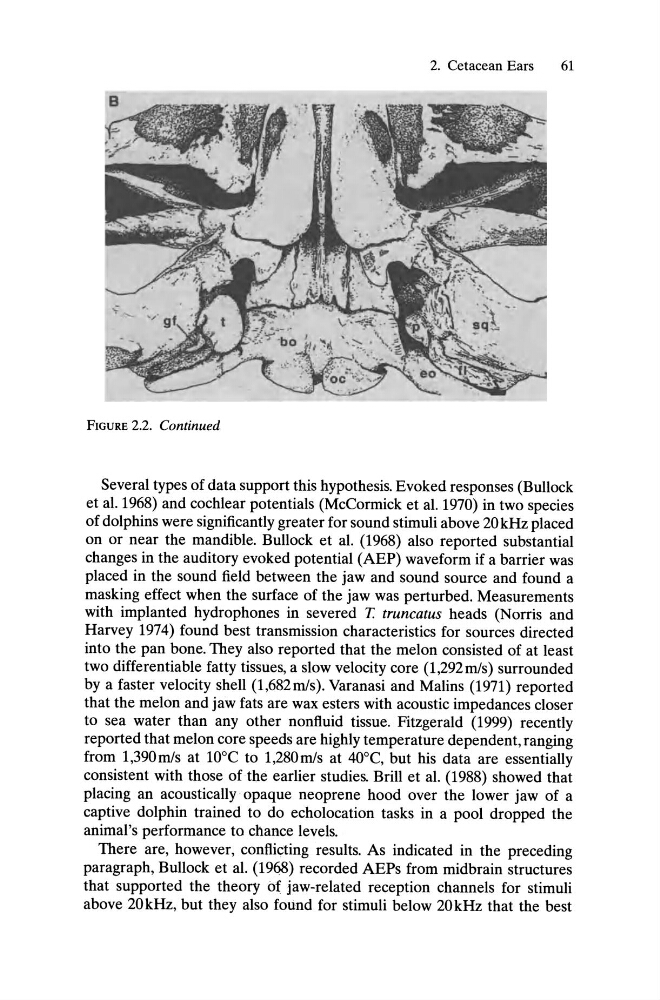
FIGURE 2.2. Continued
Several types of data support this hypothesis. Evoked responses (Bullock
et a1. 1968) and cochlear potentials (McCormick et a1. 1970) in two species
of dolphins were significantly greater for sound stimuli above 20 kHz placed
on or near the mandible. Bullock et a1. (1968) also reported substantial
changes in the auditory evoked potential (AEP) waveform if a barrier was
placed in the sound field between the jaw and sound source and found a
masking effect when the surface of the jaw was perturbed. Measurements
with implanted hydrophones in severed T. truncatus heads (Norris and
Harvey 1974) found best transmission characteristics for sources directed
into the pan bone. They also reported that the melon consisted of at least
two differentiable fatty tissues, a slow velocity core (1,292m1s) surrounded
by a faster velocity shell (1,682m1s). Varanasi and Malins (1971) reported
that the melon and jaw fats are wax esters with acoustic impedances closer
to sea water than any other nonfluid tissue. Fitzgerald (1999) recently
reported that melon core speeds are highly temperature dependent, ranging
from 1,390mls at lOoC to 1,280mls at 40°C, but his data are essentially
consistent with those of the earlier studies. Brill et a1. (1988) showed that
placing an acoustically· opaque neoprene hood over the lower jaw of a
captive dolphin trained to do echolocation tasks in a pool dropped the
animal's performance to chance levels.
There are, however, conflicting results. As indicated in the preceding
paragraph, Bullock et a1. (1968) recorded AEPs from midbrain structures
that supported the theory of jaw-related reception channels for stimuli
above 20 kHz, but they also found for stimuli below 20 kHz that the best
61
FIGURE 2.2. Continued
Several types of data support this hypothesis. Evoked responses (Bullock
et a1. 1968) and cochlear potentials (McCormick et a1. 1970) in two species
of dolphins were significantly greater for sound stimuli above 20 kHz placed
on or near the mandible. Bullock et a1. (1968) also reported substantial
changes in the auditory evoked potential (AEP) waveform if a barrier was
placed in the sound field between the jaw and sound source and found a
masking effect when the surface of the jaw was perturbed. Measurements
with implanted hydrophones in severed T. truncatus heads (Norris and
Harvey 1974) found best transmission characteristics for sources directed
into the pan bone. They also reported that the melon consisted of at least
two differentiable fatty tissues, a slow velocity core (1,292m1s) surrounded
by a faster velocity shell (1,682m1s). Varanasi and Malins (1971) reported
that the melon and jaw fats are wax esters with acoustic impedances closer
to sea water than any other nonfluid tissue. Fitzgerald (1999) recently
reported that melon core speeds are highly temperature dependent, ranging
from 1,390mls at lOoC to 1,280mls at 40°C, but his data are essentially
consistent with those of the earlier studies. Brill et a1. (1988) showed that
placing an acoustically· opaque neoprene hood over the lower jaw of a
captive dolphin trained to do echolocation tasks in a pool dropped the
animal's performance to chance levels.
There are, however, conflicting results. As indicated in the preceding
paragraph, Bullock et a1. (1968) recorded AEPs from midbrain structures
that supported the theory of jaw-related reception channels for stimuli
above 20 kHz, but they also found for stimuli below 20 kHz that the best