

398
w.w.L. Au
ations in the echoes. The difference in target area in the experiment of
Bagdonas et al. (1970) represent a 6dB difference in target strength, which
probably provided an additional cue to the dolphins.
4.2 Spheres and Cylinders
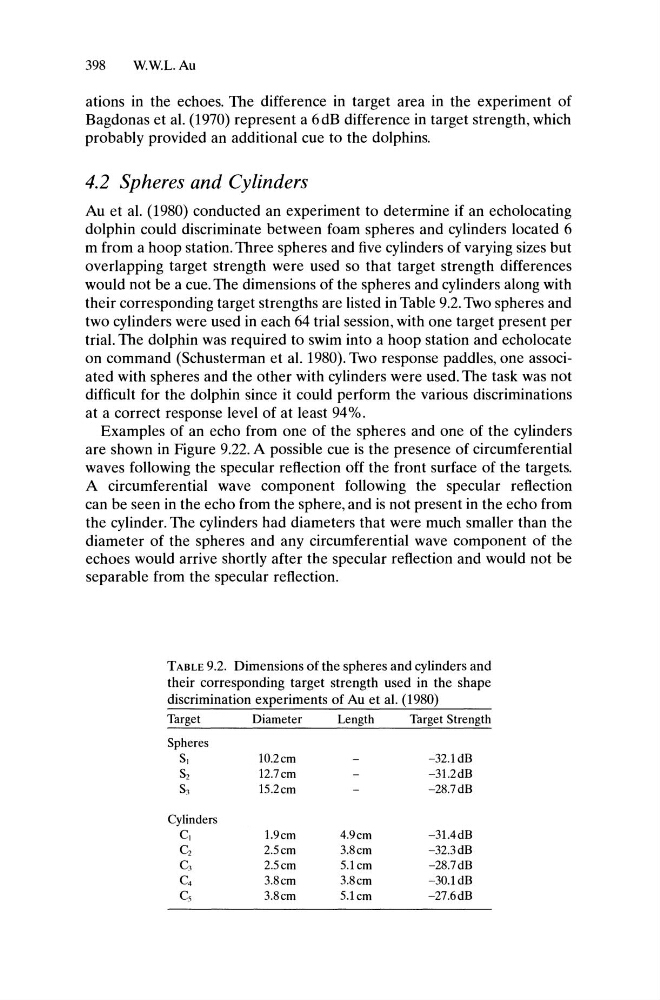
Au et al. (1980) conducted an experiment to determine if an echolocating
dolphin could discriminate between foam spheres and cylinders located 6
m from a hoop station. Three spheres and five cylinders of varying sizes but
overlapping target strength were used so that target strength differences
would not be a cue. The dimensions of the spheres and cylinders along with
their corresponding target strengths are listed in Table 9.2. Two spheres and
two cylinders were used in each 64 trial session, with one target present per
trial. The dolphin was required to swim into a hoop station and echolocate
on command (Schusterman et al. 1980). Two response paddles, one associated with spheres and the other with cylinders were used. The task was not
difficult for the dolphin since it could perform the various discriminations
at a correct response level of at least 94%.
Examples of an echo from one of the spheres and one of the cylinders
are shown in Figure 9.22. A possible cue is the presence of circumferential
waves following the specular reflection off the front surface of the targets.
A circumferential wave component following the specular reflection
can be seen in the echo from the sphere, and is not present in the echo from
the cylinder. The cylinders had diameters that were much smaller than the
diameter of the spheres and any circumferential wave component of the
echoes would arrive shortly after the specular reflection and would not be
separable from the specular reflection.
TABLE 9.2. Dimensions of the spheres and cylinders and
their corresponding target strength used in the shape
discrimination experiments of Au et aI. (1980)
Target
Diameter
Length
Target Strength
Spheres
SI
10.2 em
-32.1 dB
S2
12.7em
-31.2 dB
S,
15.2em
-28.7dB
Cylinders
C,
1.gem
4.gem
-31.4 dB
C 2
2.5em
3.8em
-32.3dB
C,
2.5em
5.1 em
-28.7dB
C.
3.8em
3.8em
-30.1 dB
C;
3.8em
5.1 em
-27.6dB
w.w.L. Au
ations in the echoes. The difference in target area in the experiment of
Bagdonas et al. (1970) represent a 6dB difference in target strength, which
probably provided an additional cue to the dolphins.
4.2 Spheres and Cylinders
Au et al. (1980) conducted an experiment to determine if an echolocating
dolphin could discriminate between foam spheres and cylinders located 6
m from a hoop station. Three spheres and five cylinders of varying sizes but
overlapping target strength were used so that target strength differences
would not be a cue. The dimensions of the spheres and cylinders along with
their corresponding target strengths are listed in Table 9.2. Two spheres and
two cylinders were used in each 64 trial session, with one target present per
trial. The dolphin was required to swim into a hoop station and echolocate
on command (Schusterman et al. 1980). Two response paddles, one associated with spheres and the other with cylinders were used. The task was not
difficult for the dolphin since it could perform the various discriminations
at a correct response level of at least 94%.
Examples of an echo from one of the spheres and one of the cylinders
are shown in Figure 9.22. A possible cue is the presence of circumferential
waves following the specular reflection off the front surface of the targets.
A circumferential wave component following the specular reflection
can be seen in the echo from the sphere, and is not present in the echo from
the cylinder. The cylinders had diameters that were much smaller than the
diameter of the spheres and any circumferential wave component of the
echoes would arrive shortly after the specular reflection and would not be
separable from the specular reflection.
TABLE 9.2. Dimensions of the spheres and cylinders and
their corresponding target strength used in the shape
discrimination experiments of Au et aI. (1980)
Target
Diameter
Length
Target Strength
Spheres
SI
10.2 em
-32.1 dB
S2
12.7em
-31.2 dB
S,
15.2em
-28.7dB
Cylinders
C,
1.gem
4.gem
-31.4 dB
C 2
2.5em
3.8em
-32.3dB
C,
2.5em
5.1 em
-28.7dB
C.
3.8em
3.8em
-30.1 dB
C;
3.8em
5.1 em
-27.6dB