

9. Echolocation in Dolphins
399
ECHO WAVEFORM
10.2 CM SPHERE
I
o
I
500 US~i:
0
1 Ilu!.. 2._5X_5_.1_C_M_C_YL_IN_D_E_R- -----1
!~~WVV
500 USEe
FREQUENCY SPECTRUM
................... .......
100
200
FREQUENCY (KHZ)
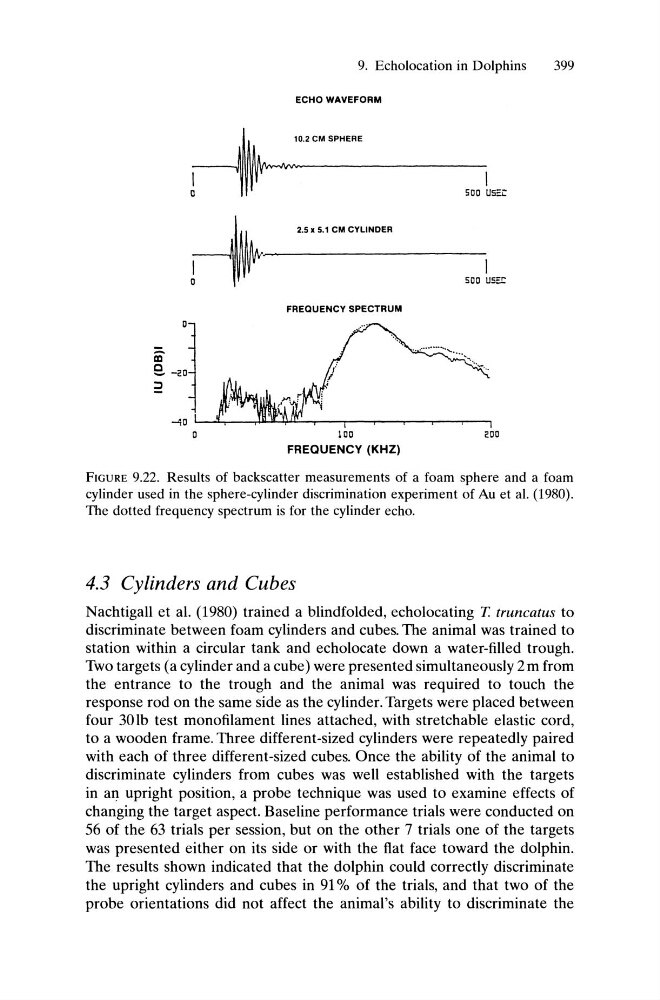
FIGURE 9.22. Results of backscatter measurements of a foam sphere and a foam
cylinder used in the sphere-cylinder discrimination experiment of Au et al. (1980).
The dotted frequency spectrum is for the cylinder echo.
4.3 Cylinders and Cubes
Nachtigall et al. (1980) trained a blindfolded, echolocating T. truncatus to
discriminate between foam cylinders and cubes. The animal was trained to
station within a circular tank and echolocate down a water-filled trough.
Two targets (a cylinder and a cube) were presented simultaneously 2 m from
the entrance to the trough and the animal was required to touch the
response rod on the same side as the cylinder. Targets were placed between
four 30lb test monofilament lines attached, with stretchable elastic cord,
to a wooden frame. Three different-sized cylinders were repeatedly paired
with each of three different-sized cubes. Once the ability of the animal to
discriminate cylinders from cubes was well established with the targets
in an upright position, a probe technique was used to examine effects of
changing the target aspect. Baseline performance trials were conducted on
56 of the 63 trials per session, but on the other 7 trials one of the targets
was presented either on its side or with the flat face toward the dolphin.
The results shown indicated that the dolphin could correctly discriminate
the upright cylinders and cubes in 91 % of the trials, and that two of the
probe orientations did not affect the animal's ability to discriminate the
399
ECHO WAVEFORM
10.2 CM SPHERE
I
o
I
500 US~i:
0
1 Ilu!.. 2._5X_5_.1_C_M_C_YL_IN_D_E_R- -----1
!~~WVV
500 USEe
FREQUENCY SPECTRUM
................... .......
100
200
FREQUENCY (KHZ)
FIGURE 9.22. Results of backscatter measurements of a foam sphere and a foam
cylinder used in the sphere-cylinder discrimination experiment of Au et al. (1980).
The dotted frequency spectrum is for the cylinder echo.
4.3 Cylinders and Cubes
Nachtigall et al. (1980) trained a blindfolded, echolocating T. truncatus to
discriminate between foam cylinders and cubes. The animal was trained to
station within a circular tank and echolocate down a water-filled trough.
Two targets (a cylinder and a cube) were presented simultaneously 2 m from
the entrance to the trough and the animal was required to touch the
response rod on the same side as the cylinder. Targets were placed between
four 30lb test monofilament lines attached, with stretchable elastic cord,
to a wooden frame. Three different-sized cylinders were repeatedly paired
with each of three different-sized cubes. Once the ability of the animal to
discriminate cylinders from cubes was well established with the targets
in an upright position, a probe technique was used to examine effects of
changing the target aspect. Baseline performance trials were conducted on
56 of the 63 trials per session, but on the other 7 trials one of the targets
was presented either on its side or with the flat face toward the dolphin.
The results shown indicated that the dolphin could correctly discriminate
the upright cylinders and cubes in 91 % of the trials, and that two of the
probe orientations did not affect the animal's ability to discriminate the