

376
W.W.L.Au
200
0 150
w
11l
~
.... oC(
> 100
a:
w
I~
~
0
El
::::i 50
0
o
---0
00
o
0
o
_ AU et al (1974)
A AU (1980)
G AU, PENNER & KAOANE (1982)
o PENNER & TURL (1984)
20
40
60
80
TARGET RANGE (M)
100
120
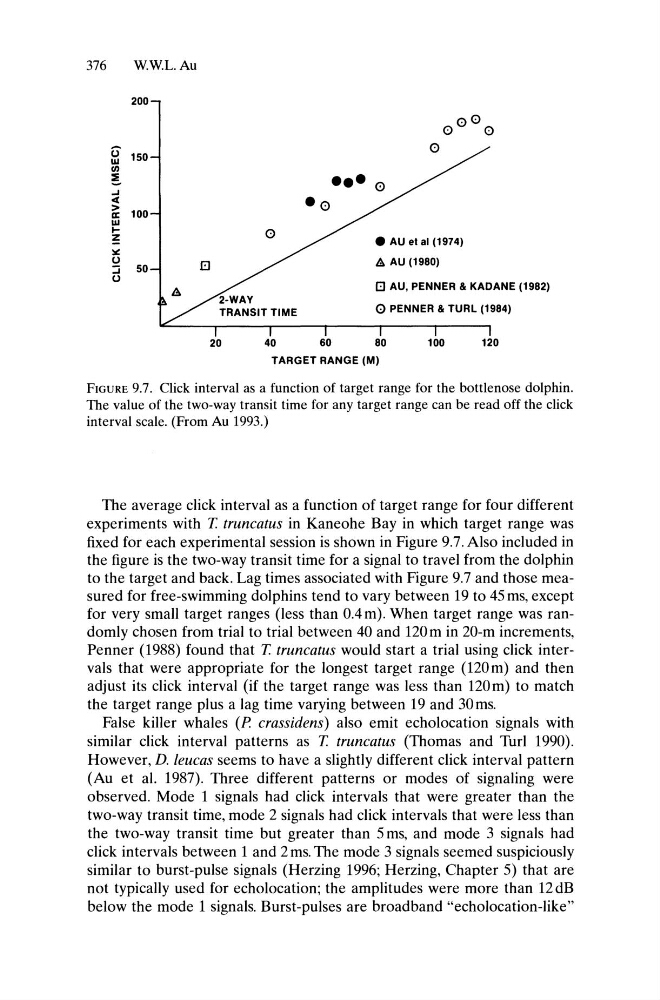
FIGURE 9.7. Click interval as a function of target range for the bottlenose dolphin.
The value of the two-way transit time for any target range can be read off the click
interval scale. (From Au 1993.)
The average click interval as a function of target range for four different
experiments with T. truncatus in Kaneohe Bay in which target range was
fixed for each experimental session is shown in Figure 9.7. Also included in
the figure is the two-way transit time for a signal to travel from the dolphin
to the target and back. Lag times associated with Figure 9.7 and those measured for free-swimming dolphins tend to vary between 19 to 45 ms, except
for very small target ranges (less than 0.4 m). When target range was randomly chosen from trial to trial between 40 and 120m in 20-m increments,
Penner (1988) found that T. truncatus would start a trial using click intervals that were appropriate for the longest target range (120m) and then
adjust its click interval (if the target range was less than 120m) to match
the target range plus a lag time varying between 19 and 30 ms.
False killer whales (P crassidens) also emit echolocation signals with
similar click interval patterns as T. truncatus (Thomas and Turl 1990).
However, D. leucas seems to have a slightly different click interval pattern
(Au et al. 1987). Three different patterns or modes of signaling were
observed. Mode 1 signals had click intervals that were greater than the
two-way transit time, mode 2 signals had click intervals that were less than
the two-way transit time but greater than 5 ms, and mode 3 signals had
click intervals between 1 and 2 ms. The mode 3 signals seemed suspiciously
similar to burst-pulse signals (Herzing 1996; Herzing, Chapter 5) that are
not typically used for echolocation; the amplitudes were more than 12dB
below the mode 1 signals. Burst-pulses are broadband "echolocation-like"
W.W.L.Au
200
0 150
w
11l
~
.... oC(
> 100
a:
w
I~
~
0
El
::::i 50
0
o
---0
00
o
0
o
_ AU et al (1974)
A AU (1980)
G AU, PENNER & KAOANE (1982)
o PENNER & TURL (1984)
20
40
60
80
TARGET RANGE (M)
100
120
FIGURE 9.7. Click interval as a function of target range for the bottlenose dolphin.
The value of the two-way transit time for any target range can be read off the click
interval scale. (From Au 1993.)
The average click interval as a function of target range for four different
experiments with T. truncatus in Kaneohe Bay in which target range was
fixed for each experimental session is shown in Figure 9.7. Also included in
the figure is the two-way transit time for a signal to travel from the dolphin
to the target and back. Lag times associated with Figure 9.7 and those measured for free-swimming dolphins tend to vary between 19 to 45 ms, except
for very small target ranges (less than 0.4 m). When target range was randomly chosen from trial to trial between 40 and 120m in 20-m increments,
Penner (1988) found that T. truncatus would start a trial using click intervals that were appropriate for the longest target range (120m) and then
adjust its click interval (if the target range was less than 120m) to match
the target range plus a lag time varying between 19 and 30 ms.
False killer whales (P crassidens) also emit echolocation signals with
similar click interval patterns as T. truncatus (Thomas and Turl 1990).
However, D. leucas seems to have a slightly different click interval pattern
(Au et al. 1987). Three different patterns or modes of signaling were
observed. Mode 1 signals had click intervals that were greater than the
two-way transit time, mode 2 signals had click intervals that were less than
the two-way transit time but greater than 5 ms, and mode 3 signals had
click intervals between 1 and 2 ms. The mode 3 signals seemed suspiciously
similar to burst-pulse signals (Herzing 1996; Herzing, Chapter 5) that are
not typically used for echolocation; the amplitudes were more than 12dB
below the mode 1 signals. Burst-pulses are broadband "echolocation-like"