

9. Echolocation in Dolphins
375
-1---+---t-----:~ 0
0
_10 0
_TYPE·1
.•• TYPE·2
_TYPE-3
_TYPE"
odB 20.
10·
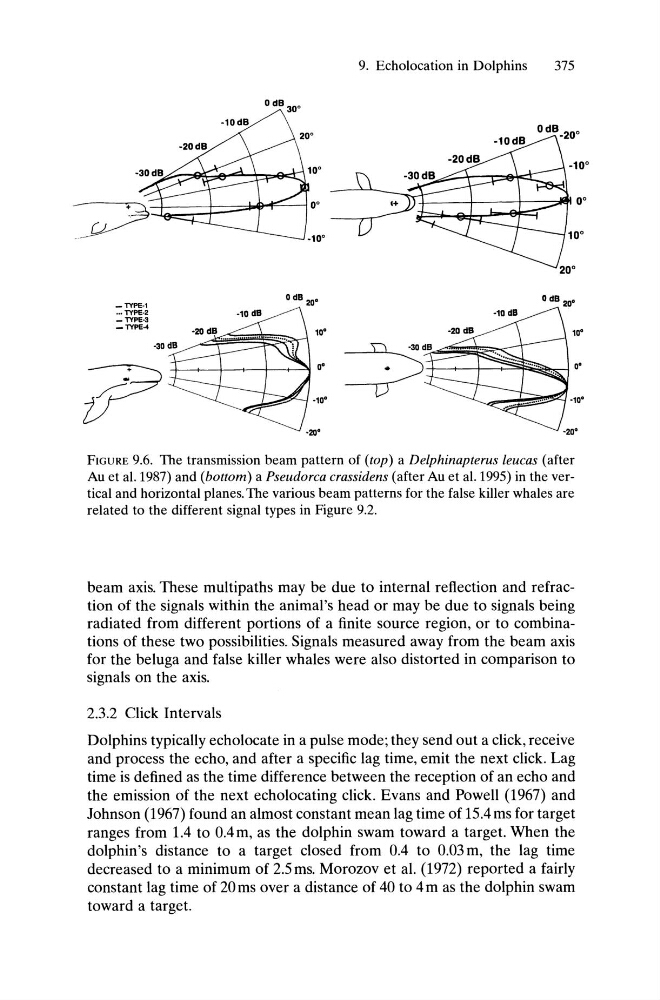
FIGURE 9.6. The transmission beam pattern of (top) a Delphinapterus leucas (after
Au et a1.1987) and (bottom) a Pseudorca crassidens (after Au et a1.1995) in the vertical and horizontal planes. The various beam patterns for the false killer whales are
related to the different signal types in Figure 9.2.
beam axis. These multipaths may be due to internal reflection and refraction of the signals within the animal's head or may be due to signals being
radiated from different portions of a finite source region, or to combinations of these two possibilities. Signals measured away from the beam axis
for the beluga and false killer whales were also distorted in comparison to
signals on the axis.
2.3.2 Click Intervals
Dolphins typically echolocate in a pulse mode; they send out a click, receive
and process the echo, and after a specific lag time, emit the next click. Lag
time is defined as the time difference between the reception of an echo and
the emission of the next echolocating click. Evans and Powell (1967) and
Johnson (1967) found an almost constant mean lag time of 15.4ms for target
ranges from 1.4 to O.4m, as the dolphin swam toward a target. When the
dolphin's distance to a target closed from 0.4 to 0.03m, the lag time
decreased to a minimum of 2.5ms. Morozov et at. (1972) reported a fairly
constant lag time of 20ms over a distance of 40 to 4m as the dolphin swam
toward a target.
375
-1---+---t-----:~ 0
0
_10 0
_TYPE·1
.•• TYPE·2
_TYPE-3
_TYPE"
odB 20.
10·
FIGURE 9.6. The transmission beam pattern of (top) a Delphinapterus leucas (after
Au et a1.1987) and (bottom) a Pseudorca crassidens (after Au et a1.1995) in the vertical and horizontal planes. The various beam patterns for the false killer whales are
related to the different signal types in Figure 9.2.
beam axis. These multipaths may be due to internal reflection and refraction of the signals within the animal's head or may be due to signals being
radiated from different portions of a finite source region, or to combinations of these two possibilities. Signals measured away from the beam axis
for the beluga and false killer whales were also distorted in comparison to
signals on the axis.
2.3.2 Click Intervals
Dolphins typically echolocate in a pulse mode; they send out a click, receive
and process the echo, and after a specific lag time, emit the next click. Lag
time is defined as the time difference between the reception of an echo and
the emission of the next echolocating click. Evans and Powell (1967) and
Johnson (1967) found an almost constant mean lag time of 15.4ms for target
ranges from 1.4 to O.4m, as the dolphin swam toward a target. When the
dolphin's distance to a target closed from 0.4 to 0.03m, the lag time
decreased to a minimum of 2.5ms. Morozov et at. (1972) reported a fairly
constant lag time of 20ms over a distance of 40 to 4m as the dolphin swam
toward a target.