

340
PE. Nachtigall et at.
1«1
-0 • P.!lel.d:7ta aassiins
1:
-6-~grissus
,",",*-~Jeu::as
100
iii
~ £()
" :g . .
!! 00
.s:.
....
40
20
0
0.1
10
100
1000
FI8QIJBlCY (kHz)
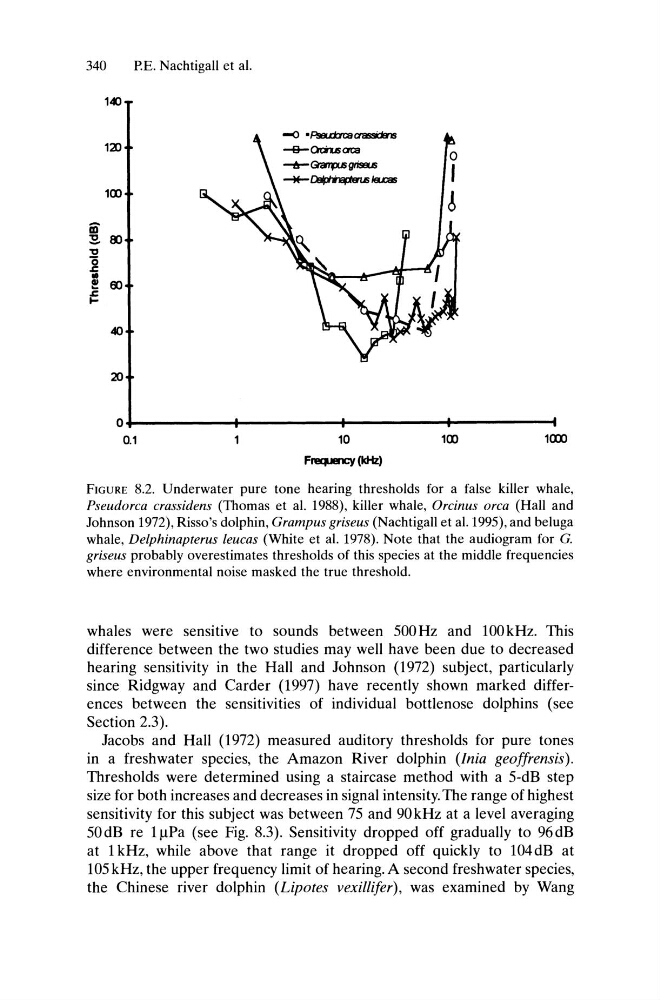
FIGURE 8.2. Underwater pure tone hearing thresholds for a false killer whale,
Pseudorca crassidens (Thomas et at. 1988), killer whale, Orcinus orca (Hall and
Johnson 1972), Risso's dolphin, Grampus griseus (Nachtigall et at. 1995), and beluga
whale, Delphinapterus leucas (White et at. 1978). Note that the audiogram for G.
griseus probably overestimates thresholds of this species at the middle frequencies
where environmental noise masked the true threshold.
whales were sensItive to sounds between 500 Hz and 100 kHz. This
difference between the two studies may well have been due to decreased
hearing sensitivity in the Hall and Johnson (1972) subject, particularly
since Ridgway and Carder (1997) have recently shown marked differences between the sensitivities of individual bottlenose dolphins (see
Section 2.3).
Jacobs and Hall (1972) measured auditory thresholds for pure tones
in a freshwater species, the Amazon River dolphin (Inia geoffrensis).
Thresholds were determined using a staircase method with a 5-dB step
size for both increases and decreases in signal intensity. The range of highest
sensitivity for this subject was between 75 and 90 kHz at a level averaging
50dB re 1flPa (see Fig. 8.3). Sensitivity dropped off gradually to 96dB
at 1 kHz, while above that range it dropped off quickly to 104 dB at
105 kHz, the upper frequency limit of hearing. A second freshwater species,
the Chinese river dolphin (Lipotes vexillifer) , was examined by Wang
PE. Nachtigall et at.
1«1
-0 • P.!lel.d:7ta aassiins
1:
-6-~grissus
,",",*-~Jeu::as
100
iii
~ £()
" :g . .
!! 00
.s:.
....
40
20
0
0.1
10
100
1000
FI8QIJBlCY (kHz)
FIGURE 8.2. Underwater pure tone hearing thresholds for a false killer whale,
Pseudorca crassidens (Thomas et at. 1988), killer whale, Orcinus orca (Hall and
Johnson 1972), Risso's dolphin, Grampus griseus (Nachtigall et at. 1995), and beluga
whale, Delphinapterus leucas (White et at. 1978). Note that the audiogram for G.
griseus probably overestimates thresholds of this species at the middle frequencies
where environmental noise masked the true threshold.
whales were sensItive to sounds between 500 Hz and 100 kHz. This
difference between the two studies may well have been due to decreased
hearing sensitivity in the Hall and Johnson (1972) subject, particularly
since Ridgway and Carder (1997) have recently shown marked differences between the sensitivities of individual bottlenose dolphins (see
Section 2.3).
Jacobs and Hall (1972) measured auditory thresholds for pure tones
in a freshwater species, the Amazon River dolphin (Inia geoffrensis).
Thresholds were determined using a staircase method with a 5-dB step
size for both increases and decreases in signal intensity. The range of highest
sensitivity for this subject was between 75 and 90 kHz at a level averaging
50dB re 1flPa (see Fig. 8.3). Sensitivity dropped off gradually to 96dB
at 1 kHz, while above that range it dropped off quickly to 104 dB at
105 kHz, the upper frequency limit of hearing. A second freshwater species,
the Chinese river dolphin (Lipotes vexillifer) , was examined by Wang