

8. Psychoacoustic Studies of Dolphins and Whales
339
160
140
-:> • T. "uncatus
120
.~100
I
! 80
~
60
40
~ T. "uncetus gIIM
_ _ Po p/I~".
1000
100
10
Frequency (kHz)
20 -1------.....------1-------+-----......
0.1
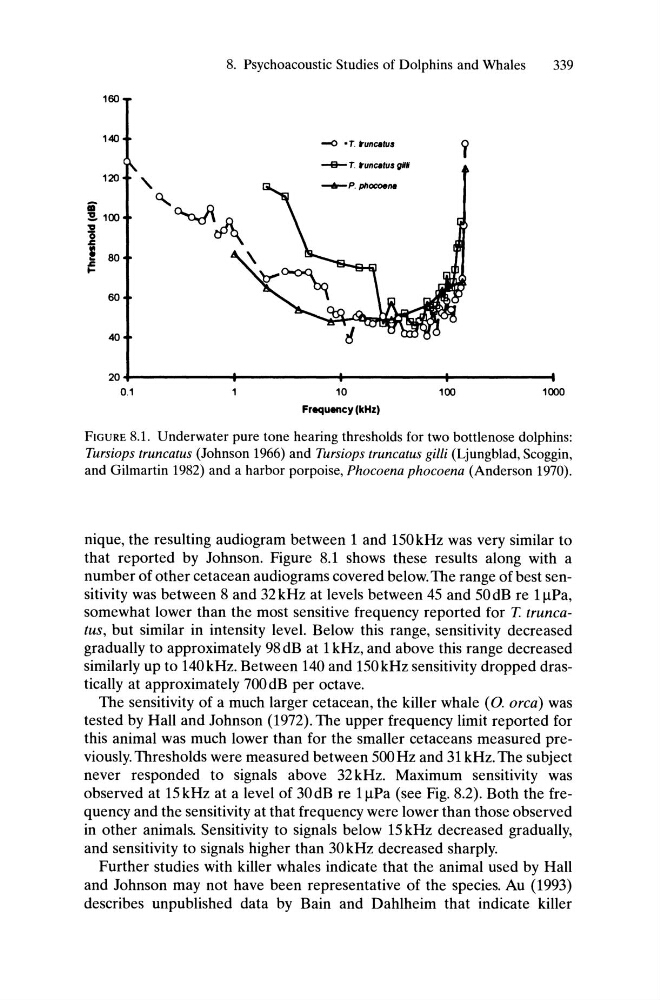
FIGURE 8.1. Underwater pure tone hearing thresholds for two bottlenose dolphins:
Tursiops truncatus (Johnson 1966) and Tursiops truncatus gilli (Ljungblad, Scoggin,
and Gilmartin 1982) and a harbor porpoise, Phocoena phocoena (Anderson 1970).
nique, the resulting audiogram between 1 and 150kHz was very similar to
that reported by Johnson. Figure 8.1 shows these results along with a
number of other cetacean audiograms covered below. The range of best sensitivity was between 8 and 32 kHz at levels between 45 and 50 dB re 1flPa,
somewhat lower than the most sensitive frequency reported for T. truncatus, but similar in intensity level. Below this range, sensitivity decreased
gradually to approximately 98dB at 1 kHz, and above this range decreased
similarly up to 140kHz. Between 140 and 150kHz sensitivity dropped drastically at approximately 700dB per octave.
The sensitivity of a much larger cetacean, the killer whale (0. orca) was
tested by Hall and Johnson (1972). The upper frequency limit reported for
this animal was much lower than for the smaller cetaceans measured previously. Thresholds were measured between 500 Hz and 31 kHz. The subject
never responded to signals above 32 kHz. Maximum sensitivity was
observed at 15 kHz at a level of 30dB re 1flPa (see Fig. 8.2). Both the frequency and the sensitivity at that frequency were lower than those observed
in other animals. Sensitivity to signals below 15 kHz decreased gradually,
and sensitivity to signals higher than 30 kHz decreased sharply.
Further studies with killer whales indicate that the animal used by Hall
and Johnson may not have been representative of the species. Au (1993)
describes unpublished data by Bain and Dahlheim that indicate killer
339
160
140
-:> • T. "uncatus
120
.~100
I
! 80
~
60
40
~ T. "uncetus gIIM
_ _ Po p/I~".
1000
100
10
Frequency (kHz)
20 -1------.....------1-------+-----......
0.1
FIGURE 8.1. Underwater pure tone hearing thresholds for two bottlenose dolphins:
Tursiops truncatus (Johnson 1966) and Tursiops truncatus gilli (Ljungblad, Scoggin,
and Gilmartin 1982) and a harbor porpoise, Phocoena phocoena (Anderson 1970).
nique, the resulting audiogram between 1 and 150kHz was very similar to
that reported by Johnson. Figure 8.1 shows these results along with a
number of other cetacean audiograms covered below. The range of best sensitivity was between 8 and 32 kHz at levels between 45 and 50 dB re 1flPa,
somewhat lower than the most sensitive frequency reported for T. truncatus, but similar in intensity level. Below this range, sensitivity decreased
gradually to approximately 98dB at 1 kHz, and above this range decreased
similarly up to 140kHz. Between 140 and 150kHz sensitivity dropped drastically at approximately 700dB per octave.
The sensitivity of a much larger cetacean, the killer whale (0. orca) was
tested by Hall and Johnson (1972). The upper frequency limit reported for
this animal was much lower than for the smaller cetaceans measured previously. Thresholds were measured between 500 Hz and 31 kHz. The subject
never responded to signals above 32 kHz. Maximum sensitivity was
observed at 15 kHz at a level of 30dB re 1flPa (see Fig. 8.2). Both the frequency and the sensitivity at that frequency were lower than those observed
in other animals. Sensitivity to signals below 15 kHz decreased gradually,
and sensitivity to signals higher than 30 kHz decreased sharply.
Further studies with killer whales indicate that the animal used by Hall
and Johnson may not have been representative of the species. Au (1993)
describes unpublished data by Bain and Dahlheim that indicate killer