

8. Psychoacoustic Studies of Dolphins and Whales
341
130
120
110
100
iii
:!:!. 90
:li!
0
.c
! 80
.c
~
70
60
50
40
0.1
-Q-Inie geotrrensls
-+-L""Ie$ vexiller
10
F,.quency (kHz)
100
1000
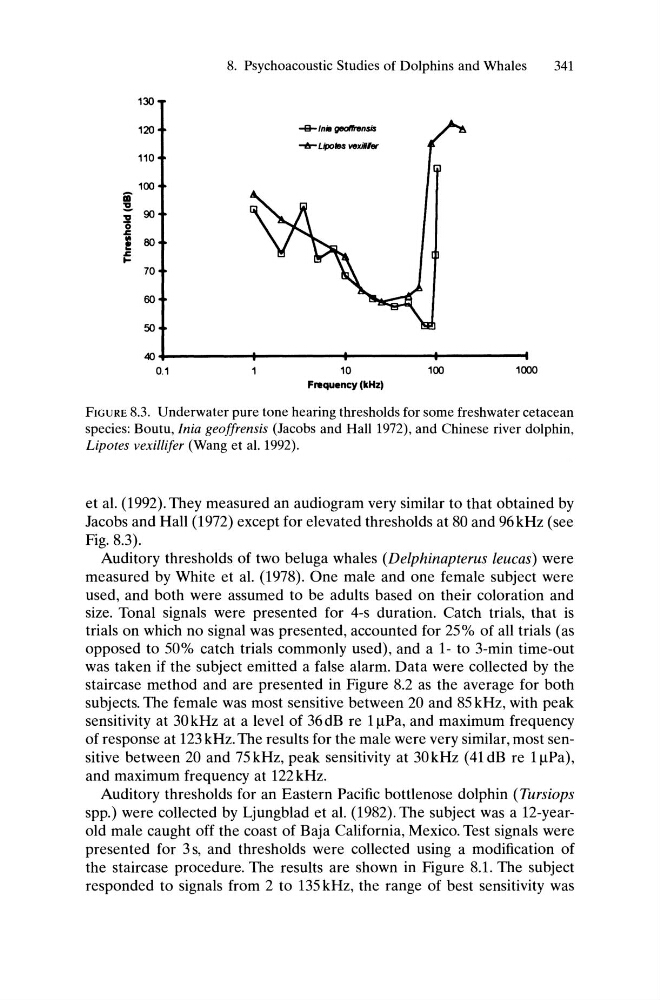
FIGURE 8.3. Underwater pure tone hearing thresholds for some freshwater cetacean
species: Boutu, Inia geoffrensis (Jacobs and Hall 1972), and Chinese river dolphin,
Lipotes vexillifer (Wang et al. 1992).
et al. (1992). They measured an audiogram very similar to that obtained by
Jacobs and Hall (1972) except for elevated thresholds at 80 and 96kHz (see
Fig. 8.3).
Auditory thresholds of two beluga whales (Delphinapterus leucas) were
measured by White et al. (1978). One male and one female subject were
used, and both were assumed to be adults based on their coloration and
size. Tonal signals were presented for 4-s duration. Catch trials, that is
trials on which no signal was presented, accounted for 25% of all trials (as
opposed to 50% catch trials commonly used), and a 1- to 3-min time-out
was taken if the subject emitted a false alarm. Data were collected by the
staircase method and are presented in Figure 8.2 as the average for both
subjects. The female was most sensitive between 20 and 85 kHz, with peak
sensitivity at 30 kHz at a level of 36 dB re IIlPa, and maximum frequency
of response at 123 kHz. The results for the male were very similar, most sensitive between 20 and 75 kHz, peak sensitivity at 30 kHz (41 dB re IIlPa),
and maximum frequency at 122 kHz.
Auditory thresholds for an Eastern Pacific bottlenose dolphin (Tursiops
spp.) were collected by Ljungblad et al. (1982). The subject was a 12-yearold male caught off the coast of Baja California, Mexico. Test signals were
presented for 3s, and thresholds were collected using a modification of
the staircase procedure. The results are shown in Figure 8.1. The subject
responded to signals from 2 to 135 kHz, the range of best sensitivity was
341
130
120
110
100
iii
:!:!. 90
:li!
0
.c
! 80
.c
~
70
60
50
40
0.1
-Q-Inie geotrrensls
-+-L""Ie$ vexiller
10
F,.quency (kHz)
100
1000
FIGURE 8.3. Underwater pure tone hearing thresholds for some freshwater cetacean
species: Boutu, Inia geoffrensis (Jacobs and Hall 1972), and Chinese river dolphin,
Lipotes vexillifer (Wang et al. 1992).
et al. (1992). They measured an audiogram very similar to that obtained by
Jacobs and Hall (1972) except for elevated thresholds at 80 and 96kHz (see
Fig. 8.3).
Auditory thresholds of two beluga whales (Delphinapterus leucas) were
measured by White et al. (1978). One male and one female subject were
used, and both were assumed to be adults based on their coloration and
size. Tonal signals were presented for 4-s duration. Catch trials, that is
trials on which no signal was presented, accounted for 25% of all trials (as
opposed to 50% catch trials commonly used), and a 1- to 3-min time-out
was taken if the subject emitted a false alarm. Data were collected by the
staircase method and are presented in Figure 8.2 as the average for both
subjects. The female was most sensitive between 20 and 85 kHz, with peak
sensitivity at 30 kHz at a level of 36 dB re IIlPa, and maximum frequency
of response at 123 kHz. The results for the male were very similar, most sensitive between 20 and 75 kHz, peak sensitivity at 30 kHz (41 dB re IIlPa),
and maximum frequency at 122 kHz.
Auditory thresholds for an Eastern Pacific bottlenose dolphin (Tursiops
spp.) were collected by Ljungblad et al. (1982). The subject was a 12-yearold male caught off the coast of Baja California, Mexico. Test signals were
presented for 3s, and thresholds were collected using a modification of
the staircase procedure. The results are shown in Figure 8.1. The subject
responded to signals from 2 to 135 kHz, the range of best sensitivity was