

7. Electrophysiological Techniques
315
o
~ "l
tn -250 r
~
I
Cl
Q)
~ -500
Q)
tn
co
.c
a... -750
500 Hz
1000 Hz
4000 Hz
10000 Hz
Avg
250 500 750 1000 1250 1500 1750
F2,1 (Hz)
-1 000 L-~--'-----~~~---L~-----L~ _ _~--'--~---'--o
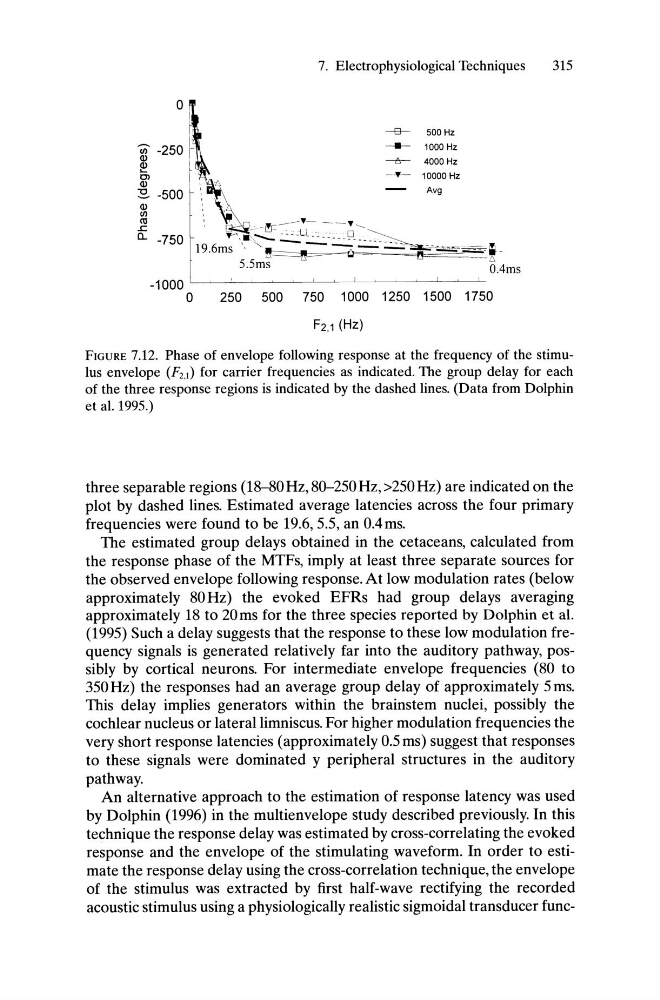
FIGURE 7.12. Phase of envelope following response at the frequency of the stimulus envelope (F 2 • 1 ) for carrier frequencies as indicated. The group delay for each
of the three response regions is indicated by the dashed lines. (Data from Dolphin
et al. 1995.)
three separable regions (18-80 Hz, 80-250 Hz, >250 Hz) are indicated on the
plot by dashed lines. Estimated average latencies across the four primary
frequencies were found to be 19.6,5.5, an OAms.
The estimated group delays obtained in the cetaceans, calculated from
the response phase of the MTFs, imply at least three separate sources for
the observed envelope following response. At low modulation rates (below
approximately 80Hz) the evoked EFRs had group delays averaging
approximately 18 to 20ms for the three species reported by Dolphin et al.
(1995) Such a delay suggests that the response to these low modulation frequency signals is generated relatively far into the auditory pathway, possibly by cortical neurons. For intermediate envelope frequencies (80 to
350Hz) the responses had an average group delay of approximately 5ms.
This delay implies generators within the brainstem nuclei, possibly the
cochlear nucleus or laterallimniscus. For higher modulation frequencies the
very short response latencies (approximately 0.5 ms) suggest that responses
to these signals were dominated y peripheral structures in the auditory
pathway.
An alternative approach to the estimation of response latency was used
by Dolphin (1996) in the multienvelope study described previously. In this
technique the response delay was estimated by cross-correlating the evoked
response and the envelope of the stimulating waveform. In order to estimate the response delay using the cross-correlation technique, the envelope
of the stimulus was extracted by first half-wave rectifying the recorded
acoustic stimulus using a physiologically realistic sigmoidal transducer func-
315
o
~ "l
tn -250 r
~
I
Cl
Q)
~ -500
Q)
tn
co
.c
a... -750
500 Hz
1000 Hz
4000 Hz
10000 Hz
Avg
250 500 750 1000 1250 1500 1750
F2,1 (Hz)
-1 000 L-~--'-----~~~---L~-----L~ _ _~--'--~---'--o
FIGURE 7.12. Phase of envelope following response at the frequency of the stimulus envelope (F 2 • 1 ) for carrier frequencies as indicated. The group delay for each
of the three response regions is indicated by the dashed lines. (Data from Dolphin
et al. 1995.)
three separable regions (18-80 Hz, 80-250 Hz, >250 Hz) are indicated on the
plot by dashed lines. Estimated average latencies across the four primary
frequencies were found to be 19.6,5.5, an OAms.
The estimated group delays obtained in the cetaceans, calculated from
the response phase of the MTFs, imply at least three separate sources for
the observed envelope following response. At low modulation rates (below
approximately 80Hz) the evoked EFRs had group delays averaging
approximately 18 to 20ms for the three species reported by Dolphin et al.
(1995) Such a delay suggests that the response to these low modulation frequency signals is generated relatively far into the auditory pathway, possibly by cortical neurons. For intermediate envelope frequencies (80 to
350Hz) the responses had an average group delay of approximately 5ms.
This delay implies generators within the brainstem nuclei, possibly the
cochlear nucleus or laterallimniscus. For higher modulation frequencies the
very short response latencies (approximately 0.5 ms) suggest that responses
to these signals were dominated y peripheral structures in the auditory
pathway.
An alternative approach to the estimation of response latency was used
by Dolphin (1996) in the multienvelope study described previously. In this
technique the response delay was estimated by cross-correlating the evoked
response and the envelope of the stimulating waveform. In order to estimate the response delay using the cross-correlation technique, the envelope
of the stimulus was extracted by first half-wave rectifying the recorded
acoustic stimulus using a physiologically realistic sigmoidal transducer func-