

304
W.E Dolphin
V
12
10
:;- 8
2Q)
"0 6
::J
:!:
a. 4
E
« 2
0
0.000
0.001
0.002
0.003
0.004
0.005
0.006
0.007
Time (sec)
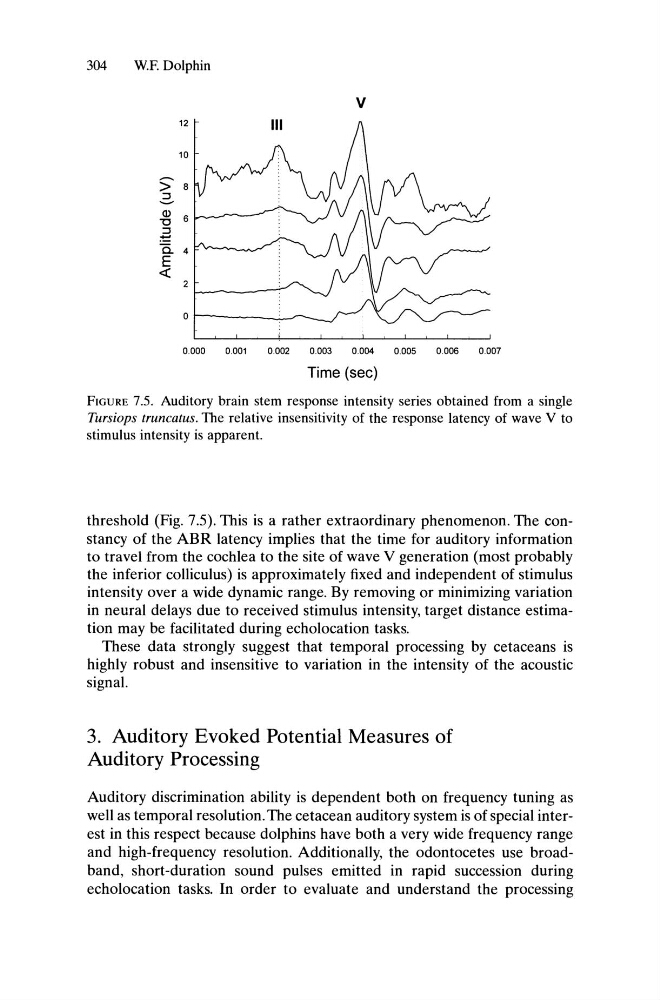
FIGURE 7.5. Auditory brain stem response intensity series obtained from a single
Tursiops truncatus. The relative insensitivity of the response latency of wave V to
stimulus intensity is apparent.
threshold (Fig. 7.5). This is a rather extraordinary phenomenon. The constancy of the ABR latency implies that the time for auditory information
to travel from the cochlea to the site of wave V generation (most probably
the inferior colliculus) is approximately fixed and independent of stimulus
intensity over a wide dynamic range. By removing or minimizing variation
in neural delays due to received stimulus intensity, target distance estimation may be facilitated during echolocation tasks.
These data strongly suggest that temporal processing by cetaceans is
highly robust and insensitive to variation in the intensity of the acoustic
signal.
3. Auditory Evoked Potential Measures of
Auditory Processing
Auditory discrimination ability is dependent both on frequency tuning as
well as temporal resolution. The cetacean auditory system is of special interest in this respect because dolphins have both a very wide frequency range
and high-frequency resolution. Additionally, the odontocetes use broadband, short-duration sound pulses emitted in rapid succession during
echolocation tasks. In order to evaluate and understand the processing
W.E Dolphin
V
12
10
:;- 8
2Q)
"0 6
::J
:!:
a. 4
E
« 2
0
0.000
0.001
0.002
0.003
0.004
0.005
0.006
0.007
Time (sec)
FIGURE 7.5. Auditory brain stem response intensity series obtained from a single
Tursiops truncatus. The relative insensitivity of the response latency of wave V to
stimulus intensity is apparent.
threshold (Fig. 7.5). This is a rather extraordinary phenomenon. The constancy of the ABR latency implies that the time for auditory information
to travel from the cochlea to the site of wave V generation (most probably
the inferior colliculus) is approximately fixed and independent of stimulus
intensity over a wide dynamic range. By removing or minimizing variation
in neural delays due to received stimulus intensity, target distance estimation may be facilitated during echolocation tasks.
These data strongly suggest that temporal processing by cetaceans is
highly robust and insensitive to variation in the intensity of the acoustic
signal.
3. Auditory Evoked Potential Measures of
Auditory Processing
Auditory discrimination ability is dependent both on frequency tuning as
well as temporal resolution. The cetacean auditory system is of special interest in this respect because dolphins have both a very wide frequency range
and high-frequency resolution. Additionally, the odontocetes use broadband, short-duration sound pulses emitted in rapid succession during
echolocation tasks. In order to evaluate and understand the processing