

333
This results in sensitivity differences between species of approximately 20–40 dB
(SPL and PAL) (Schulz-Mirbach et al. 2012 ).
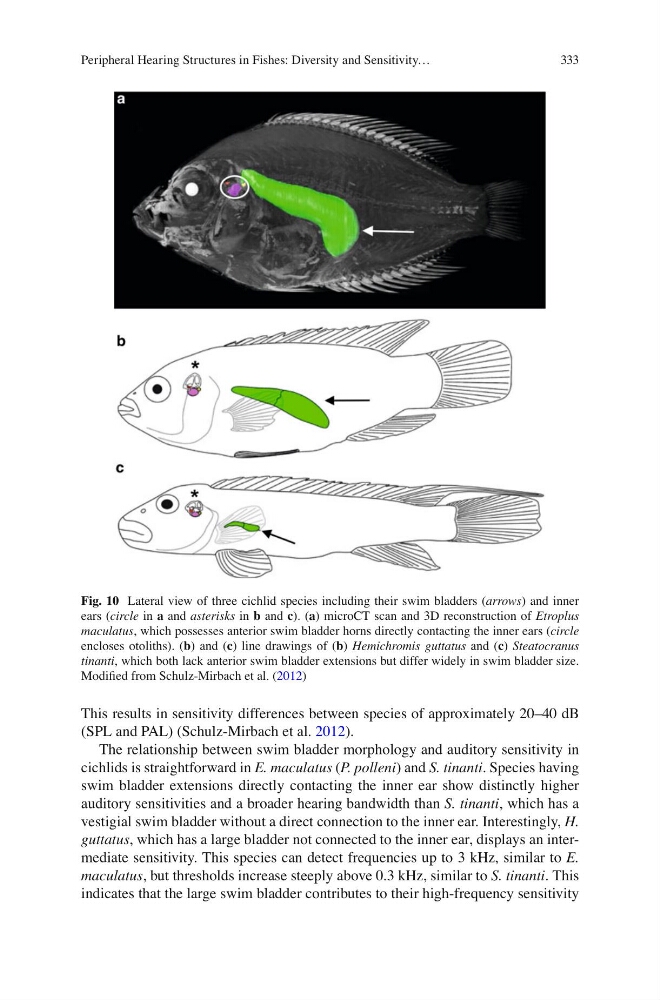
The relationship between swim bladder morphology and auditory sensitivity in
cichlids is straightforward in E. maculatus ( P. polleni ) and S. tinanti . Species having
swim bladder extensions directly contacting the inner ear show distinctly higher
auditory sensitivities and a broader hearing bandwidth than S. tinanti , which has a
vestigial swim bladder without a direct connection to the inner ear. Interestingly, H.
guttatus , which has a large bladder not connected to the inner ear, displays an intermediate sensitivity. This species can detect frequencies up to 3 kHz, similar to E.
maculatus , but thresholds increase steeply above 0.3 kHz, similar to S. tinanti . This
indicates that the large swim bladder contributes to their high-frequency sensitivity
Fig. 10 Lateral view of three cichlid species including their swim bladders ( arrows ) and inner
ears ( circle in a and asterisks in b and c ). ( a ) microCT scan and 3D reconstruction of Etroplus
maculatus , which possesses anterior swim bladder horns directly contacting the inner ears ( circle
encloses otoliths). ( b ) and ( c ) line drawings of ( b ) Hemichromis guttatus and ( c ) Steatocranus
tinanti , which both lack anterior swim bladder extensions but differ widely in swim bladder size.
Modifi ed from Schulz-Mirbach et al. ( 2012 )
Peripheral Hearing Structures in Fishes: Diversity and Sensitivity…
This results in sensitivity differences between species of approximately 20–40 dB
(SPL and PAL) (Schulz-Mirbach et al. 2012 ).
The relationship between swim bladder morphology and auditory sensitivity in
cichlids is straightforward in E. maculatus ( P. polleni ) and S. tinanti . Species having
swim bladder extensions directly contacting the inner ear show distinctly higher
auditory sensitivities and a broader hearing bandwidth than S. tinanti , which has a
vestigial swim bladder without a direct connection to the inner ear. Interestingly, H.
guttatus , which has a large bladder not connected to the inner ear, displays an intermediate sensitivity. This species can detect frequencies up to 3 kHz, similar to E.
maculatus , but thresholds increase steeply above 0.3 kHz, similar to S. tinanti . This
indicates that the large swim bladder contributes to their high-frequency sensitivity
Fig. 10 Lateral view of three cichlid species including their swim bladders ( arrows ) and inner
ears ( circle in a and asterisks in b and c ). ( a ) microCT scan and 3D reconstruction of Etroplus
maculatus , which possesses anterior swim bladder horns directly contacting the inner ears ( circle
encloses otoliths). ( b ) and ( c ) line drawings of ( b ) Hemichromis guttatus and ( c ) Steatocranus
tinanti , which both lack anterior swim bladder extensions but differ widely in swim bladder size.
Modifi ed from Schulz-Mirbach et al. ( 2012 )
Peripheral Hearing Structures in Fishes: Diversity and Sensitivity…