

332
4 Cichlids
Cichlids represent a huge family of freshwater fi shes (more than 1000 species) and
are an interesting group of bony fi shes for studying the relationship between swim
bladder form and its effect on hearing sensitivity. This is because they exhibit a large
diversity in swim bladder size and in the swim bladder–inner ear linkage. In contrast
to catfi shes (and otophysines in general) they do not always possess a mechanical
linkage between the swim bladder and the inner ear, and in contrast to other families
such as sciaenids (Ramcharitar et al. 2006 ) their swim bladder varies considerably
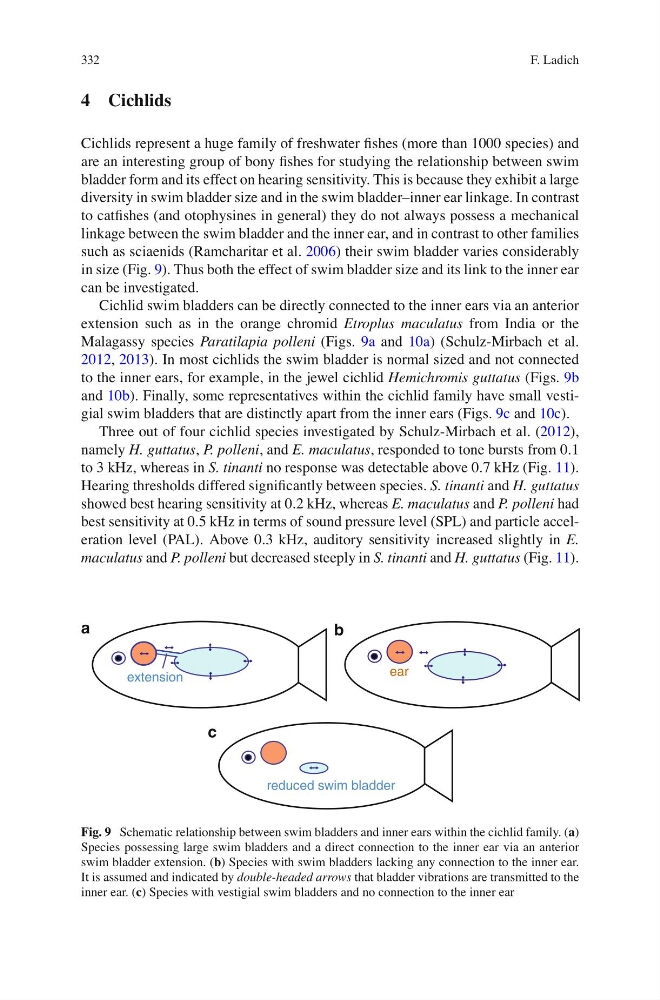
in size (Fig. 9 ). Thus both the effect of swim bladder size and its link to the inner ear
can be investigated.
Cichlid swim bladders can be directly connected to the inner ears via an anterior
extension such as in the orange chromid Etroplus maculatus from India or the
Malagassy species Paratilapia polleni (Figs. 9a and 10a ) (Schulz-Mirbach et al.
2012 , 2013 ). In most cichlids the swim bladder is normal sized and not connected
to the inner ears, for example, in the jewel cichlid Hemichromis guttatus (Figs. 9b
and 10b ). Finally, some representatives within the cichlid family have small vestigial swim bladders that are distinctly apart from the inner ears (Figs. 9c and 10c ).
Three out of four cichlid species investigated by Schulz-Mirbach et al. ( 2012 ),
namely H. guttatus , P. polleni , and E. maculatus , responded to tone bursts from 0.1
to 3 kHz, whereas in S. tinanti no response was detectable above 0.7 kHz (Fig. 11 ).
Hearing thresholds differed signifi cantly between species. S. tinanti and H. guttatus
showed best hearing sensitivity at 0.2 kHz, whereas E. maculatus and P. polleni had
best sensitivity at 0.5 kHz in terms of sound pressure level (SPL) and particle acceleration level (PAL). Above 0.3 kHz, auditory sensitivity increased slightly in E.
maculatus and P. polleni but decreased steeply in S. tinanti and H. guttatus (Fig. 11 ).
extension
a
ear
b
reduced swim bladder
c
Fig. 9 Schematic relationship between swim bladders and inner ears within the cichlid family. ( a )
Species possessing large swim bladders and a direct connection to the inner ear via an anterior
swim bladder extension. ( b ) Species with swim bladders lacking any connection to the inner ear.
It is assumed and indicated by double-headed arrows that bladder vibrations are transmitted to the
inner ear. ( c ) Species with vestigial swim bladders and no connection to the inner ear
F. Ladich
4 Cichlids
Cichlids represent a huge family of freshwater fi shes (more than 1000 species) and
are an interesting group of bony fi shes for studying the relationship between swim
bladder form and its effect on hearing sensitivity. This is because they exhibit a large
diversity in swim bladder size and in the swim bladder–inner ear linkage. In contrast
to catfi shes (and otophysines in general) they do not always possess a mechanical
linkage between the swim bladder and the inner ear, and in contrast to other families
such as sciaenids (Ramcharitar et al. 2006 ) their swim bladder varies considerably
in size (Fig. 9 ). Thus both the effect of swim bladder size and its link to the inner ear
can be investigated.
Cichlid swim bladders can be directly connected to the inner ears via an anterior
extension such as in the orange chromid Etroplus maculatus from India or the
Malagassy species Paratilapia polleni (Figs. 9a and 10a ) (Schulz-Mirbach et al.
2012 , 2013 ). In most cichlids the swim bladder is normal sized and not connected
to the inner ears, for example, in the jewel cichlid Hemichromis guttatus (Figs. 9b
and 10b ). Finally, some representatives within the cichlid family have small vestigial swim bladders that are distinctly apart from the inner ears (Figs. 9c and 10c ).
Three out of four cichlid species investigated by Schulz-Mirbach et al. ( 2012 ),
namely H. guttatus , P. polleni , and E. maculatus , responded to tone bursts from 0.1
to 3 kHz, whereas in S. tinanti no response was detectable above 0.7 kHz (Fig. 11 ).
Hearing thresholds differed signifi cantly between species. S. tinanti and H. guttatus
showed best hearing sensitivity at 0.2 kHz, whereas E. maculatus and P. polleni had
best sensitivity at 0.5 kHz in terms of sound pressure level (SPL) and particle acceleration level (PAL). Above 0.3 kHz, auditory sensitivity increased slightly in E.
maculatus and P. polleni but decreased steeply in S. tinanti and H. guttatus (Fig. 11 ).
extension
a
ear
b
reduced swim bladder
c
Fig. 9 Schematic relationship between swim bladders and inner ears within the cichlid family. ( a )
Species possessing large swim bladders and a direct connection to the inner ear via an anterior
swim bladder extension. ( b ) Species with swim bladders lacking any connection to the inner ear.
It is assumed and indicated by double-headed arrows that bladder vibrations are transmitted to the
inner ear. ( c ) Species with vestigial swim bladders and no connection to the inner ear
F. Ladich