

331
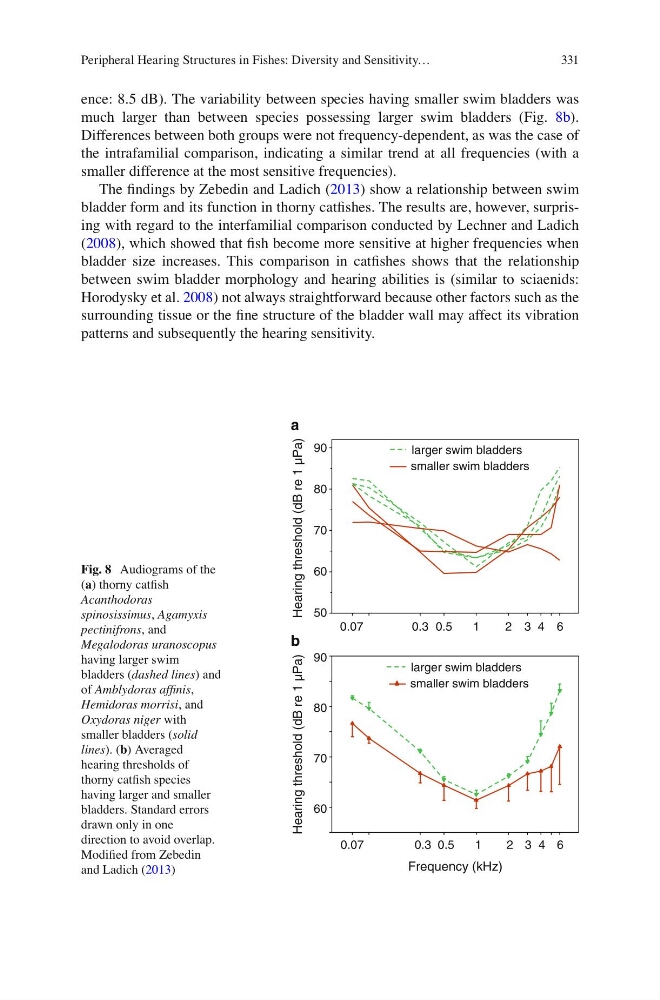
ence: 8.5 dB). The variability between species having smaller swim bladders was
much larger than between species possessing larger swim bladders (Fig. 8b ).
Differences between both groups were not frequency-dependent, as was the case of
the intrafamilial comparison, indicating a similar trend at all frequencies (with a
smaller difference at the most sensitive frequencies).
The fi ndings by Zebedin and Ladich ( 2013 ) show a relationship between swim
bladder form and its function in thorny catfi shes. The results are, however, surprising with regard to the interfamilial comparison conducted by Lechner and Ladich
( 2008 ), which showed that fi sh become more sensitive at higher frequencies when
bladder size increases. This comparison in catfi shes shows that the relationship
between swim bladder morphology and hearing abilities is (similar to sciaenids:
Horodysky et al. 2008 ) not always straightforward because other factors such as the
surrounding tissue or the fi ne structure of the bladder wall may affect its vibration
patterns and subsequently the hearing sensitivity.
Hearing threshold (dB re 1 µPa)
0.07
0.3 0.5
1
2 3 4 6
50
60
70
80
90
larger swim bladders
smaller swim bladders
a
Frequency (kHz)
0.07
0.3 0.5
1
2 3 4 6
60
70
80
90
Hearing threshold (dB re 1 µPa)
larger swim bladders
smaller swim bladders
b
Fig. 8 Audiograms of the
( a ) thorny catfi sh
Acanthodoras
spinosissimus, Agamyxis
pectinifrons , and
Megalodoras uranoscopus
having larger swim
bladders ( dashed lines ) and
of Amblydoras affi nis ,
Hemidoras morrisi , and
Oxydoras niger with
smaller bladders ( solid
lines ). ( b ) Averaged
hearing thresholds of
thorny catfi sh species
having larger and smaller
bladders. Standard errors
drawn only in one
direction to avoid overlap.
Modifi ed from Zebedin
and Ladich ( 2013 )
Peripheral Hearing Structures in Fishes: Diversity and Sensitivity…
ence: 8.5 dB). The variability between species having smaller swim bladders was
much larger than between species possessing larger swim bladders (Fig. 8b ).
Differences between both groups were not frequency-dependent, as was the case of
the intrafamilial comparison, indicating a similar trend at all frequencies (with a
smaller difference at the most sensitive frequencies).
The fi ndings by Zebedin and Ladich ( 2013 ) show a relationship between swim
bladder form and its function in thorny catfi shes. The results are, however, surprising with regard to the interfamilial comparison conducted by Lechner and Ladich
( 2008 ), which showed that fi sh become more sensitive at higher frequencies when
bladder size increases. This comparison in catfi shes shows that the relationship
between swim bladder morphology and hearing abilities is (similar to sciaenids:
Horodysky et al. 2008 ) not always straightforward because other factors such as the
surrounding tissue or the fi ne structure of the bladder wall may affect its vibration
patterns and subsequently the hearing sensitivity.
Hearing threshold (dB re 1 µPa)
0.07
0.3 0.5
1
2 3 4 6
50
60
70
80
90
larger swim bladders
smaller swim bladders
a
Frequency (kHz)
0.07
0.3 0.5
1
2 3 4 6
60
70
80
90
Hearing threshold (dB re 1 µPa)
larger swim bladders
smaller swim bladders
b
Fig. 8 Audiograms of the
( a ) thorny catfi sh
Acanthodoras
spinosissimus, Agamyxis
pectinifrons , and
Megalodoras uranoscopus
having larger swim
bladders ( dashed lines ) and
of Amblydoras affi nis ,
Hemidoras morrisi , and
Oxydoras niger with
smaller bladders ( solid
lines ). ( b ) Averaged
hearing thresholds of
thorny catfi sh species
having larger and smaller
bladders. Standard errors
drawn only in one
direction to avoid overlap.
Modifi ed from Zebedin
and Ladich ( 2013 )
Peripheral Hearing Structures in Fishes: Diversity and Sensitivity…