

334
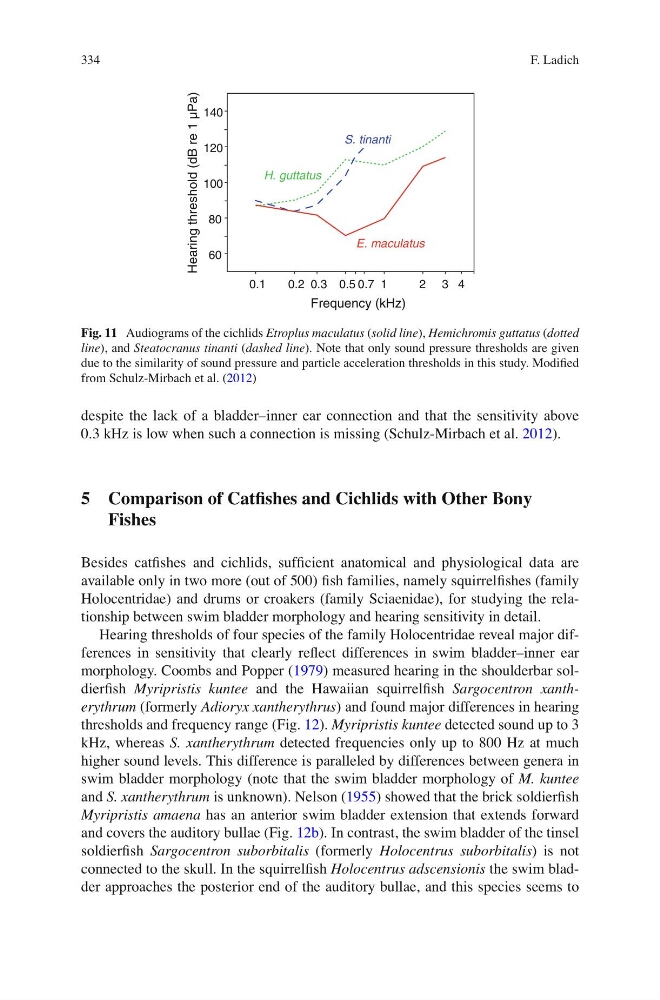
despite the lack of a bladder–inner ear connection and that the sensitivity above
0.3 kHz is low when such a connection is missing (Schulz-Mirbach et al. 2012 ).
5 Comparison of Catfi shes and Cichlids with Other Bony
Fishes
Besides catfi shes and cichlids, suffi cient anatomical and physiological data are
available only in two more (out of 500) fi sh families, namely squirrelfi shes (family
Holocentridae) and drums or croakers (family Sciaenidae), for studying the relationship between swim bladder morphology and hearing sensitivity in detail.
Hearing thresholds of four species of the family Holocentridae reveal major differences in sensitivity that clearly refl ect differences in swim bladder–inner ear
morphology. Coombs and Popper ( 1979 ) measured hearing in the shoulderbar soldierfi sh Myripristis kuntee and the Hawaiian squirrelfi sh Sargocentron xantherythrum (formerly Adioryx xantherythrus ) and found major differences in hearing
thresholds and frequency range (Fig. 12 ). Myripristis kuntee detected sound up to 3
kHz, whereas S. xantherythrum detected frequencies only up to 800 Hz at much
higher sound levels. This difference is paralleled by differences between genera in
swim bladder morphology (note that the swim bladder morphology of M. kuntee
and S. xantherythrum is unknown). Nelson ( 1955 ) showed that the brick soldierfi sh
Myripristis amaena has an anterior swim bladder extension that extends forward
and covers the auditory bullae (Fig. 12b ). In contrast, the swim bladder of the tinsel
soldierfi sh Sargocentron suborbitalis (formerly Holocentrus suborbitalis ) is not
connected to the skull. In the squirrelfi sh Holocentrus adscensionis the swim bladder approaches the posterior end of the auditory bullae, and this species seems to
Frequency (kHz)
0.1
0.2 0.3 0.5 0.7 1
2 3 4
Hearing threshold (dB re 1 µPa)
60
80
100
120
140
H. guttatus
S. tinanti
E. maculatus
Fig. 11 Audiograms of the cichlids Etroplus maculatus ( solid line ), Hemichromis guttatus ( dotted
line ), and Steatocranus tinanti ( dashed line ). Note that only sound pressure thresholds are given
due to the similarity of sound pressure and particle acceleration thresholds in this study. Modifi ed
from Schulz-Mirbach et al. ( 2012 )
F. Ladich
despite the lack of a bladder–inner ear connection and that the sensitivity above
0.3 kHz is low when such a connection is missing (Schulz-Mirbach et al. 2012 ).
5 Comparison of Catfi shes and Cichlids with Other Bony
Fishes
Besides catfi shes and cichlids, suffi cient anatomical and physiological data are
available only in two more (out of 500) fi sh families, namely squirrelfi shes (family
Holocentridae) and drums or croakers (family Sciaenidae), for studying the relationship between swim bladder morphology and hearing sensitivity in detail.
Hearing thresholds of four species of the family Holocentridae reveal major differences in sensitivity that clearly refl ect differences in swim bladder–inner ear
morphology. Coombs and Popper ( 1979 ) measured hearing in the shoulderbar soldierfi sh Myripristis kuntee and the Hawaiian squirrelfi sh Sargocentron xantherythrum (formerly Adioryx xantherythrus ) and found major differences in hearing
thresholds and frequency range (Fig. 12 ). Myripristis kuntee detected sound up to 3
kHz, whereas S. xantherythrum detected frequencies only up to 800 Hz at much
higher sound levels. This difference is paralleled by differences between genera in
swim bladder morphology (note that the swim bladder morphology of M. kuntee
and S. xantherythrum is unknown). Nelson ( 1955 ) showed that the brick soldierfi sh
Myripristis amaena has an anterior swim bladder extension that extends forward
and covers the auditory bullae (Fig. 12b ). In contrast, the swim bladder of the tinsel
soldierfi sh Sargocentron suborbitalis (formerly Holocentrus suborbitalis ) is not
connected to the skull. In the squirrelfi sh Holocentrus adscensionis the swim bladder approaches the posterior end of the auditory bullae, and this species seems to
Frequency (kHz)
0.1
0.2 0.3 0.5 0.7 1
2 3 4
Hearing threshold (dB re 1 µPa)
60
80
100
120
140
H. guttatus
S. tinanti
E. maculatus
Fig. 11 Audiograms of the cichlids Etroplus maculatus ( solid line ), Hemichromis guttatus ( dotted
line ), and Steatocranus tinanti ( dashed line ). Note that only sound pressure thresholds are given
due to the similarity of sound pressure and particle acceleration thresholds in this study. Modifi ed
from Schulz-Mirbach et al. ( 2012 )
F. Ladich